Who Made the Song I Heard with My Eyes Closed?
The sentence in my notebook was "Pick an instrumental, play it loud, lie on the floor and close your eyes." Now that the song might be made by a machine rather than a person, I looked at how far Suno, which turns a few lines of text into a song, has come, and what songwriters fear and gain from it. I walked through the two ways machines turn sound into number tokens to make music and the trends in open-source models on GitHub, then made an instrumental, a theme song and a trot version on a single gaming-laptop GPU and measured time and memory. There is also a guide for anyone who wants to try with a DGX Spark or the graphics card they already have. The seventeenth piece in A Page for Today.
When I opened my idea notebook today, this sentence was waiting:
Pick an instrumental, play it loud, lie on the floor and close your eyes.
I don't remember when I wrote it. I think I know what kind of day it was, though. A day when my head was so noisy that even a song with words felt like too much. With lyrics, my ears keep catching on the words. An instrumental doesn't do that. Turn it up louder than usual and the sound fills the room; lie flat on your back and the vibration comes up through the floor. Close your eyes and only the sound is left.
I don't remember what I played that day, either. But these days the scene comes with one more question: who made that song? Playlists labeled "Focus" or "Relax" on streaming apps can now include tracks no person made, and nobody would be surprised. So today I followed that question. How machines make music, how people are taking it, and whether my own laptop can do it.
A Song from a Few Lines of Text
The first name that comes up in AI songwriting these days is Suno. Using it is simple. Type "a calm piano piece for a rainy day" and you get a song. Give it lyrics and it sings them; give it none and it writes the lyrics too, then sings. It plays you two versions at a time, and if you don't like them you press the button again.
The company started in 2022 in Cambridge, Massachusetts. Its four founders came from Kensho, a company that applied AI to financial data (Wikipedia)). In April 2023 they open-sourced a speech model called Bark, which turned text straight into speech and could also produce laughter and singing (GitHub suno-ai/bark). Today's Suno grew out of that.
It moved fast. According to the official release notes, the V3 alpha in February 2024 made songs up to two minutes long. v3.5 in May that year reached four minutes, then came v4 in November, v4.5 in May 2025, and v5 that September. In September 2025 Suno added Suno Studio, a workspace for editing a song track by track, and v5.5 in March 2026 let you register your own voice and have songs sung in it. Then last month, in September 2026, v6 arrived (Suno release notes). When it raised money in November 2025, the company said nearly 100 million people had made music on Suno over two years, and it was valued at $2.45 billion (Suno blog).
The uses have spread too. Two kinds keep showing up when I watch YouTube. One is small channels making their own theme song to play at the start or end of their videos. A short song with the channel's name in it gives the channel a face. The other is K-pop idol songs re-sung as trot, the old-school Korean pop style with its bouncy two-beat rhythm and quavering vocals. A December 2025 report said an AI trot version of Jay Park's "Mommae" passed 2 million views in two weeks (Korea Economic Daily, via Nate). This September, a report said a Latin-trot version of ATEEZ's "BAD" had 1.2 million views and a trot version of YENA's "Catch Catch" had 1.5 million (Aju News, via Nate). What makes people laugh is the surprise: a song they know shows up wearing completely different clothes.
It has reached the charts as well. Mumuru's "Have You Become the Adult You Dreamed Of?" was planned, written and produced by people, with vocals made in Suno. The makers didn't hide it, and the song still climbed to No. 3 on Melon's TOP100 and No. 2 on YouTube Music's Korea chart (Wikitree). In the US, "AI singer" Xania Monet, whose lyrics are written by the poet Telisha Jones while the music and vocals come from Suno, hit No. 1 on Billboard's R&B Digital Song Sales chart (The Decoder).
A Threat to Some, a Source of Ideas to Others
Songwriters are split.
The worried side has heavy numbers. CISAC, the global confederation of authors' societies, estimated in a December 2024 report that generative AI puts 24% of music creators' income at risk by 2028 (CISAC). In July this year the French streaming service Deezer announced that AI-made tracks had, for the first time, passed half of all new daily uploads. In June it was about 90,000 tracks a day. Yet those tracks accounted for only 1–3% of actual streams (Deezer). There is a big gap between how much is uploaded and how much is heard, and what usually fills it is background lists like "music for focus" or "sleep music." That means the scene in my note, an instrumental played while lying on the floor, is exactly where AI music squeezed in first.
The court fights are long. In June 2024 the Recording Industry Association of America (RIAA), acting for the three majors Universal, Sony and Warner, sued Suno and its rival Udio. In autumn 2025 Udio settled with Universal and then with Warner, and Suno settled with Warner in November 2025. The terms included launching a new model trained on licensed music and stopping free users from downloading what they make (Music Business Worldwide). Last month's v6 is that first model. Even so, Universal and Sony filed a second lawsuit aimed at v6 on September 18, arguing that because it was retrained on the old model's output it is "the fruit of the same poisoned tree" (Billboard). In Europe, the German collecting society GEMA partly won in the Munich Regional Court in July. The court found that making a model memorize whole songs for training goes beyond permitted data analysis. The ruling is not yet final (Simmons & Simmons).
Korea has gone back and forth. From March 2025, the Korea Music Copyright Association (KOMCA) asked songwriters to confirm they hadn't used AI when registering a song, and put AI-assisted songs on hold (YTN Science). On August 3, 2026 it began registering songs when a person had taken a substantial part in making them. Then lawmakers and the Ministry of Culture said there was not enough public consensus, and the association withdrew the rule 22 days later, on August 25. Registration is on hold again, and only one principle remains: songs made 100% by AI are not accepted (Asia Economy). That is why reports said Mumuru's song would struggle to collect royalties through the association even while it sat high on the charts.
On the other side are people who use it as a tool. The US producer Timbaland became an adviser to Suno in 2024 and has said he feeds his own demos into Suno, refines them, and lays human-written lyrics on top (Music Business Worldwide). Telisha Jones, who created Xania Monet, said she didn't think she sang well enough to front a record herself, so she handed the voice to AI. A poet got to release songs. In Korea, the composer Kim Hyung-suk has argued for embracing AI music rather than blocking it, and proposed that collecting societies charge fees when AI reworks the songs they manage (Aju News).
I think both sides are right. For someone who earned a living from background music, 90,000 tracks a day is a real threat. For someone who had melodies in their head but couldn't play an instrument, it is the first open door. Changing someone else's song, like those idol-songs-as-trot videos, is a separate problem. Re-singing an original melody and lyrics in a new arrangement makes a derivative work, which needs the original author's permission, and imitating a voice raises publicity-rights issues (Bizhankook). When the Korea Copyright Protection Agency monitored for two weeks, it found 1,647 unauthorized AI covers across 227 channels (KCOPA). Being fun doesn't make it fine.
How a Machine Turns Sound into Numbers
So how does a machine make a song? The starting point is always the same: turn sound into pieces of numbers small enough to handle.
CD-quality audio records 44,100 numbers per second. A three-minute song is close to 8 million numbers. Asking a model to predict them one by one would take far too long, so a separate model is trained first to compress sound: put audio in, squeeze it into a much shorter row of numbers, then bring it back to audio. Meta's EnCodec is the standard example. The EnCodec used by the music model MusicGen divides each second into 50 slots and writes four numbers stacked in each slot (audiocraft docs). The first number captures the rough sound, the second records what the first missed, the third records what was still missing, and so on. That shrinks a three-minute song to about 36,000 numbers. Each of those numbers is a token. Just as ChatGPT chops text into tokens, chopping music into tokens lets you handle it the same way.
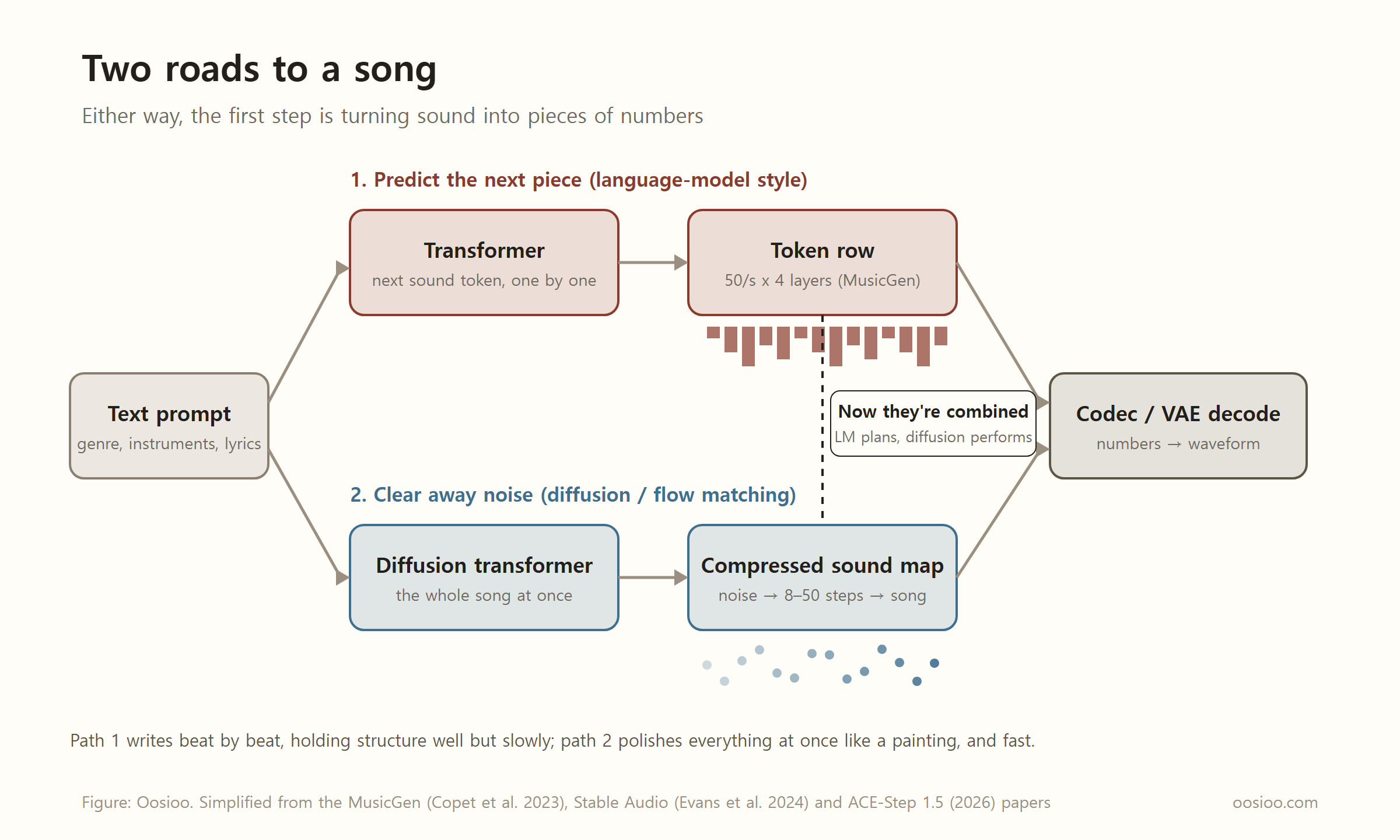
From there, the road splits in two.
The first path is predicting the next piece. Just as a language model picks the next word after reading the sentence so far, the model reads the sound tokens so far and picks the next one. OpenAI's Jukebox made songs this way in 2020, and in 2023 MusicGen staggered its four stacked numbers by one slot each so that it only needs 50 predictions per second (Copet et al. 2023). Suno has never published the architecture of its music model in a paper. But CEO Mikey Shulman said in an interview that autoregression, this predict-the-next-piece approach, "figures it out bit by bit, which tends to make for more interesting music," and that the team spent a lot of time figuring out the right way to tokenize audio (Amplify Partners). Bark belonged to the same family.
The second path is clearing away noise. It is the same diffusion principle used in image generation. You start with random noise the length of the whole song, then remove the noise little by little, guided by the text prompt. Each pass brings the outline of the sound into view. Because it polishes the whole song at once, like painting a picture, instead of writing it piece by piece, it is fast. Stability AI said its Stable Audio makes 95 seconds of audio in 8 seconds on an A100 GPU (Evans et al. 2024). These days many models use flow matching, which straightens the denoising path so fewer steps are needed. In the same interview, Shulman said diffusion makes "great sounding elevator music that's a little boring." In other words, writing piece by piece is better for carrying structure over a long stretch, while diffusion is better for texture and speed.
So recent models combine the two. A language model plans the song first, and diffusion performs it. ACE-Step 1.5, which I ran myself today, works this way. Its language model takes the text prompt, decides tempo, key, the song's arc and, if needed, the lyrics, then writes a rough "sound blueprint" at about five frames per second. A diffusion transformer follows that blueprint and draws the actual sound (ACE-Step 1.5 technical report). YuE2, released last month, goes one step further and first writes a score a person can read. It writes the melody and harmony in ABC, a text-based music notation, and builds the sound from that. When the same model was compared with and without the score step, experts preferred the version that wrote the score first more often (49.3% vs. 34.6%, YuE2 paper). The machine is relearning the order in which human composers work: write it on staff paper first, then record.
Songs have one more hard problem: matching lyrics to the voice. An accompaniment can drift a little without anyone noticing, but lyrics sound wrong if they slip by a single syllable. So models are made to sing the lyrics, the result is transcribed to measure how many phonemes come out wrong (the phoneme error rate), and then the model is retrained on large numbers of output pairs where people picked the better one. Tencent said SongGeneration 2 used about 200,000 such preference pairs to cut down its habit of singing the wrong lyrics.
The Trends Visible on GitHub
Suno is closed, but models that do similar work keep appearing on GitHub. Here are the ones that stand out as of today, October 18, 2026. Stars are the number of people who bookmarked the repository on GitHub.
| Model | Made by | Approach | Vocals (lyrics) | License | GPU memory | GitHub stars |
|---|---|---|---|---|---|---|
| ACE-Step 1.5 | ACE Studio & StepFun | LM planning + diffusion | Yes, 50+ languages | MIT (commercial OK) | From under 4GB | ~13,700 |
| YuE2 | HKUST and others | Score first + flow matching | Yes | Weights CC BY-NC (individual creators may monetize) | 24GB recommended | ~12,100 |
| HeartMuLa | HeartMuLa team | Next-piece prediction | Yes | Apache 2.0 | Not stated | ~3,800 |
| DiffRhythm 2 | NWPU ASLP & Xiaomi | Block-wise flow matching | Yes | Apache 2.0 | Not stated (v1 from 8GB) | ~2,400 (v1) |
| Magenta RealTime 2 | Real-time generation | Instrumental | Weights CC BY 4.0 | Real-time on Apple Silicon | ~1,800 | |
| MusicGen | Meta | Next-piece prediction | Instrumental | Weights CC BY-NC (no commercial use) | 16GB recommended (medium) | ~23,700 (audiocraft) |
| Stable Audio Open | Stability AI | Diffusion | Instrumental, sound effects | Commercial use under $1M annual revenue | Not stated | ~3,900 |
Here are the trends I saw while building the table.
- From short clips to whole songs. MusicGen in 2023 made instrumental clips of around 30 seconds. Now four-minute songs with vocals are the norm, and ACE-Step 1.5 goes up to ten minutes.
- Planning and performing are split. That's the hybrid described above: a language model plans and diffusion handles the sound. The direction is to put a score or a structure description into the planning stage so a person can edit it midway.
- Faster and smaller. Cutting diffusion from 50 steps to around 8, shrinking weights to 8 bits, and parking unused parts on the CPU have become standard. These models are built with gaming graphics cards in mind, not data-center GPUs.
- Editing more than generating. Features like regenerating just one section of a song (repaint), re-singing it in another genre (cover), splitting it into stems, and adding accompaniment to a vocal-only recording keep growing. It's the same direction as Suno Studio.
- Teaching it your own songs. A small extra training run called LoRA on a few of your own songs gets the model to follow that style. ACE-Step 1.5 says eight songs are enough.
- Licenses are actually getting narrower. As quality improves, more models attach conditions to commercial use. YuE v1 was Apache 2.0, but YuE2's weights moved to a non-commercial license with exceptions. Read the license before you use one.
I Tried It on My Laptop
Talking about it doesn't give you a feel for it, so I ran it myself. The machine is a gaming laptop with an RTX 3070 laptop GPU, 8GB of graphics memory and 16GB of system memory. I installed ACE-Step 1.5 inside the Linux environment on Windows (WSL2). Following the instructions, that meant cloning the repository and running one line, uv sync. The model files download on the first run, a little over 7GB in all.
I set it up for an 8GB card. The diffusion model that draws the sound was shrunk to 8 bits and moved to the CPU while idle. For the planning language model I chose the smallest one, 0.6B. That's the combination the ACE-Step docs recommend for 6–8GB cards. Then I ordered three songs.
- Straight from the note, an instrumental to listen to lying on the floor with your eyes closed. I wrote "warm felt piano, soft string pads, rain, spacious reverb, no drums," set the length to three minutes and the tempo to 66.
- An Oosioo channel theme song. I gave it lyrics I wrote, in Korean (roughly: "Today again I open my notebook / pick a line and read it … Oosioo, Oosioo / read slowly as you go"), as bright acoustic pop, one minute long.
- Track 2 re-sung as trot. Changing someone else's song would raise the problems above, so I used the theme song I had just made as the original. I wrote "ppongjjak rhythm, accordion, brass, a male voice with lots of vibrato."
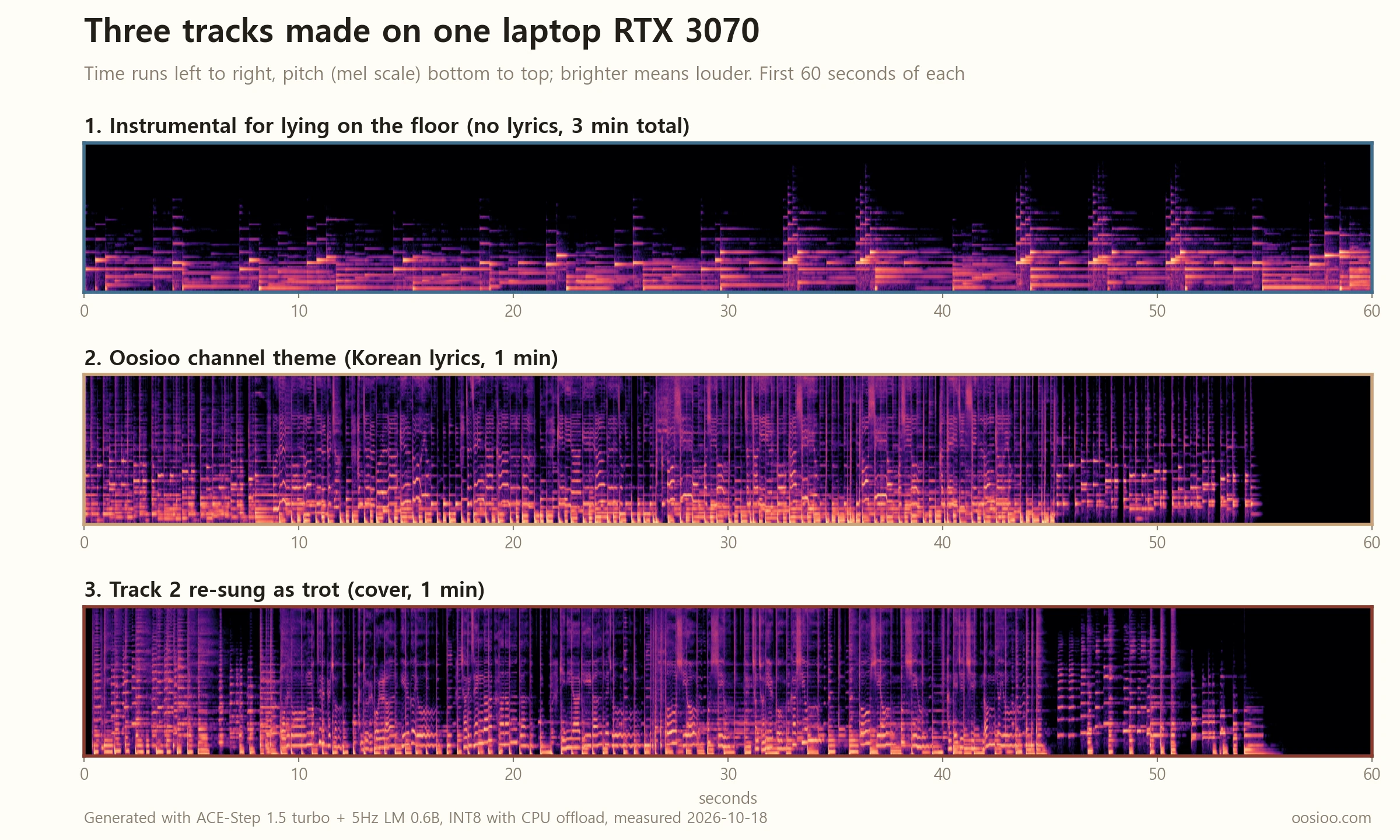
The short version: all three came out. The instrumental starts quiet and grows. Measuring loudness in 10-second blocks, the first 10 seconds sat around -30 dB, the track peaked near -17 dB for 30 seconds starting around the two-minute mark, and the last 10 seconds fell back to -28 dB. I didn't write that arc. The language model took my short prompt and expanded it into a long description ("lush string pads enter, swelling underneath to build emotional depth … before gracefully de-escalating back to its initial quiet theme"), then followed it. The rain, however, never made it in. In the spectrogram, too, most of the high range is empty. The rain got dropped while the prompt was being expanded. Because the planning side leaves a written note of what it put in and what it left out, it was easy to see where things went off track.
I checked the singing by transcription. Running the open-source speech recognizer Whisper (medium) on it, the theme song's chorus, "read slowly as you go / Oosioo, Oosioo / turn one page at a time," came out word for word. The first verse was almost unrecognizable. The trot version, oddly, got most of the first verse through as well ("one small thought … becomes a story"), with only "page" smeared into "ppiji" and one word clipped. The pattern: it sings repeated lines like the chorus well and slurs lines it sings only once.
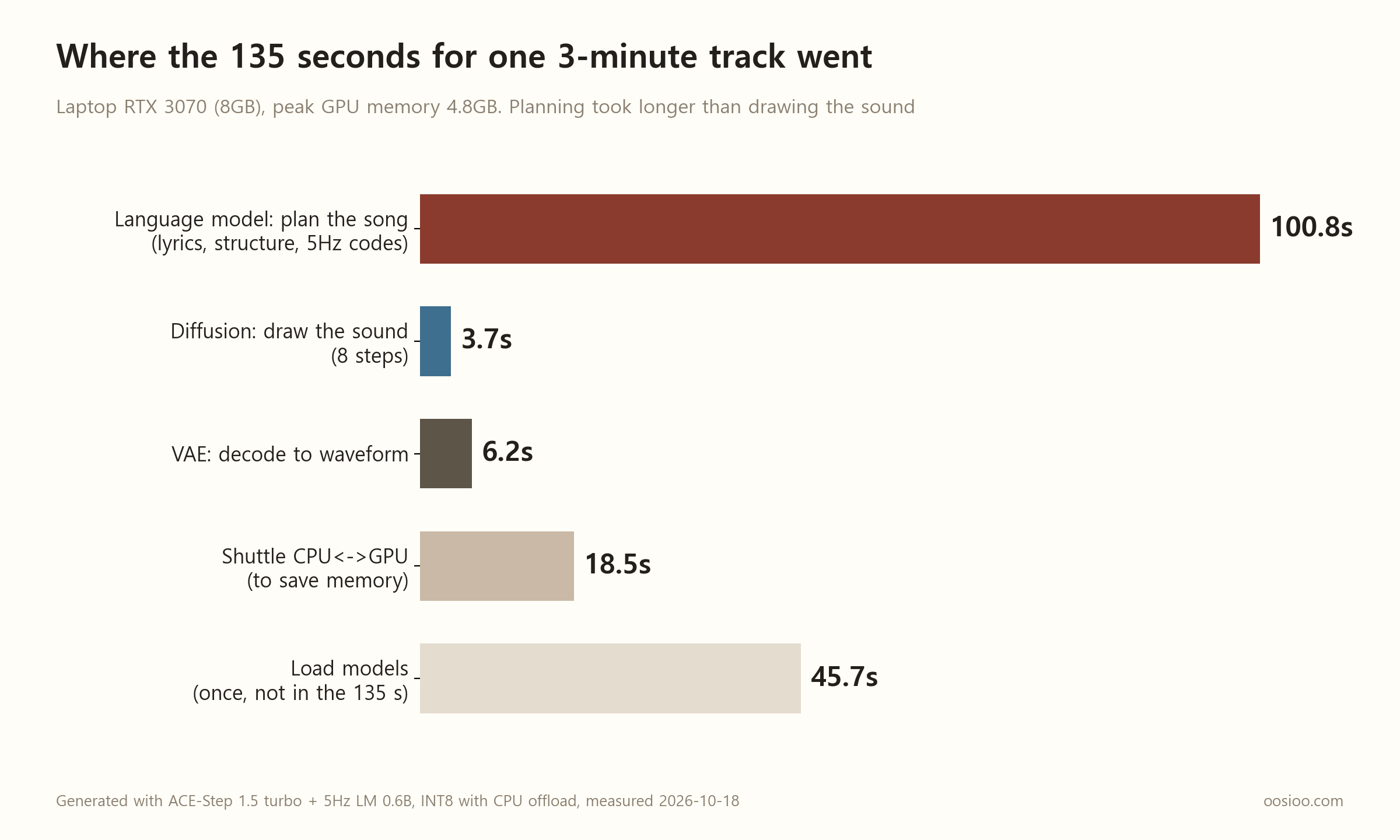
Here's the time and memory.
| Track | Length | Time to make | Peak GPU memory |
|---|---|---|---|
| 1. Lying-on-the-floor instrumental | 3 min | 135 s | 4.8GB |
| 2. Oosioo theme | 1 min | 74 s | 4.5GB |
| 3. Trot version (re-singing 2) | 1 min | 20 s | 4.5GB |
Loading the models the first time took a separate 46 seconds or so. A three-minute song came out in a little over two minutes, so making it is faster than listening to it. On an 8GB card it used just over half the memory.
The most interesting part was where the time went. Of the 135 seconds, the diffusion stage that actually draws the sound took 3.7 seconds: eight steps at 0.46 seconds each. Most of the rest, 101 seconds, went to the language model planning the song. The blueprint has to be written one piece after another, so the longer the song, the longer it takes. The one-minute theme took 46 seconds to plan, and the trot version, which re-sings an existing song, skipped planning and finished in 20 seconds. The difference between the two paths showed up as plain numbers on my laptop. Writing piece by piece is slow; painting it all at once is fast. Shuttling models between CPU and GPU to save memory also cost 18 seconds. On a card with plenty of graphics memory, that time disappears.
If You Want to Try It at Home
For anyone who wants to try, here's a summary. How many GB of graphics memory you have matters more than which card it is.
| What you have | Worth trying | Notes |
|---|---|---|
| 4–8GB GPU memory (laptop RTX 3060/3070, RTX 4060, etc.) | ACE-Step 1.5 base model + 0.6B planner, DiffRhythm (chunked mode) | This is where my test sits. Turn on offloading and 8-bit |
| 12–16GB (RTX 3060 12GB, 4060 Ti 16GB, 5070 Ti, 5080) | ACE-Step 1.5 + 1.7B planner, YuE (low-memory YuEGP), LoRA training on your own songs | LoRA is comfortable from 12GB up |
| 24–32GB (RTX 3090/4090, 5090) | ACE-Step 1.5 XL (4B), YuE2, most models without offloading | YuE2's makers say it makes a 3 min 35 s song in 71 seconds on a 4090 |
| DGX Spark (128GB unified memory) | Keeping several large models loaded at once, combining music and video | Huge memory, but slower than high-end gaming cards |
| Mac (Apple Silicon) | ACE-Step 1.5, DiffRhythm | Both officially support Mac |
What about the DGX Spark? It's the small box NVIDIA sells as an "AI supercomputer for your desk." It measures 15 cm on each side and weighs 1.2 kg, and its CPU and GPU share 128GB of memory (NVIDIA docs). Even the biggest gaming card, the RTX 5090, has 32GB, so for how large a model you can hold there's no contest. But it reads data out of memory at 273GB per second, about a quarter of an RTX 4090 (around 1,008GB/s) and just over a sixth of an RTX 5090 (1,792GB/s). You can load big models, but you can't run them fast. One user on NVIDIA's forum ran ACE-Step 1.5 on ASUS's version of the Spark: with the 4B planner, a two-minute song took about 8 seconds and used roughly 15GB of memory (NVIDIA Developer Forums). The Spark's advantage is that you can keep video or image models loaded in the remaining 100-plus GB at the same time.
The price keeps rising. It launched in the US in October 2025 at $3,999, went to $4,699 in February 2026 because of memory shortages, and early this month reports said the 128GB version is now $6,950, with a new 64GB version at $4,999 (The Register). In Korea, the 4TB model was 7.15 million won in the July 2025 pre-order (News1); retailers now list it from the 9 millions. Gaming cards aren't cheap either. By Korea's lowest retail prices in August this year, the RTX 5090 was in the 7.3 million won range (ZDNet Korea, August 3, 2026, based on Danawa lowest prices). For music generation alone, starting with the gaming card you already have makes far more sense. The people who should buy a Spark are those who want to run large language models more than music.
The Spark has pitfalls, too. Its CPU is ARM-based and it uses the latest CUDA 13, so many common Python packages don't have matching builds yet. Pulling together experiences posted on the forums: you need to pick the CUDA 13 build of PyTorch, you're better off skipping flash-attn (which speeds up attention), and the audio I/O package torchcodec sometimes installs as an empty placeholder, so you have to read audio files with a different package.
Installation isn't hard. From easiest to hardest:
- A few clicks on Windows. ACE-Step 1.5 provides a separate Windows archive with everything included. Unzip it, run the launcher, and a composing screen opens in your web browser. Pinokio, which installs many AI tools at once, also has ACE-Step and YuE.
- If you already use ComfyUI. ComfyUI, popular for image generation, supports ACE-Step natively. You can make music from the same screen you used for images by swapping nodes (ComfyUI docs).
- If you're comfortable with the command line. This is what I did today: clone the repository, then
uv syncanduv run acestep. Calling it from Python makes it easy to generate many songs at once or measure timing. On Windows, doing it inside WSL2 means fewer package problems.
Finally, two things worth keeping to. One is not feeding in other people's songs or voices: the source for a cover or for LoRA training should be a song you made. The other is saying that you used AI. YouTube requires a label on synthetic content that could be mistaken for real, and since July 2025 it has been stricter about keeping mass-produced, repetitive content out of monetization (NBC News). Using AI doesn't by itself block monetization. What gets you in trouble is hiding it or taking someone else's work.
Back on the Floor
After the experiment I played the first track. I turned the volume up past the usual, lay on the floor and closed my eyes. The piano started quietly, grew a little, then faded back. The rain never came.
With my eyes closed, nothing in the sound says that this song is the result of a few lines from me, a model that learned from countless songs, and a laptop graphics card running for 135 seconds. Heard with your eyes closed, sound is just sound. That's why I think it matters more to record who made a song. You can't tell by listening, so the people who know should write it down.
Back to the note. It says to "pick" an instrumental. The machine has become fast at making, but choosing which song a day like today needs is still my job. In a world where a three-minute song takes two minutes to make, I suspect that eye for choosing will only become more valuable.