
People Who Add Value (1) — Fill Only Your Assigned Share and You'll Be Replaced
Following on from How to Repeat Small Wins, this time I want to shift one lens through which we view work: the lens of value added.
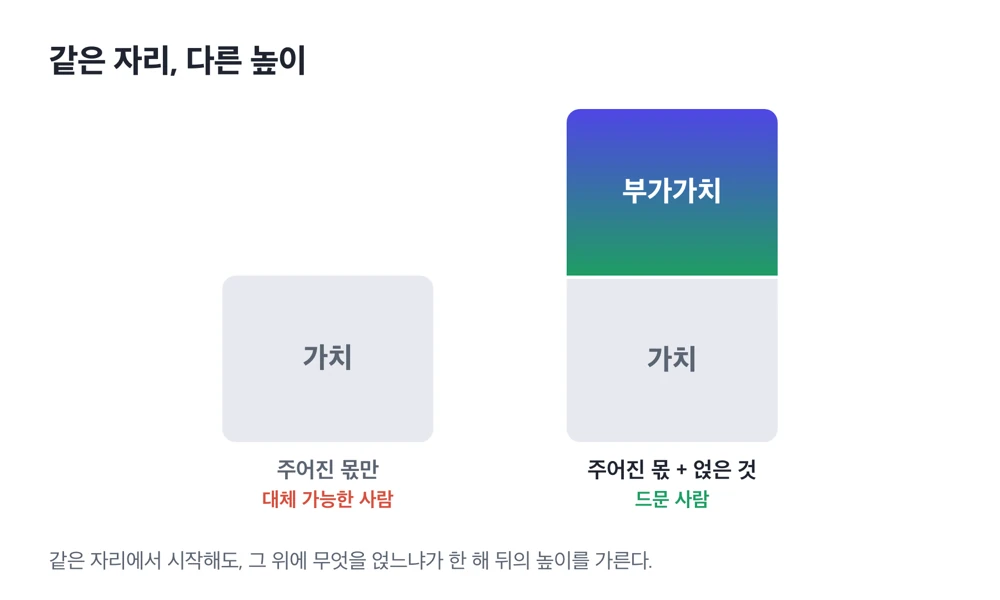
When you join a company, your employment contract spells out what you're supposed to do. When you open a shop, the goods and services you sell are fixed. When you study, there's an exam range and assignments. Whatever the work, there's an "assigned share." Fill that share, and you've earned your keep. But if that's all you do, you become someone who could just as easily be anyone else. You can be replaced by someone younger and cheaper. Value added is what you stack on top of that assigned share.
Where the Term "Value Added" Comes From
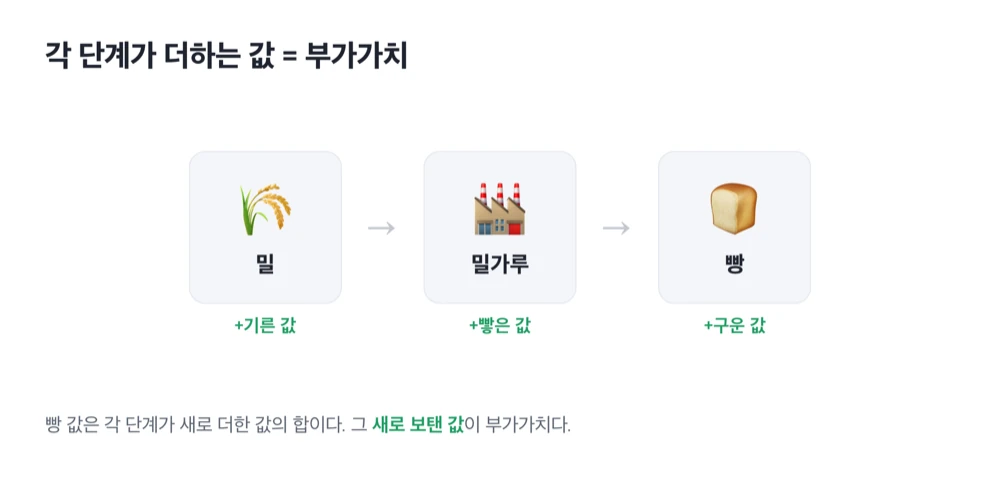
Value added was originally an economics term. Picture a loaf of bread. A farmer grows wheat, a mill grinds the wheat into flour, and a baker bakes the flour into bread. At each stage, something is added to the material received from the stage before. That "newly added worth" is value added. The price of the bread is, in the end, the sum of the value added at every stage, and a country's GDP is likewise calculated by adding up all this value added.
Applied to a working person, it looks like this: what am I adding, and how much, to the materials I've received from my company — my desk, my tools, my time? That added worth is my value added.
People often mistake value added for some great invention or flash of genius. It isn't. Taking half a step further into a spot everyone else just walks past — that's what most value added actually is. Someone who, handed the same data, also attaches one extra table to organize it. Someone who, giving the same report, adds, "so here's what we should do next." At first it barely registers. But these small additions accumulate, and before long they become a reputation: "hand it to that person and you get something more." Value added is less a matter of talent than a matter of habit.
The Assigned Share, and What Sits Above It
| Domain | Assigned share (value) | What's stacked on top (value added) |
|---|---|---|
| Employment | Contracted duties | Unrequested improvements, results, connections |
| Business | The product or service sold | Experience, brand, added services |
| Study | Exam and assignment scope | Application, connection, one's own output |
Someone who only fills the assigned share, and someone who stacks something on top of it — their days may look similar, but after a year passes, they stand in entirely different places.
Why This Lens Matters
Because of replaceability. If ten people can do the same job, your worth goes down; if only one or two can, it goes up. Labor economics has a long-standing observation that scarcer skills command better treatment. Whether that's driven purely by supply and demand, or more by institutions and bargaining power, is still debated, so I won't claim certainty either way. But the direction is clear. Stay within your assigned share, and you're a common commodity. Stack value added on top of it, and you become rare.
Density Instead of Expansion
Sungsimdang in Daejeon was once a neighborhood bakery. Baking and selling bread is the assigned share — up to this point, every bakery is the same. What Sungsimdang stacked on top was a choice: not to expand. Instead of opening branches nationwide, it remained bread sold only in Daejeon, and people traveled all the way to Daejeon to eat it. The bakery became a reason to visit the city. In 2025, this bakery's revenue surpassed 260 billion won. That figure surely comes not just from the quality of the bread, but from the value added of "only here" stacked on top of it.
Samjin Fish Cake in Busan was similar. Fish cake had long been a cheap, everyday side dish. Selling fish cake was, in that sense, no different from any other shop. What this company stacked on top was "experience." It created a "fish cake bakery," displaying freshly fried fish cakes the way a bakery displays bread, so customers could pick and choose. Once buying a side dish became something to browse and enjoy, revenue jumped from around 8 billion won to over 100 billion won within a few years of opening its stores. Same fish cake — but the experience stacked on top of it changed its worth.
Seen through the lens of value added, the same work looks different. "Am I just filling the assigned share right now, or am I stacking something on top of it?" That single question is the starting point. In the next piece, I want to talk about the value added closest at hand: before taking on something new, doing the work you already do better than anyone else.