How to Repeat Small Wins (4) — But They Have to Point Toward a Bigger Direction
So far I've talked about the power of stacking up small wins. If it were simply a good method, everyone would already be working this way. Naturally, it comes with plenty of pitfalls. Setting priorities isn't easy either. In the end, without real expertise in your own job, project, or task, both breaking things into small goals and setting priorities are bound to be difficult.
Breaking things down tends to gravitate toward what's easy
When small wins scatter in every direction, all you get is busyness. I myself have broken easy-to-produce work into small pieces and diligently ground through them, while shoving harder questions — like "who would actually pay for this, and why" — into a vague corner for later. Breaking things down keeps pulling toward whatever's easy to touch. And the more a task requires stepping outside to get rejected in order to verify it, the less you feel like breaking it down. So I think it helps to ask, every so often: am I breaking down what actually matters right now, or just breaking down what's convenient to break down? It seems to work better to keep checking this and keep your priorities in order.
Breaking it down doesn't make it happen on its own
Breaking things down doesn't automatically make them work, either. The surgeon Atul Gawande proposed a checklist that split complex surgery into a handful of short verification steps. When hospitals in eight countries tried this checklist, post-surgical mortality reportedly fell by nearly half, from 1.5% to 0.8%. But there's a follow-up to that story. When about a hundred hospitals in Ontario, Canada made the checklist mandatory and it was later analyzed at scale, this time neither mortality nor complications dropped meaningfully. Why the difference? Apparently, one case involved a genuine culture of the team actually stopping to check in with each other, while the other was just a formality of filling in boxes. Even breaking things into small pieces and checking them off one by one accomplishes nothing if it becomes just filling in boxes because someone said so. For breaking things down to have real power, it seems each of those small boxes has to be something that truly needs doing, and it has to point in the right direction.
The big direction comes first
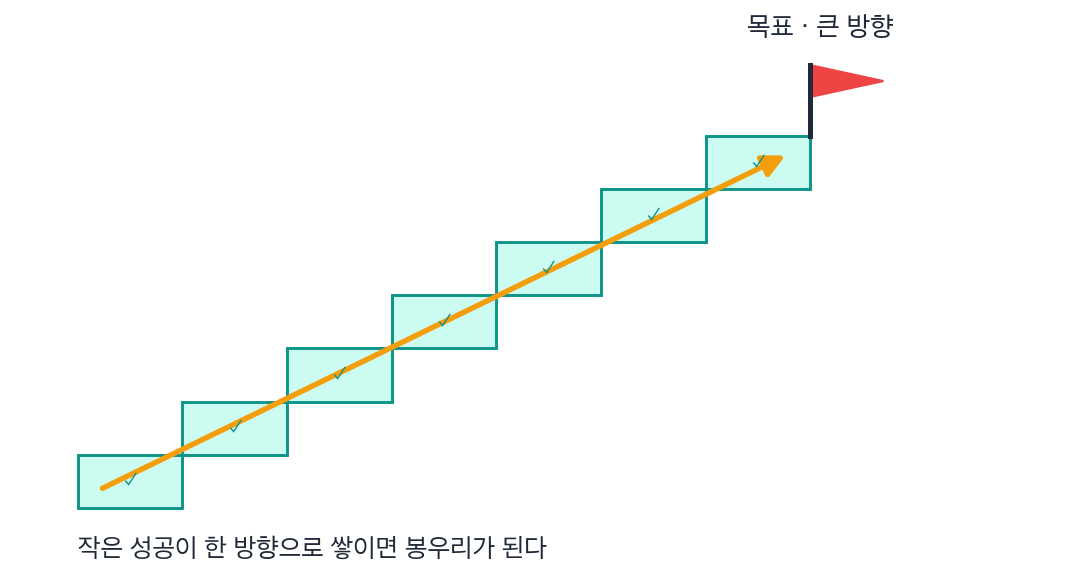
Small wins absolutely have to be preceded by a big direction. Only when you decide where you're going and then break the path into steps toward it do those steps converge into a single summit instead of scattering. Diligence without direction just goes in circles; diligence with direction reaches the peak.
A small win aimed in a clear direction carries one more kind of power. The psychologist Karl Weick, whom I discussed earlier in relation to "small wins," argued that as visible small achievements pile up one after another, the people around you join that momentum, and even those who opposed it start to come around. Each small achievement becomes a signal that "this direction works," drawing allies in. So a small win with a clear direction isn't just personal progress — it's also a way of gathering people who'll come along with you. Typically, for people early in their careers, this direction is often set by their team lead or manager, and they're given very small pieces of work to handle. It might be worth occasionally observing the order in which your team lead or manager assigns work, and what short-term goals they set.
Closing thoughts
When you have a big direction and goal, repeatedly solving the small problems that lead toward it and steadily stacking up small wins — I believe this is the surest way to actually get things done. A big success, I think, isn't something you aim for directly; it's what follows as a result for someone who has diligently stacked up small wins. Why not start by cutting out the smallest piece you can finish today? Someday those pieces will have become the summit you were trying to climb. Best of luck wherever you are.