The Art of Repeating Small Wins (3) — Big Success Is the Sum of Small Successes
Junior professionals want the home run, but data from cycling, software, and organizational psychology research all say the same thing: repeating small wins is what actually wins big in the end.
It seems like the shorter someone's career, the more they crave a single big hit — a dazzling achievement that earns instant recognition, one swing for the fences. I understand the impulse, but most big successes don't arrive that way. They're usually built from a pile of small ones stacked up over time. When someone achieves great success at a young age, it's almost always because they'd been diligently accumulating that success since they were even younger.
The Compounding Power of 1% a Day
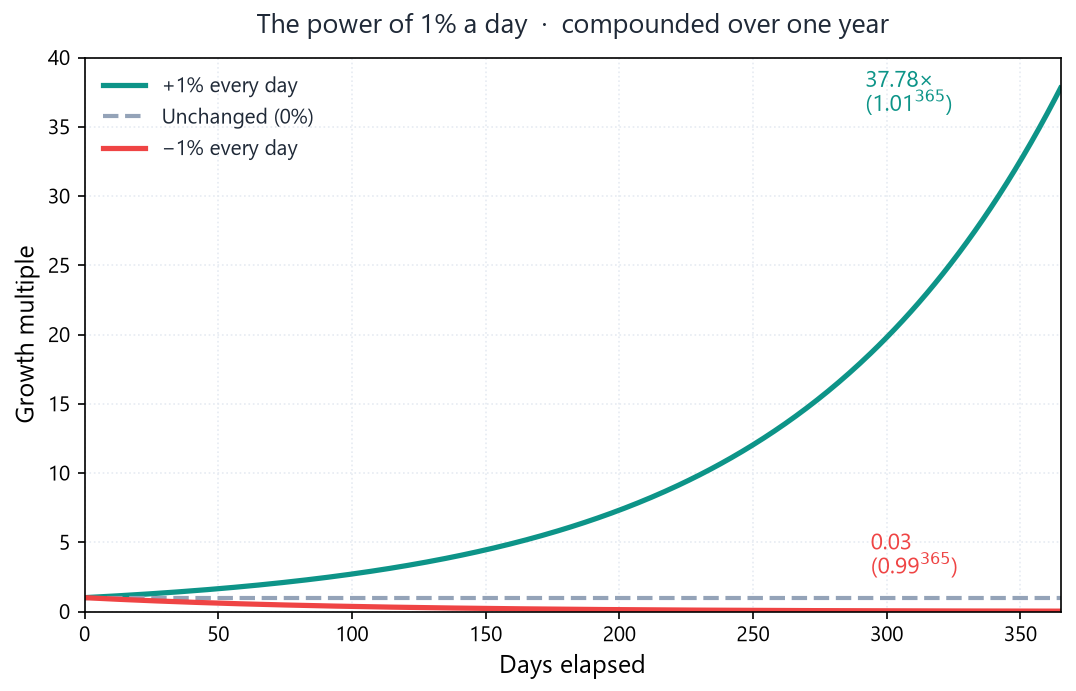
In Atomic Habits, James Clear ran the numbers: improve by 1% every day and after a year you're 37.78 times better (1.01 to the power of 365), but decline by 1% every day and after a year you're down to 0.03 — essentially zero (0.99 to the power of 365). The difference on any single day is negligible, but repeated over time it compounds into a massive gap.
It's Building Up Even When You Can't See It
As you stack up small wins, there's often a stretch where nothing seems to change at all. James Clear calls this the "plateau of latent potential." Picture heating ice gradually from below freezing. The temperature keeps rising, but the ice stays solid for a long time — until it hits a certain point and suddenly starts to melt. The heat applied before that point wasn't wasted; it was being stored inside the ice all along. Small wins work the same way. During the stretch with no visible results, most people give up. But progress is quietly accumulating the whole time, and once it crosses a certain threshold, it all shows up at once. It's the same story as a compound-interest curve getting steeper the further out it goes.
It's Not Just Results That Accumulate
Results aren't the only thing that builds up — confidence does too. The psychologist Albert Bandura, in outlining the four sources that build self-efficacy — the belief that "I can do this" — identified the most powerful one as "mastery experience," or having actually done the thing yourself. More than watching someone else succeed or being encouraged by others, actually pulling something off yourself is what builds belief most solidly. Small wins don't just accumulate visible results; they simultaneously build the belief that you can handle the next step too. And that belief is what calls forth the next success. Both the results and the confidence compound.
Among people who build products, there's a term: the "minimum viable product," or MVP. It's a concept Eric Ries laid out in The Lean Startup — rather than spending a long time building a finished product and releasing it all at once, put out the smallest version that lets you learn the fastest, and see how people respond. The idea is that it's better to build small and learn fast than to build big and fail late. In the end, this too is a method of breaking something big into small pieces, so that every step delivers both a small success and a small lesson.
Sports and Software Are Saying the Same Thing
Dave Brailsford, who headed the British cycling team, championed what he called the "aggregation of marginal gains" — the idea of improving every single factor by just 1%. Before he took over, Britain had won only one Olympic cycling gold medal in 76 years. At the 2008 Beijing Olympics, the team swept 7 of the 10 track cycling gold medals, and repeated the feat in London in 2012. Afterward, Team Sky (which was, in effect, the British cycling team at the time) went on to dominate the Tour de France repeatedly through the 2010s.
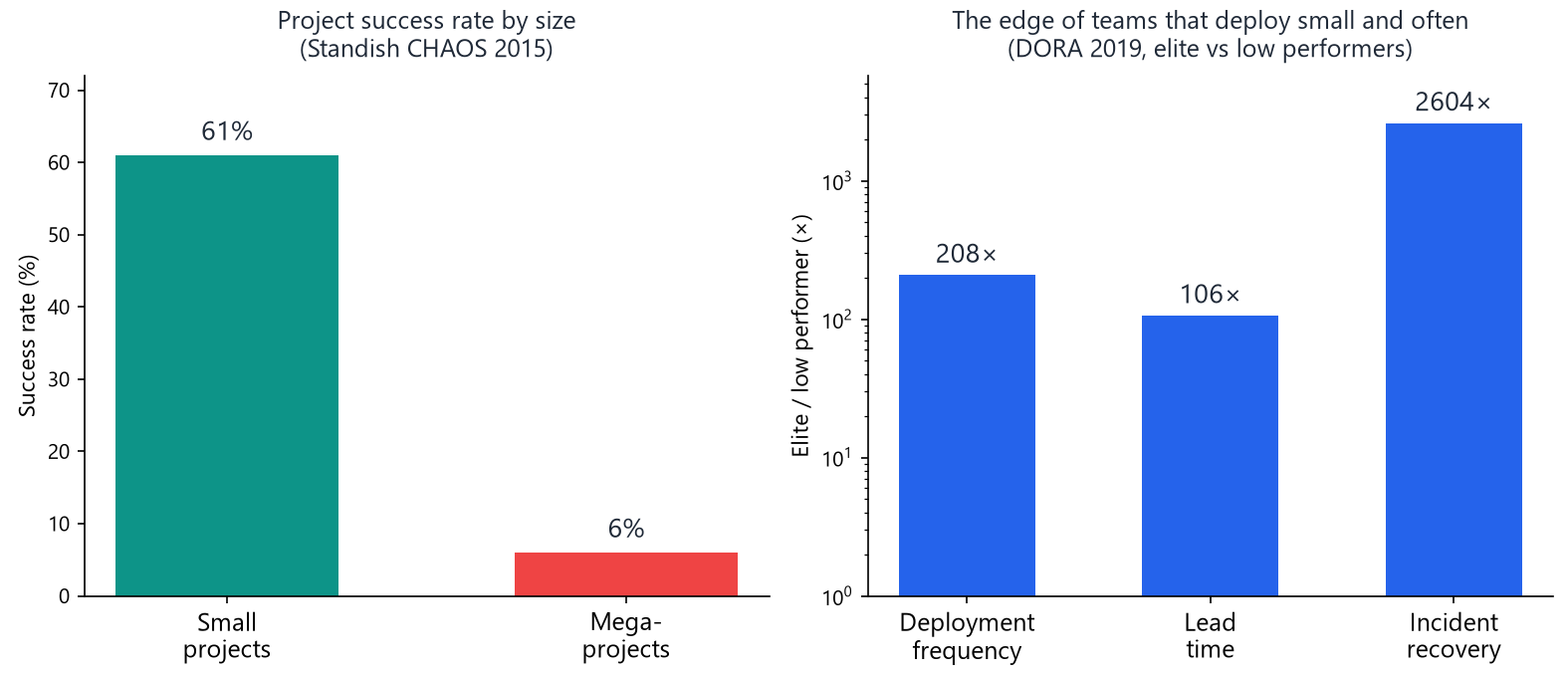
Data from the software industry points the same direction. According to Google's DORA research team's 2019 State of DevOps report, "elite" organizations that deploy small changes frequently had 208 times higher deployment frequency than low-performing organizations, 106 times faster lead times, 2,604 times faster recovery from incidents, and a change failure rate one-seventh as high. The Standish Group's 2015 CHAOS Report found that small projects succeeded 61% of the time, while mega-projects succeeded only 6% of the time. Trying to go big in one shot, it turns out, fails more often, not less.
How to Get a Base Hit Every Day
The same holds true from a motivational standpoint. A research team led by Harvard Business School professor Teresa Amabile analyzed roughly 12,000 work diary entries from 238 employees across seven companies, and found that the single biggest driver of daily emotion and motivation was "small progress on meaningful work." It's not some grand reward but today's small step forward that gets you back to your desk again tomorrow.
So what junior professionals really need to learn isn't how to hit a home run — it's how to get a base hit every single day. String enough hits together, and the runs take care of themselves. The more you chase big success, the further it seems to slip away; the more you repeat small successes, the closer it comes.