Repeating small wins (2) — Splitting the goal brings focus and calm in its wake
Breaking a big goal into small wins seems to sharpen short-term focus and ease worry about problems that haven't arrived yet.
So what happens if you split a big goal into several smaller ones? As long as you don't lose sight of the overall direction, quite a few advantages seem to follow.
Looking only at the next square makes focus easy
The first is short-term focus. Put "finish the product" in front of you, and it's hard to immerse yourself fully in any single task, because your mind stays gripped by the whole. The product has to satisfy this condition and that one, the price has to be a certain figure while the cost has to come out to another, and the conditions, worries, and problems never let up — so it's hard to concentrate on solving any one of them. Worries chain into each other, and often time just slips away before you've even started. But once the scope narrows to "let's just implement this one feature today," your field of view gathers onto that single square, like a racehorse's. Something whose end you can see is easy to sink into — it looks relatively achievable and simple. Split a day into several small finish lines, and you end up sprinting flat out between them.
The smaller it is, the more you keep at it
BJ Fogg, who has studied behavior, takes this a step further. He says that when building a new habit, start "absurdly small." If you want to take up flossing, floss just one tooth a day. Human motivation rises and falls daily, but if you make the behavior easy enough, you can still pull it off even on a day when motivation is at rock bottom. He held that behavior happens when motivation, ability, and a prompt all converge at once — and of those, the lever we can most reliably pull is making it easy, in other words, breaking it down small.
There's a program for people just starting to run called "Couch to 5K." It's a plan that takes someone who's been lying on the sofa all the way to finishing a 5-kilometer run, and the method is simple: over nine weeks, three times a week, you extend your running time by just a little each week. Instead of the distant goal of 5 kilometers, it has you look only at "this week's one square." Broken into weekly units with a visible end, people who had never run in their lives reach the finish line.
A nearby goal is what keeps people walking
There's an experiment showing this isn't just a matter of feeling. Psychologists Bandura and Schunk gave arithmetic workbooks to children who were badly behind on subtraction, varying only the goal they were set. One group was given a near goal — "solve six pages every hour" — while another was given a distant goal — "solve all forty-two pages over seven days." The results were stark. The children given the near goal showed the biggest gains both in arithmetic skill and in confidence in their own ability. More strikingly, when they were later told they could go play freely, nine out of ten children in the near-goal group kept solving subtraction problems on their own. Among those with the distant goal or no goal at all, it was only about four out of ten. What's interesting is that giving only a distant goal made almost no difference compared to giving no goal at all. A goal that exists only far away turned out to be much the same as no goal.
Locke and Latham, who have studied goals for a long time, gathered hundreds of studies and summed it up this way: a specific, somewhat demanding goal always produces better results than a vague "do your best." And the more complex and uncertain the task, the more performance improved when that big goal was broken down into small, immediate sub-goals. The big goal is for pointing the direction; what actually moves people is the near square they can reach today.
Most worries never happen
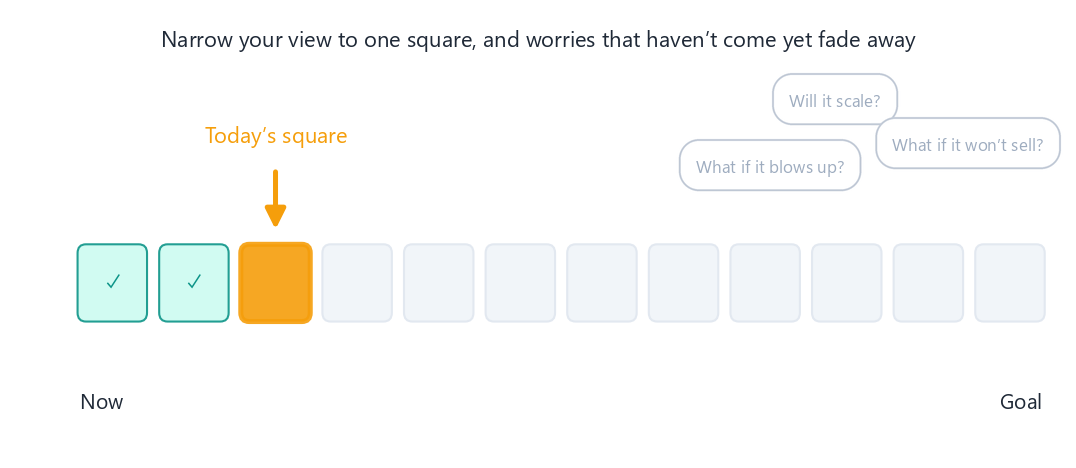
The second effect was even bigger. As mentioned earlier, worry over problems that haven't even happened yet tends to shrink. Look at a big goal as one whole, and all sorts of future risks surface at once: "Will this even scale?" "What if that problem blows up later?" "What if I finish building it and it doesn't sell?" Most of these are worries about problems you can't touch right now — problems that may, in fact, never happen at all. Yet that worry is enough to frighten people out of even starting, or to keep them hesitating, unable to stay focused.
Focus on the one square right in front of you, and this noise tends to quiet down. In practice, a good many of those future problems never even arise, because by the time you've solved the square ahead of it, the situation has already changed. Worry, it seems, isn't something you do in advance — it's something you do once you actually arrive at that square. Splitting things up moves the work forward while also lightening the mind. People with little experience looking at work on a large scale, when told they have to take on a large-scale project, often end up doing nothing but worrying, or stewing over it until the time is simply gone. As the Nike slogan goes, most things just need doing. Keep the big direction steady, and if the goal is clear, it's far better to split it into pieces, focus on each without the worry, and solve them one at a time.