How Far Can Yes and No Take You?
My notebook said: you may select only one option. Picking one of two makes a problem as simple as it gets. I followed the power of yes and no from twenty questions, which picks one in a million with twenty answers, to Jev, the much-discussed new model that writes nothing and only judges. I lay out five ways to solve big problems with weak binary judges (repeat, split, pool, filter, compare) and wire the Altman Z-score, the Piotroski F-score, a trend rule and the Kelly formula into four gates of an investment judge, with a playground that runs it on 400 made-up companies. The twentieth piece in A Page for Today.
Today I opened my idea notebook and found this sentence.
You may select only one option.
I don't remember when or why I wrote it down. From the tone, it sounds like a notice I saw on some screen: the kind of line that sits next to the round buttons on a survey, or on a checkout page that lets you use only one coupon. Copied into a notebook, though, it reads as something quite firm. You get to pick one. Not both.
Cut the options down to two and a problem becomes very simple. Do it or don't. Buy or don't. Right or wrong. The answer is yes or no. It is so simple it can look useless. Things in the world rarely split that cleanly in two.
Yet computers have built everything out of exactly this simple answer from the start. And the new AI model developers have been talking about lately also puts "pick just one" front and center. Today I want to follow how weak a single yes or no is, and how far you can get by tying many of them together. At the end I'll try to build an investment decision out of a few yes-or-no questions.
A yes or a no is one bit
In 1948, Claude Shannon set the unit for measuring information in "A Mathematical Theory of Communication." One answer that settles a choice between two things counts as one. He called it a "binary digit," or "bit" for short, and noted in the paper that the shortened word was suggested by his colleague John Tukey (Wordorigins).
One bit is truly small. It is as much information as a single coin toss. But bits multiply. Each extra yes-or-no question doubles the number of cases you can tell apart. Twenty questions gives 2 to the 20th power, 1,048,576. That is why, in the game of twenty questions, you can pin down one thing among a million.
There is one condition. Every question has to split the remaining candidates exactly in half. A question like "Is it a cat?" wins big if it's right, but it's usually wrong, and when it's wrong the candidates barely shrink. You finish within twenty only if you keep asking half-splitting questions like "Is it alive?" Computer science calls this binary search. To find a value among a million sorted ones, a computer doesn't look at them one by one from the start. It points to the middle and asks only whether the target is above or below.
The first tab of the playground below is this game. Think of a number from 1 to 1,000,000, press only yes or no, and it will find your number within twenty questions.
A model that doesn't think, only picks
The "pick just one" that has drawn the most attention lately came from AI. On September 15, 2026, TypeSafe AI in San Francisco released a model called Jev in early access (launch post). Its founder, Diogo Almeida, came from OpenAI and is described as one of the people who created RLHF, the method that trains a model by having people pick the better of two answers (TechCrunch). The name reportedly comes from the economist William Stanley Jevons, the Jevons of the "Jevons paradox": when something gets cheaper, people end up using more of it.
Jev doesn't write. It only judges. The company calls it a "System One model," and its documentation says the name comes from the fast, intuitive thinking Daniel Kahneman called System 1 in Thinking, Fast and Slow (TypeSafe docs). If a chat LLM is System 2, weighing things slowly, Jev is the side that picks the moment it looks.
Using it is simple, too. You put what needs judging into a field called state and attach a few questions. There are three question types (quickstart).
| Type | What it asks | What comes back |
|---|---|---|
| Choice | Which of the given options is it | The chosen option, a probability for each, a confidence |
| Score | Which of the given levels is it at | A score computed from the level probabilities |
| Noul | Is this statement true | A single probability between 0 and 1 |
Put in one customer message and ask all at once "Which team should handle this (billing, technical, sales)," "How angry are they (calm, frustrated, furious)," and "Is it urgent," and the answers come back shaped like {"choice":"technical","probabilities":{"technical":1.0,…}}, {"score":0.67,…} and {"noul":0.99}. The state is read once, and then each question is judged separately. The third type, Noul, is the purest yes or no. It returns only the probability that the statement is true. Near 0.5 means the model is unsure too.
Because it writes nothing, it is fast and cheap. The company says response times are 70 to 500 milliseconds, 40 to 200 times faster than the 3 to 329 seconds the same jobs took on frontier LLMs. The price is $0.042 per million input tokens, and output is free (models page). The company itself adds that these numbers come from its own evaluations and may be the upper end of real gains. The reaction was quick. Jev was on the Vercel AI Gateway the next day, and in its October report Vercel wrote that 35% of paying teams used it within the first two weeks, making it the fastest-adopted model in the gateway's history (Vercel). One team reported that swapping its command-safety classifier for Jev made it 5 to 18 times faster.
Its weaknesses are written down carefully in the docs too (1.13 jaggedness page). It reads questions literally, so it struggles with negations, double negatives and conditions stated indirectly. It can't count or compare dates; the docs suggest doing the math in code and leaving only the judgment to Jev. Accuracy drops on questions that need several steps of reasoning, and in Choice the answer can change with the order of the options, leaning toward the first one.
I think of that list as Jev's user manual. A judge that picks only one picks best when the question is small and clear. So what do you do with a big question? Break it into several small ones, ask each, and tie the answers together. Machine learning has spent decades refining how to do the tying.
Five ways to stack yes-or-no decisions
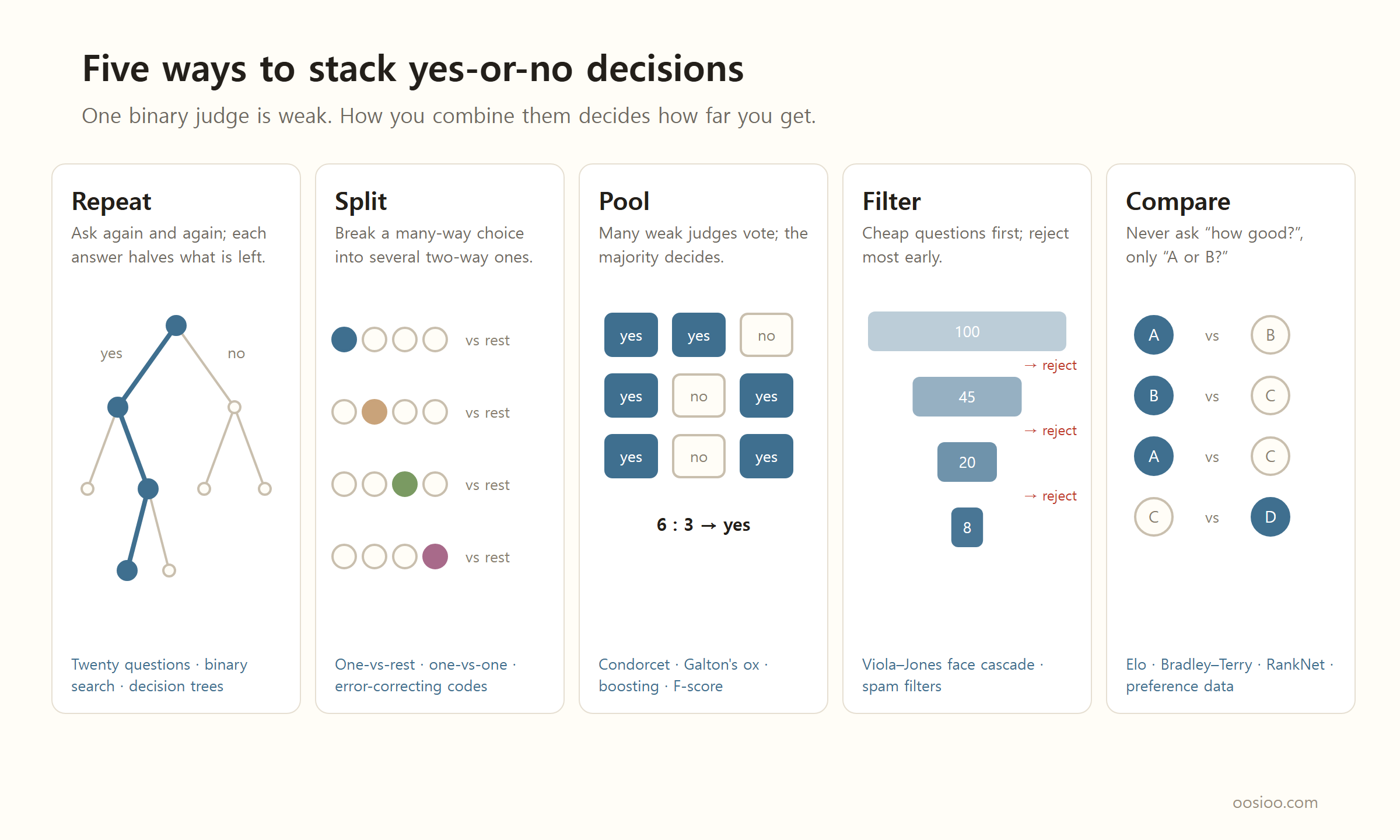
Repeat. Keep asking questions, as in twenty questions. When the next question depends on the answer to the last one, you have a decision tree. CART, published by Breiman and colleagues in 1984, built trees whose every split is always into exactly two (CART), and Ross Quinlan's ID3 in 1986 chose which question to ask first using Shannon's measure of information. The question that splits the candidates most evenly goes first. It is the same trick good twenty-questions players use.
Split. When there are three or more options, turn the problem into several two-way problems. The most common way is one-vs-rest. With K options, you keep K judges, each asking "Is it option 1 or not," and go with whichever is most confident. One-vs-one pairs the options two at a time and keeps K(K−1)/2 judges. In 1995 Dietterich and Bakiri went a step further. They gave each option a long code of 0s and 1s and had one judge guess each digit of the code. Even if a few judges get it wrong, finding the nearest code still gives the answer. They brought the error-correcting codes used to read noisy signals in communications into classification (JAIR).
Pool. Ask many weak judges the same question and follow the majority. In 1785 the Marquis de Condorcet proved that if each juror is even slightly more likely than not to be right, and they judge independently, the chance that the majority is right approaches 1 as the jury grows. In 1907 Francis Galton collected 787 tickets from an ox-weighing contest at a country fair. The ox weighed 1,198 pounds; the median guess was 1,207, less than 1% off (Wallis 2014). Machine learning refined this into a technique called boosting. In 1990 Robert Schapire showed that any "weak learner" just slightly better than a coin can be combined into a learner as accurate as you like, and Freund and Schapire's AdaBoost (1995) trains each new judge with extra weight on the cases the previous ones got wrong.
Filter. Ask the cheap questions first and send most candidates home early. Paul Viola and Michael Jones's 2001 face detector is the classic example. It has to ask "Is there a face here?" at every position and size in a photo, and a single photo has tens of thousands of such windows. They lined up their judges in 38 stages. The first stage looks at just two features, light-and-dark band patterns. It lets almost every face through while throwing out about 60% of the windows that aren't faces. Later stages get heavier, but most windows are rejected at the first or second. Of 6,061 features in total, an average of only 10 were computed per window. That let a 700 MHz Pentium III in 2001 process a 384×288 image in 0.067 seconds (paper).
Compare. Don't ask "how good is it," only "A or B?" Ask people to give scores and everyone uses a different scale, but ask them to pick one of two and they are much more consistent. In 1952 Bradley and Terry proposed a model that works backward from such pairwise comparisons to each candidate's hidden strength. Chess's Elo rating is essentially the same math, and Microsoft's RankNet in 2005 learned to rank search results by comparing documents two at a time. The preference data used today to fit LLMs to human taste is also a pile of "which of these two answers is better." It's interesting that the person behind Jev helped create that very method.
The five are often mixed. Gather hundreds of decision trees and let them vote, and you have a random forest; each stage of the face detector is a judge built by boosting. Either way the principle is the same. Each judge is given only a very small question, and the big answer comes from how they are tied together.
What if you asked about investing in yes and no?
Few things are as much a choice between two as investing. Buy or don't. Sell or hold. So investing is full of rules built by tying yes-or-no questions together. Pick a few and tie them with the five methods above, and you get a judge like this.
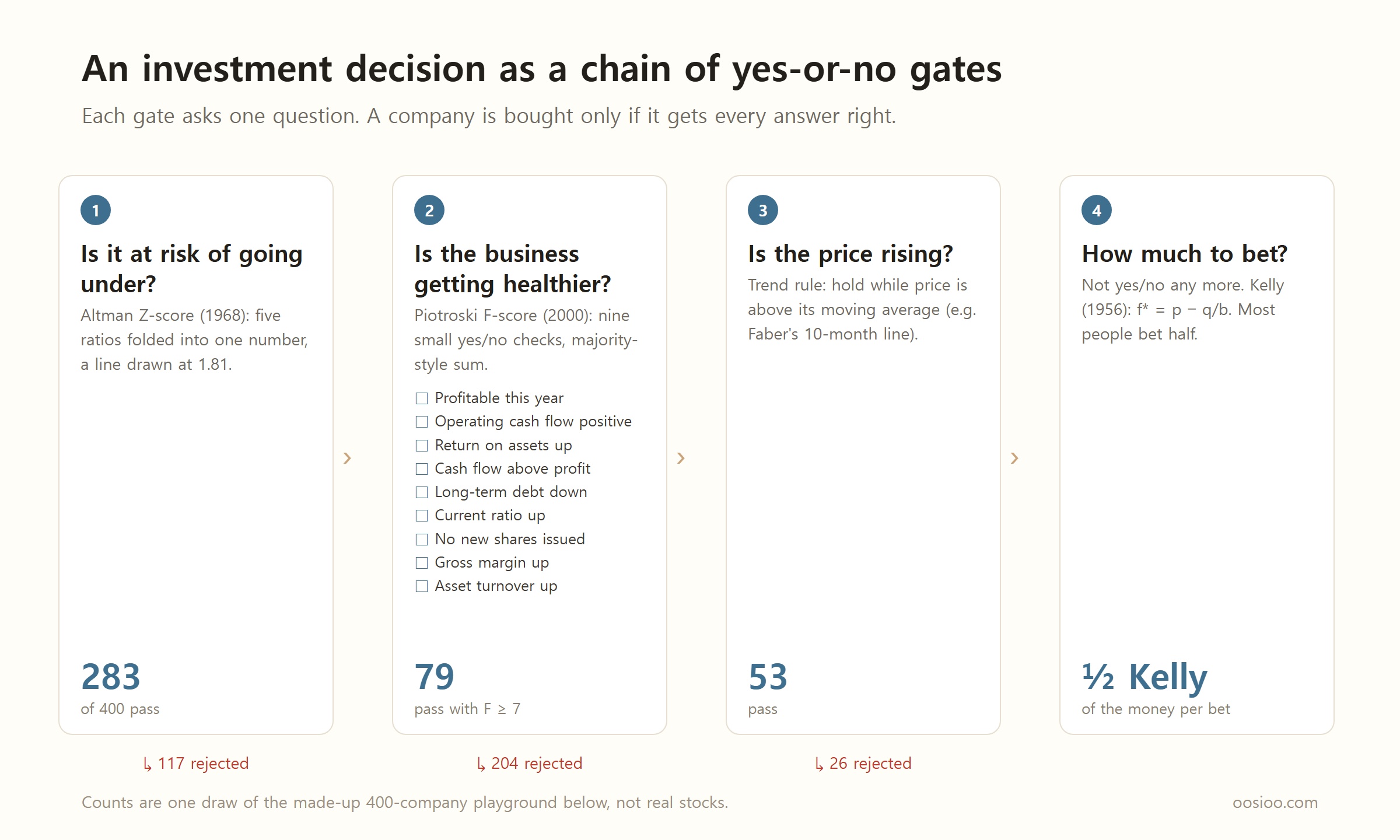
Gate one: is it going to go under? In 1968 Edward Altman compared the financial ratios of 33 manufacturers that had gone bankrupt with 33 healthy ones and built a formula that folds five ratios into one number. He treated a Z-score below 1.81 as danger and above 2.99 as safe, and in his original sample it caught about 95% of firms a year before bankruptcy (Altman Z-score). In effect he drew a line across a continuous number and turned it into a yes or no. This gate is a filter. It is cheap, and it blocks the biggest losses first.
Gate two: is the business getting healthier? In 2000 Joseph Piotroski built a nine-item checklist for stocks trading cheaply relative to their book value. Was it profitable this year? Is operating cash flow positive? Is return on assets higher than last year? Is cash flow larger than accounting profit? Did long-term debt fall? Did the current ratio rise? Did it avoid issuing new shares? Did gross margin rise? Did asset turnover rise? One point each, added up, is the F-score. Each question is weak on its own, but nine together become useful. That's pooling. In his paper, picking only high F-score stocks raised a value investor's average annual return by at least 7.5 percentage points, and buying the high scorers while shorting the low ones returned 23% a year from 1976 to 1996 (Chicago Booth Review). Some later studies, though, found the effect weakened after that.
Gate three: is the price rising? This is a trend-following rule. In a 2007 paper, Meb Faber tested holding an asset while its month-end price is above its 10-month moving average and moving to cash when it falls below. The idea is to earn roughly what stocks earn with less of the swing. This question ignores the company's health and looks only at the market's mood. Because it makes mistakes in a different way from the first two gates, it's worth using alongside them.
Step four: how much to bet? From here on it is no longer yes or no. In 1956 John Kelly at Bell Labs worked out, for a bet you win with probability p and that pays b times your stake, what fraction of your money to bet so your wealth grows fastest. The answer is f* = p − (1 − p)/b. For an even-money bet you win 55% of the time, you bet 10%. Because getting the probability even slightly wrong can hurt badly, many people bet only half of that in practice. If a judge returns a probability the way Noul does, you can feed it straight into the Kelly formula. That is why a machine that picks only one should also return how sure it is.
Building this judge, two things struck me again. One is that judges are wrong more often than you'd think. In 2018 Fischer and Krauss used an LSTM neural network to predict whether S&P 500 stocks would beat the median the next day, and on the stocks it was most confident about, accuracy was about 54% (working paper). Four points better than a coin. For that small edge to turn into returns, the judgment has to be repeated many, many times, independently. It's Condorcet's condition again. And trading costs eat a good part of the edge.
The other is that the two kinds of mistakes don't cost the same. Miss a good company and you lose one opportunity. Buy one that goes under and you lose almost everything you put in. So it's fine to set the first gate's threshold a little strict. Look only at a judge's "accuracy" and this asymmetry disappears. Deciding which mistake you would rather avoid is the person's job, not the judge's.
One more thing: betting money on a product whose outcome is one of two is different from this judge. The price of a yes-or-no contract on prediction markets like Polymarket or Kalshi can be read roughly as the market's probability, but long shots are known to be overpriced. Polymarket settled with the U.S. Commodity Futures Trading Commission (CFTC) for $1.4 million in 2022 and wound down unregistered event contracts. For retail "binary options," the CFTC and the SEC issued a fraud alert in 2013, and the European Securities and Markets Authority (ESMA) banned their sale to retail investors from July 2018 (CFTC). Splitting a question into yes and no and betting money on something that ends in yes or no are entirely different stories.
Playground: twenty questions, majority vote, investment gates
The investment data in the playground is a set of companies I made up. Each company has a hidden "health" value, and its financial ratios, price trend and one-year return are tied to that health only very weakly. So the filter doesn't always win. When I drew 200 years, the default filter beat the overall average in 154 of them, by 4.6 percentage points on average. It loses one year in four. If you can't sit through that one year, you don't get to keep the edge from the other three. In the "Majority vote" tab, I'd recommend raising "how alike they are." A hundred judges who read the same news and use the same indicators aren't much different from one.
The trap in "pick only one"
Useful as yes and no are, there are places to be careful.
First, question whether there really are only two options. Talking as if there were only two is a fallacy logicians call a false dilemma. In investing, between buying and not buying there is buying a little, buying in pieces, and waiting. That is also why the Kelly formula ends up asking "how much."
Second, failing to choose when both are equally good is its own problem. There's the story of "Buridan's ass," which starves between two identical piles of hay because it can't pick either. Funnily enough, there is no donkey in anything Buridan left behind. A dog appears in a commentary on Aristotle, and the donkey is thought to have been added later by people mocking him (Britannica).
In Amazon's 2015 shareholder letter, Jeff Bezos split decisions into two kinds. Irreversible ones are "one-way doors" and should be made slowly and carefully. But most decisions are reversible "two-way doors," and those, he wrote, should be made quickly by individuals with good judgment (shareholder letter). Agonizing in front of a two-way door is the starving donkey too.
The economist Steven Levitt went as far as leaving it to a coin. On a website, he took decisions people had long agonized over, such as whether to quit a job or end a relationship, and flipped a coin for them. Heads meant make the change; tails meant stay put. There were 22,511 valid flips. People who got heads really were more likely to change, and when asked six months later, those who had changed an important decision reported being about 2 points happier on a 10-point scale (NBER). Levitt read this as a sign that people lean too far toward the status quo. If it truly is fifty-fifty and you can't choose, the change may not be as bad as you think.
If you can pick only one, ask many times
Back to the sentence in the notebook. You may select only one option.
At first it read like a constraint. Following it today, the constraint turned out to be the strength. Shrink a question down to "pick only one," and the judgment becomes faster, cheaper and easier to check. Jev runs dozens of times faster than an LLM, and Viola and Jones found faces in photos on a 2001 computer, because they made their questions that small.
In exchange, a small question has only a small answer. The big answer comes from how the questions are tied together. Keep asking questions that split things in half, break many-way choices into several two-way ones, pool the votes of different judges, filter with the cheap questions first, and compare pairs instead of giving scores. And which mistake hurts more, whether there really are only two options, whether the door swings both ways: those are decided by a person, outside the judge.
A Page for Today is a series where I open my idea notebook to a random page and lay that day's thoughts on the line I find there. Thanks to today's line, this became the twentieth piece. Twenty questions are supposed to pick out one in a million, yet after twenty of these I'm still not sure where this series has landed. I suppose my questions didn't split things in half.