
We Are All the Same (5) — The One Who Connects
No matter how different our backgrounds, people turn out to be the same in wanting to be recognized, understood, and to do meaningful work. Becoming someone who bridges others — enough attempts at that, and it adds up to trust.
Generations differ, ranks differ, backgrounds differ, but underneath it's all the same. Everyone wants to be recognized, wants to be understood, wants to do meaningful work.
The Same Foundation
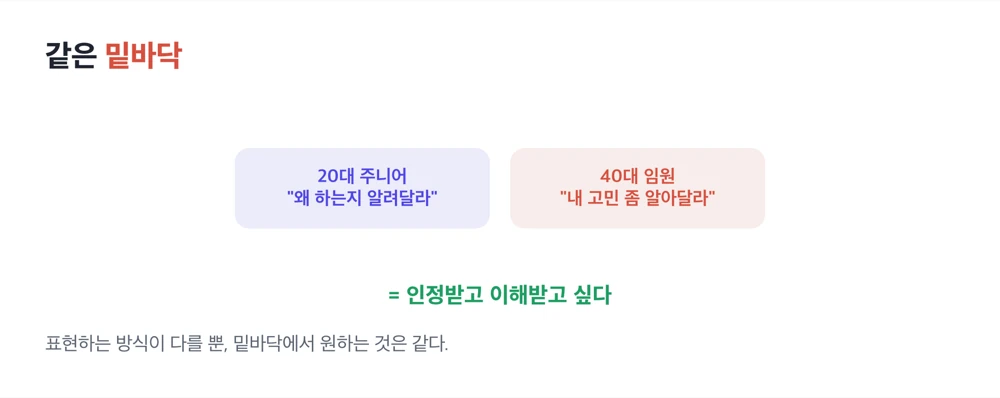
One of the most frequently cited studies in psychology shows just how fundamental and universal the human "need to belong and connect" is. Whatever their background, people form bonds easily and resist having those bonds broken. The way it's expressed differs, but what's wanted is the same. A junior in their twenties saying "tell me why we're doing this" and an executive in their forties saying "please understand what I'm dealing with" were, in fact, saying the same thing. Wanting to be recognized, wanting to be understood.
This doesn't seem to change even as the times do. The tools in hand and the buzzwords on the tongue differ from generation to generation, but the heart beating underneath is the same. That's why conversations across generations always start at this point — recognizing that the other person wants to be recognized, just like you do.
Learning From Each Other
That's why some organizations turn generational difference into mutual teaching rather than conflict. There's a system called reverse mentoring. Long ago, one American CEO paired hundreds of senior executives with young employees to learn the internet from them. Our own companies have set up sessions where a vice chairman learns communication skills from a new hire. It shows, in action, that learning has no hierarchy — with the senior person being the one to ask first, "please teach me."
In fact, one global cosmetics company ran this system at scale. Even the CEO took a young employee as a mentor, and more than a thousand pairs have been matched cumulatively. Close to nine in ten participants said their capabilities had grown stronger, and that learning fed into new products and campaigns. Generational difference became not a weakness but an asset for teaching each other. Still, even a system like this doesn't work well if left on its own. One analysis found that only a third of programs started without training and design achieved their goals. It's attitude, not format, that has to fill it in.

When the Shoe Is on the Other Foot
I'll confess, I've taken only one side myself. As a junior, I said "the executives are the problem," and once I became a leader, I found myself frustrated, saying "why don't the employees understand?" One day, setting both versions of myself side by side, I had to laugh. The very complaint I used to aim upward, I was now aiming downward in exactly the same way, now that I was the leader. When my position changed, my perspective changed. And both sides had their own reasons. Someone who has lived through both positions, it seems, has a duty to interpret between them.
Differences can't be erased. But an attitude of acknowledging and trying to understand the difference can be shown. If there's someone different from you nearby, why not try, just for today, thinking from their position? Why they act the way they do, what situation they're in. It's fine not to understand them perfectly. The attempt to understand, in itself, changes the relationship. Even in an age when machines do so much of the work, connecting people who are different from one another will remain a human task. Keep making that attempt, and at some point, without noticing, trust will have formed — the sense that "that person is on my side."