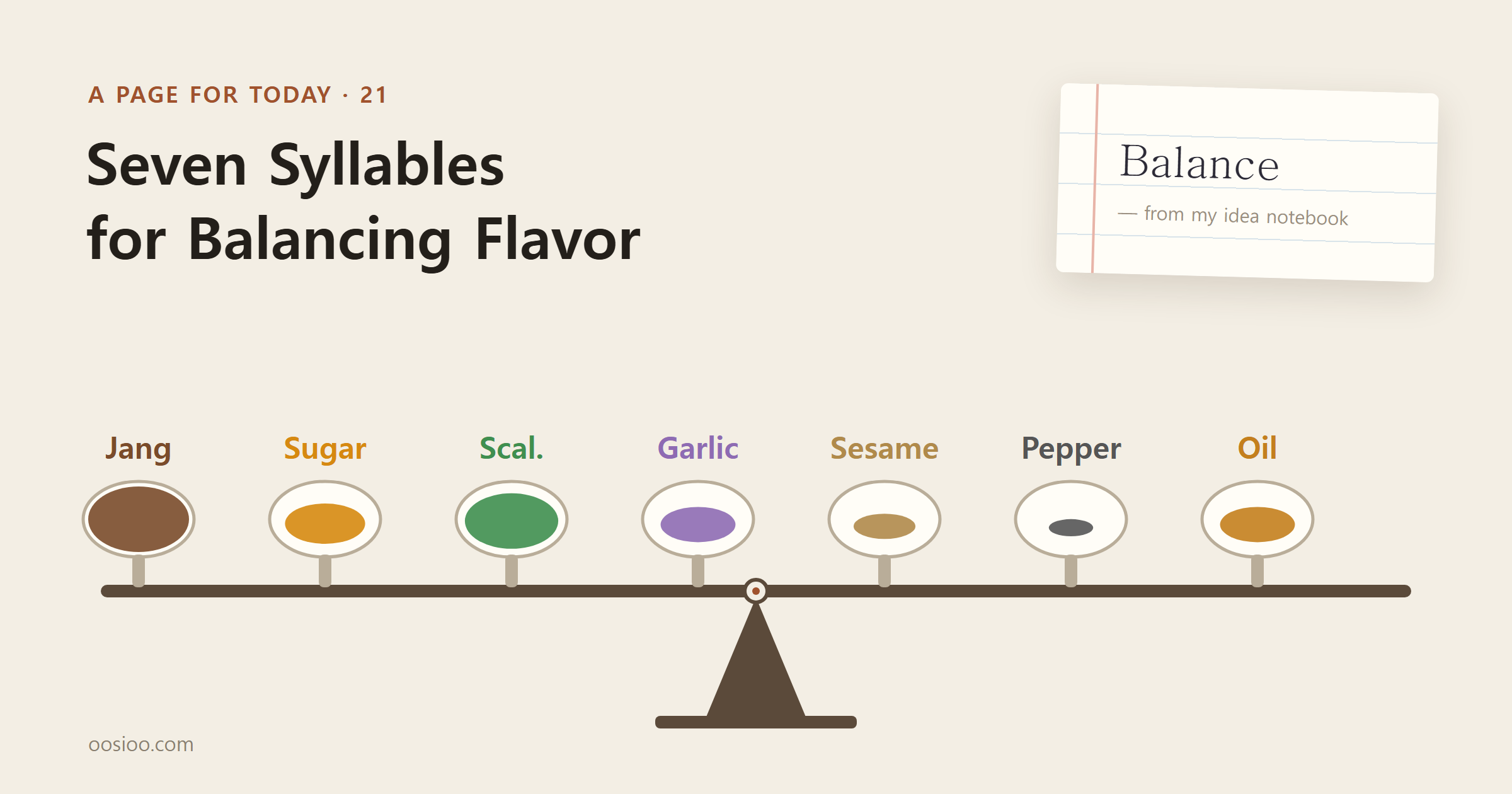
Seven Syllables for Balancing Flavor
My notebook held a single word: balance. That evening I happened to mix chili crab paste with tomato pasta sauce into a well-balanced plate. Flavor is a total art form, the five tastes plus smell, texture and even pain, and tastes push and pull on each other: salt suppresses bitterness, sweet and sour suppress each other, and umami multiplies. By way of electronic tongues that try to measure taste in numbers, I turned the seven syllables Korean cooks use to remember seasonings, jang-seol-pa-ma-kkae-hu-cham, into an 18-sauce dictionary that rescales spoon counts to your amount of food, compares your own sauce with a target, and finds a good ratio for mixing two sauces. The twenty-first piece in A Page for Today.
The page I opened today had a single word on it.
Balance
Nothing before it, nothing after. I don't know what I meant to balance. Work and rest, maybe, or spending and saving, or it was just a word that came to me on the bike. Whichever it was, it isn't easy. Balance is not something you reach once. It's a state you keep catching again.
Tonight, though, the balance came out quite well. There was some chili crab paste left in the fridge and a jar of tomato pasta sauce in the cupboard. I mixed them roughly half and half and tossed it with pasta. Chili crab paste alone is sweet, hot and salty, and you tire of it fast. Tomato sauce alone is sour and flat. Together, the tomato's sourness reined in the sweetness, and the paste's heat and savoriness filled in the tomato's flatness. No single taste stuck out. So this is what a balanced flavor is, I thought.
Come to think of it, flavor is the balance we adjust most often in a day. We taste the soup for salt, decide whether to sugar the coffee, judge how much water to pour for the ramen. Today I want to follow what flavor balance is made of, and at the end build a seasoning dictionary anyone can follow, using the seven syllables Korean cooks use to remember their seasonings: jang-seol-pa-ma-kkae-hu-cham.
Chili crab and tomato were family from the start
After I'd mixed them, I looked it up and found I wasn't the first. Singapore's chili crab began with tomato.
According to Infopedia, from the National Library of Singapore, the dish is usually traced to Cher Yam Tian, who in the 1950s was stir-frying crabs her husband caught and tried adding bottled chili sauce to the tomato sauce she normally used. The couple began selling it from a pushcart along the Kallang River in 1956 and opened a restaurant called Palm Beach in the early 1960s (Infopedia). The chili crab most restaurants serve today is a little different: a tangier version credited to chef Hooi Kok Wah in the 1960s, with lemon juice, vinegar, sambal, tomato paste and egg white. Either way, tomato was in chili crab sauce from the beginning.
So my dinner only raised the share of tomato that was already in the sauce. Changing that share moved the center of gravity from sweet and hot toward sour and savory. Balance, in the end, is a question of proportion.
Flavor isn't just the tongue
Many of us remember the tongue map from school: sweet at the tip, sour on the sides, bitter at the back. It's wrong. In 1901 the German researcher David Hänig measured taste thresholds around the edge of the tongue and found only small differences from place to place. In 1942 the Harvard psychologist Edwin Boring replotted the data in a book in a way that exaggerated those differences, and that hardened into the picture of taste zones (Tongue map). In fact, receptors for all five tastes are spread across the whole tongue.
The five are salty, sweet, sour, bitter and umami. Umami was the last to get its name. In 1908 Kikunae Ikeda of Tokyo Imperial University decided that the taste of kelp broth belonged to none of the other four, and found the substance in kelp responsible: glutamate. The name he gave it was umami (Ajinomoto). In 1913 his student Shintaro Kodama found another umami substance, inosinate, in katsuobushi.
Much more than the tongue goes into deciding something tastes good. As you chew, aroma molecules rise from the back of the mouth into the nose, which is why food tastes flat when a cold blocks your nose. Texture — crunch, chew, the slickness of fat — is part of flavor too. And spicy heat isn't a taste at all; it's pain. Capsaicin in chili peppers triggers TRPV1, a receptor for burning heat. David Julius's lab at the University of California, San Francisco identified it in 1997, and Julius shared the 2021 Nobel Prize in Physiology or Medicine for that work. Calling flavor a total art form isn't an exaggeration. Five tastes from the tongue, smell from the nose, touch inside the mouth and pain all arrive at once.
Tastes push and pull on each other
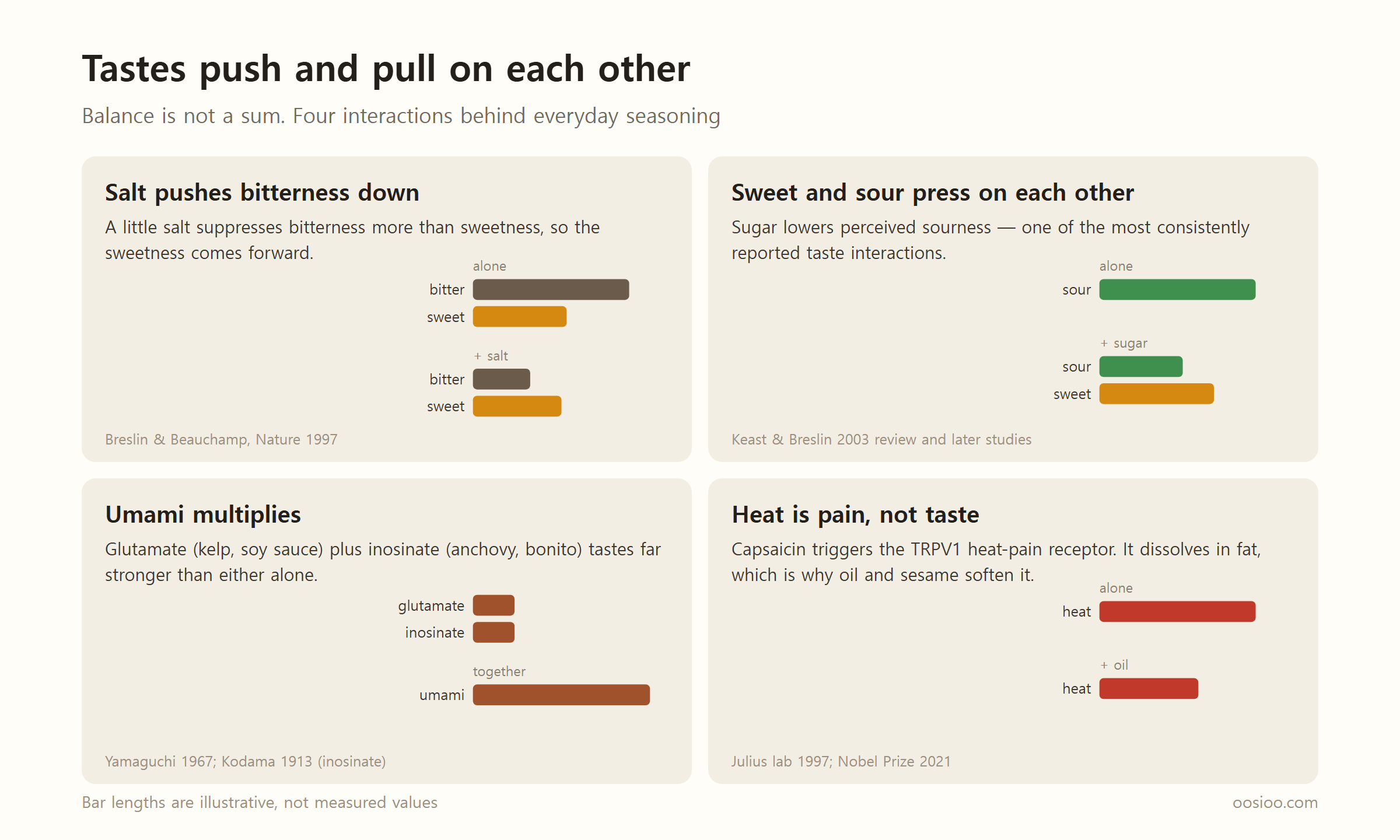
Balance is hard because flavor isn't simple addition. One taste can suppress another, or amplify it.
Salt pushes bitterness down. In 1997 Paul Breslin and Gary Beauchamp published a short paper in Nature: a little salt suppresses bitterness much more than sweetness, so the sweetness comes through more clearly. They saw salt as a kind of flavor filter that picks out the unpleasant tastes (Nature). The habit of salting watermelon or grapefruit has some basis.
Sweet and sour press on each other. Sugar makes sourness taste weaker. Among studies of taste interactions it is one of the most consistent results. It runs the other way too: sourness suppresses sweetness, which is why lemonade can hold so much sugar without tasting merely sweet. It's also why vinegar and sugar always travel together in Korean vinegared gochujang and tangy salads.
Umami multiplies. Glutamate and inosinate together taste far more savory than the two added separately. Shizuko Yamaguchi described this synergy in people in 1967. The current explanation is that inosinate binds next to glutamate on the umami receptor and holds it more tightly. A 2024 study found that the pair also makes food taste saltier (PubMed). Korean stock, made with kelp (glutamate) and anchovy (inosinate), and Japanese dashi, made with kelp and katsuobushi, knew this before the science did.
Oil softens heat. Capsaicin dissolves far better in fat than in water. That is one reason sesame oil, sesame seeds or milk take the edge off spicy food.
So balancing flavor isn't like putting equal weights on two sides of a scale. A pinch of salt raises sweetness; a spoon of sugar wipes out sourness. Change one thing and everything else moves with it.
A tongue that measures in numbers
Some people want to measure these tangled tastes in numbers. Enter the electronic tongue.
The most refined is the taste sensor from Professor Kiyoshi Toko's group at Kyushu University in Japan. Several lipid polymer membranes, modeled on the membranes of taste cells, are dipped into a sample, and the change in electrical potential on each is measured. Rather than identifying each chemical, it puts a number on taste qualities themselves, such as how strong the bitterness is. The group calls this "global selectivity" (Analytical Sciences). A commercial instrument built on it is Insent's TS-5000Z, which reports the five basic tastes along with aftertaste and richness. It has been used to compare the taste of beef breeds and to keep the taste of mass-market coffee blends consistent. Its longest-standing users are drug makers, who can check how well a children's medicine masks its bitterness without having people taste every batch.
Now machine learning has been added. In October 2024 Saptarshi Das's group at Penn State published an electronic tongue in Nature that pairs graphene sensors with a neural network. It told apart milk diluted with water, different sodas and coffees, and fruit juice starting to spoil. Accuracy was higher when the network chose its own criteria rather than ones people gave it (Penn State).
Still, what an electronic tongue tells you is something like "this broth is 8% saltier than last time". It doesn't tell you "this much salt tastes good". Which proportions taste good is still decided by people. We call the people best at finding the proportions others love chefs. And for the rest of us, there are good proportions shrunk into words that are easy to remember.
Jang-seol-pa-ma-kkae-hu-cham
Korean cooking has seven syllables for remembering seasonings: jang, seol, pa, ma, kkae, hu, cham. They are the first syllables of jang (soy sauce, gochujang or doenjang), seoltang (sugar), pa (scallion), maneul (garlic), kkae (sesame seeds), huchu (black pepper) and chamgireum (sesame oil). I couldn't find who coined it. It has long been passed down in cookbooks and cooking classes as the order for mixing seasonings. The Korean word for seasoning, yangnyeom, has an older form, yaknyeom. It is often explained with Chinese characters meaning "added with thought, like medicine", but some point out that old texts don't record any characters for it, so that reading may have been fitted to the word later.
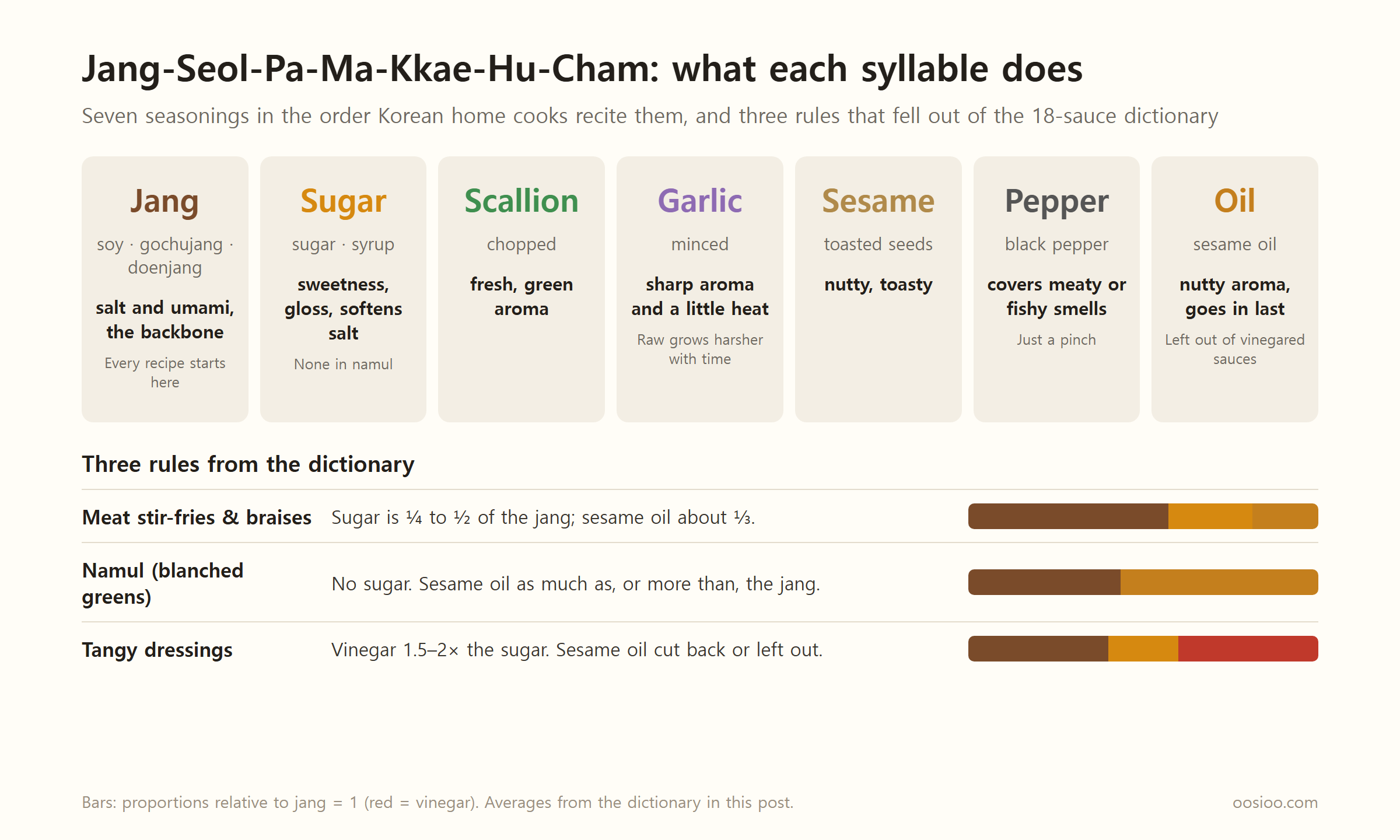
Each syllable has a job. Jang is the backbone, bringing salt and umami together, which is why Korean cooks reach for jang rather than salt. Sugar adds sweetness and gloss and rounds off salt's corners. Scallion and garlic are aroma: scallion fresh, garlic sharp. Sesame seeds and sesame oil carry the nuttiness. Pepper covers the gaminess of meat or fish, and a pinch really is enough.
People say the order has reasons too. Mix and dissolve the base flavors such as jang and sugar first, and add sesame oil, whose aroma flies off easily, last. Japan has a similar saying: sa-shi-su-se-so, for sugar (satō), salt (shio), vinegar (su), soy sauce (seuyu, an old spelling of shōyu) and miso, in that order. Sugar, with its large crystals, soaks in slowly so it goes first, and soy sauce and miso, whose aroma fades, go later. I like that Korea starts with jang and Japan with sugar. Neither, though, is a rule carefully tested by food science; both are kitchen lore. For a dressing where everything goes into one bowl and gets mixed, proportion matters far more than order.
Turning seven syllables into a dictionary
The trouble is proportion. The seven syllables tell you what to add, not how much. Someone who has just started cooking for themselves looks up a recipe and finds different numbers on every blog, then has to redo the math when their amount of meat is different. So I gathered the seasonings for eighteen common side dishes and dishes into a dictionary, laid out in the seven slots: five soy-sauce seasonings, six gochujang, two doenjang, two salt-and-soup-soy namul, and three tangy salads. I set the numbers myself, within the range of common home recipes.
With all eighteen in one table, some rules showed up.
- In meat stir-fries and braises, sugar is ¼ to ½ of the jang. Bulgogi takes 2½ of soy sauce to 1¼ of sugar; spicy pork stir-fry takes 3 of jang (2 gochujang, 1 soy sauce) to 1 of sugar. Sesame oil is about ⅓ of the jang.
- Namul gets almost no sugar. Instead, there's as much sesame oil as jang, or more. Seasoned spinach is ½ of soup soy sauce, a pinch of salt and 1 of sesame oil. The vegetable's own sweetness stays, wrapped in nuttiness.
- Tangy seasonings use 1.5 to 2 times as much vinegar as sugar. Vinegared gochujang is 1½ vinegar to 1 sugar; radish and cucumber salads are 1 vinegar to ½ sugar. And sesame oil is cut back or left out, because oil muffles the sweet-sour edge.
Knowing just these three, you can roughly guess the seasoning for a dish you've never made. Stir-frying meat? Decide the jang and keep the sugar under half of it. Namul? Skip the sugar and be generous with sesame oil. Want it tangy? Make the vinegar twice the sugar.
Playground: the seasoning dictionary
It's simple to use. In "Seasoning dictionary", pick a dish and move the slider to match your amount of food; 600 g of meat is ×2. A tablespoon is a 15 mL measuring spoon; everyday Korean spoons are usually smaller, so heap them a little. Put in two-thirds first, taste, then add the rest, and you'll rarely go wrong. Jang varies a lot, doenjang most of all, from household to household.
"Taste scale" is a practice board for making seasoning by feel, without the dictionary. Set the target to bulgogi and start from 1 of soy sauce and 1 of sugar, and it tells you the aroma is flat and the umami thin, and to add scallion and garlic. The taste strengths here, though, are my rough estimates per ingredient, with only a few interactions such as sweet suppressing sour added in very simply. It's a toy model and doesn't replace a real tongue. Do the final seasoning yourself.
"Mix two sauces" has tonight's chili crab pasta in it. If you score how evenly the five tastes are spread, my rough numbers put the most even point near 55 chili crab paste to 45 tomato sauce — almost exactly where my half-and-half dinner was. Soy sauce and honey score low however you mix them, because sweet-and-salty isn't a flavor that spreads the five tastes evenly; it deliberately stands two of them up tall. Even is not the same as delicious.
Balance isn't reached, it's kept
Back to the word in the notebook. Balance.
Following it today, flavor balance turned out not to be a fixed point. A pinch of salt pushes bitterness down and sweetness comes up; add vinegar and sweetness backs off. Gochujang's saltiness differs from house to house, and the same potato is sweeter in some seasons. So whoever cooks adds, tastes, and adds again. "Put in two-thirds first" is the slack that makes room for that loop.
Jang-seol-pa-ma-kkae-hu-cham is a map that keeps you from wandering too much in that loop. The seven syllables tell you what to add; the dictionary tells you how much. The last touch is up to the tongue. However good electronic tongues get, I suspect that last touch will stay with people for a while.
A Page for Today is a series where I open my idea notebook to a random page and lay that day's thoughts on the line I find there. Today a single word became the twenty-first piece. While I wrote it, I finished the rest of the chili crab paste. Next time I'll try a little more tomato.