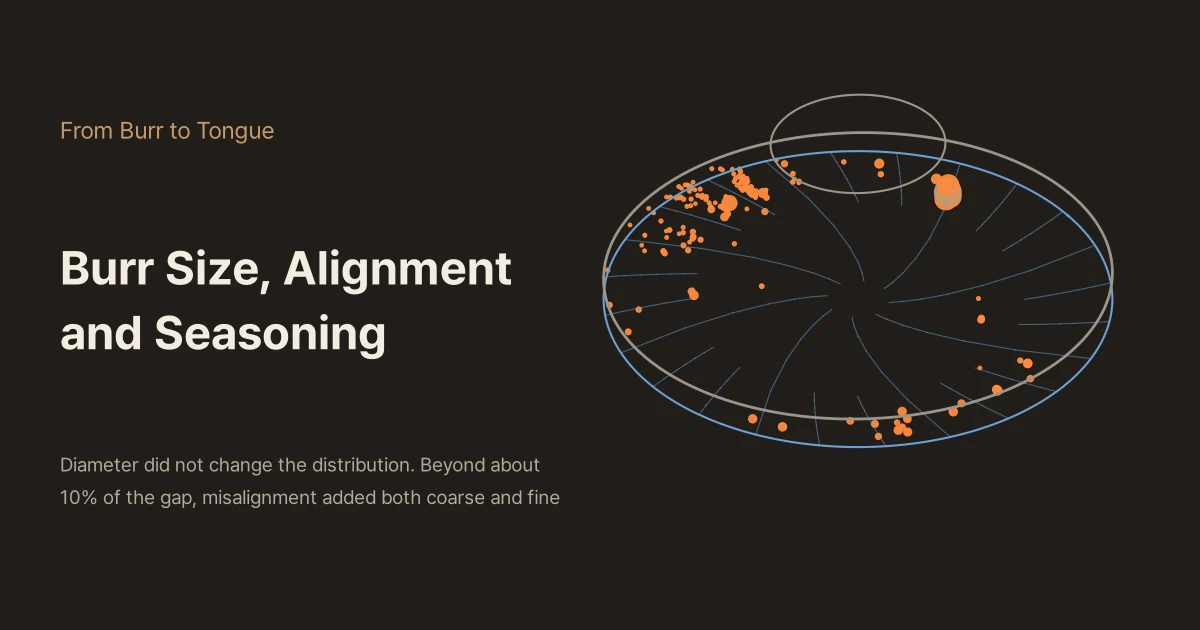
Burr Size, Alignment and Seasoning
Are bigger burrs better, how much does a slight misalignment matter, and how long should new burrs be broken in? I moved the simulation to 3D to find out. Making the burr 1.5 times wider left the distribution unchanged. Edge errors within 8% of the gap made no difference; beyond 17%, a tilted burr sent coarse pieces out of its wide side and fine ones out of its narrow side, spreading the distribution both ways. The same 30 µm is 12% of an espresso gap. With a 3D replay and a gap map.
Grinder talk has three favourite topics. Are bigger burrs better? Are the two burrs truly parallel? How many kilograms of beans does it take to break in new burrs? All three ask the same question: how much does a small difference change the distribution? This time I switched the simulation to 3D to ask it. Tilt and wobble of a burr are 3D effects by nature and cannot be drawn on a flat cross-section.
The short version: making the burr 1.5 times wider left the distribution unchanged. Alignment has to be judged against the gap. When the error at the burr edge was within 8% of the gap, it was lost in the simulation's own scatter; beyond 17%, both the coarse and the fine ends grew. At espresso gaps, the commonly measured 30 µm misalignment sits right around that threshold.
Leaving the plane for 3D
The simulations in the last few episodes ran on a 2D plane, a thin slice between the two burrs. A particle's height was kept only as a number, and I invented a few rules to fill the gap: two particles whose heights added up to less than the gap could pass over each other, and the stationary burr's teeth caught only particles taller than 60% of the gap. Rules like these change the results, and they rest on little.
This time I rebuilt the same virtual flat burr (64 mm, 1,000 rpm) in 3D. Particles are spheres, and the burrs are an upper and a lower face plus tooth walls that have height. The teeth follow the same helical polylines as before, but the rotating burr's teeth rise from the lower face by 40% of the local gap, and the stationary burr's teeth hang down from the upper face by 40%. The middle 20% is open, so pieces smaller than that slip between the teeth. Rules like "pass over each other" or the 60% threshold are no longer needed; the geometry does the job.
Moving to 3D, I stepped into two traps. One comes from spheres rolling. A sphere rolls as it slides, so the same friction changes its speed far more easily than it would a flat disc. Applying too much friction in one step made the vibration grow until particles flew off at hundreds of metres per second. The other is freshly broken fragments. If a fragment is born already overlapping a neighbour, a large repulsive force hits all at once. As in earlier episodes, contacts that are already deep when first met are allowed to pass until they separate. But when I applied this rule to the burr faces too, fragments slipped through the faces into the body of the burr, so it applies only between particles.
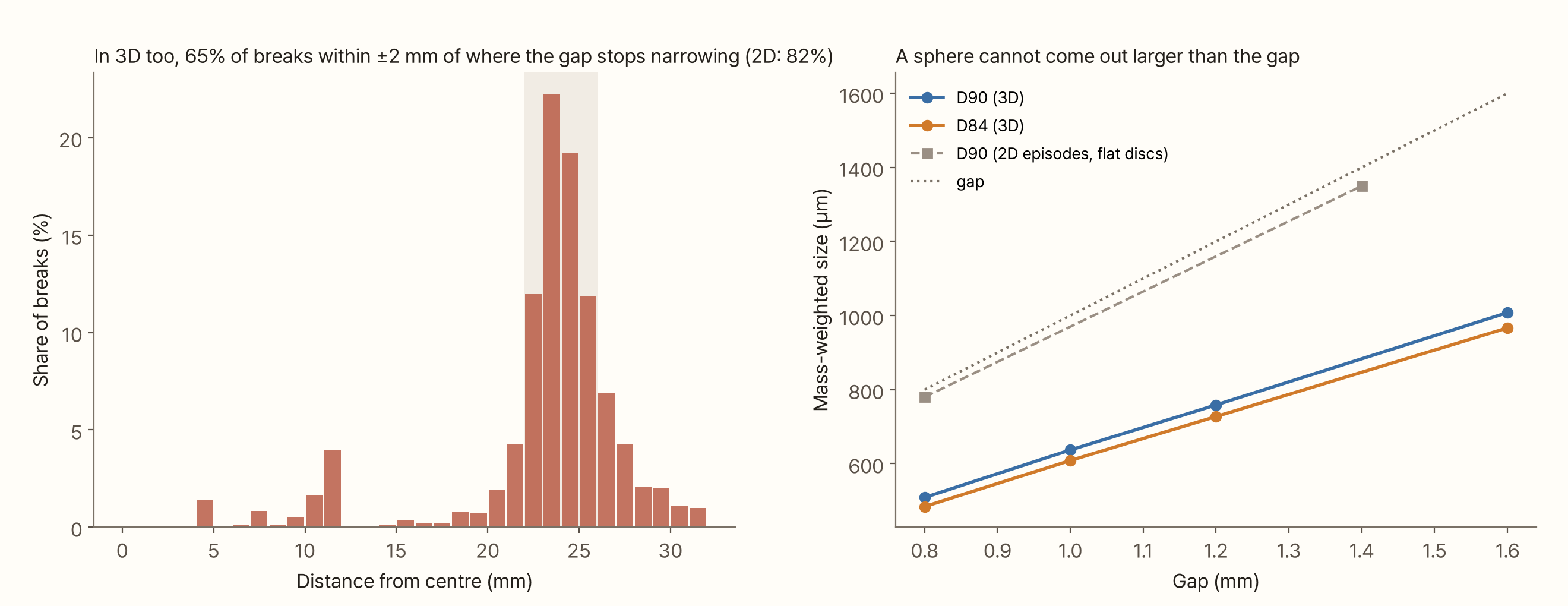
The 3D model behaved like the 2D one. At a 1.2 mm gap, 65% of breaks bunched within ±2 mm of where the gap stops narrowing (2D: 82%). A bean passed through while the burr turned 0.5–0.7 turns. The big difference is the size of the grounds. A sphere larger than the gap cannot get through the finishing band, so D90 stayed at about 0.63 times the gap. In 2D, with flat discs, D90 was almost equal to the gap. Real coffee fragments lie somewhere between a sphere and a disc. The numbers in this piece are for spheres, so they sit on the fine side of reality. To stay above the resolution (400 µm), I ran the experiments at a 1.2 mm gap.
Making the burr bigger
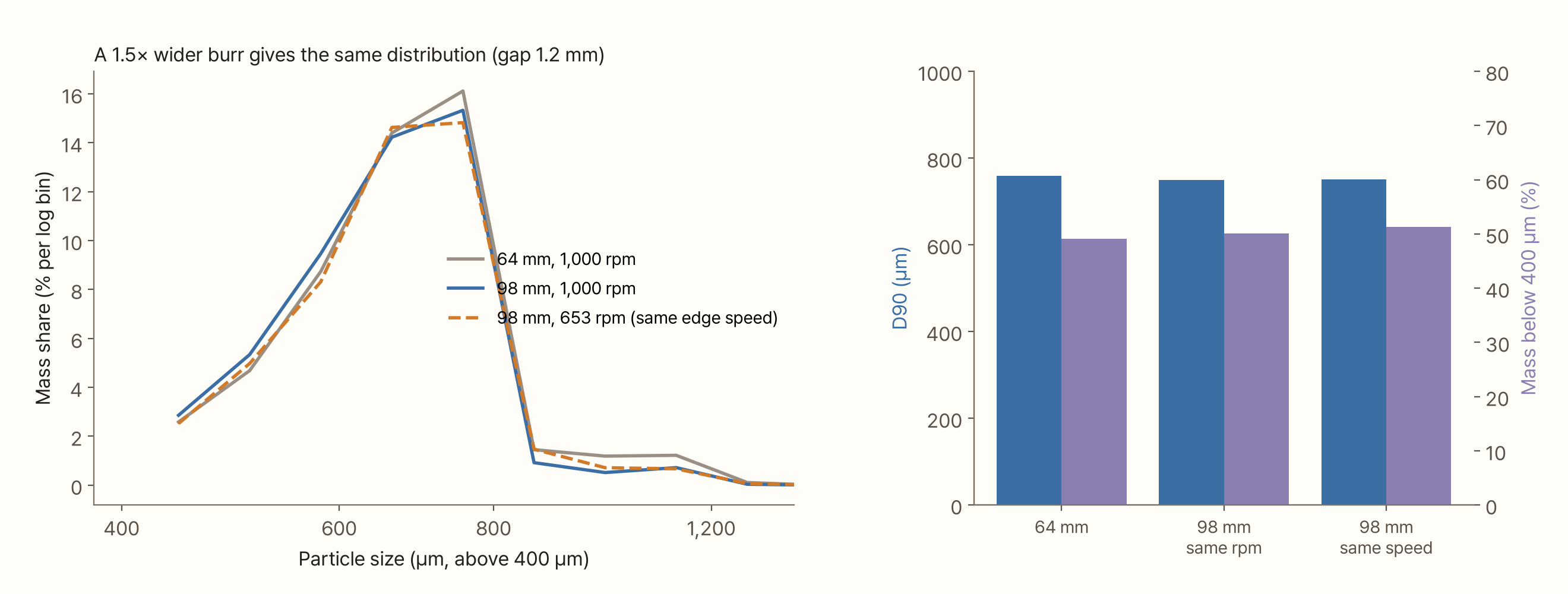
I built a 98 mm burr, the size of an EK43, scaling every dimension by 1.53 and the number of teeth by 1.5. I compared it with the 64 mm burr at the same speed (1,000 rpm) and at the same edge speed (653 rpm). At a 1.2 mm gap, D90 was 759 µm for the 64 mm burr and 749 and 750 µm for the 98 mm. The mass below 400 µm was also almost the same: 49%, 50% and 51%. Beans stayed longer in the bigger burr (52–59 ms, versus 27 ms for the 64 mm), but what set the final size was the gap of the finishing band.
In the 24 espresso grinders Gagné (2023) reanalysed, larger burrs did not give systematically more even distributions either. The exception was a single 83 mm Ceado E37, which had fewer fines than average but was no more uniform. Gagné wrote that tooth geometry and coating appear more important. I could not find a measurement that changed only the diameter while keeping the same tooth design. This model's answer is that changing only the diameter leaves the distribution as it was.
Tilt and runout
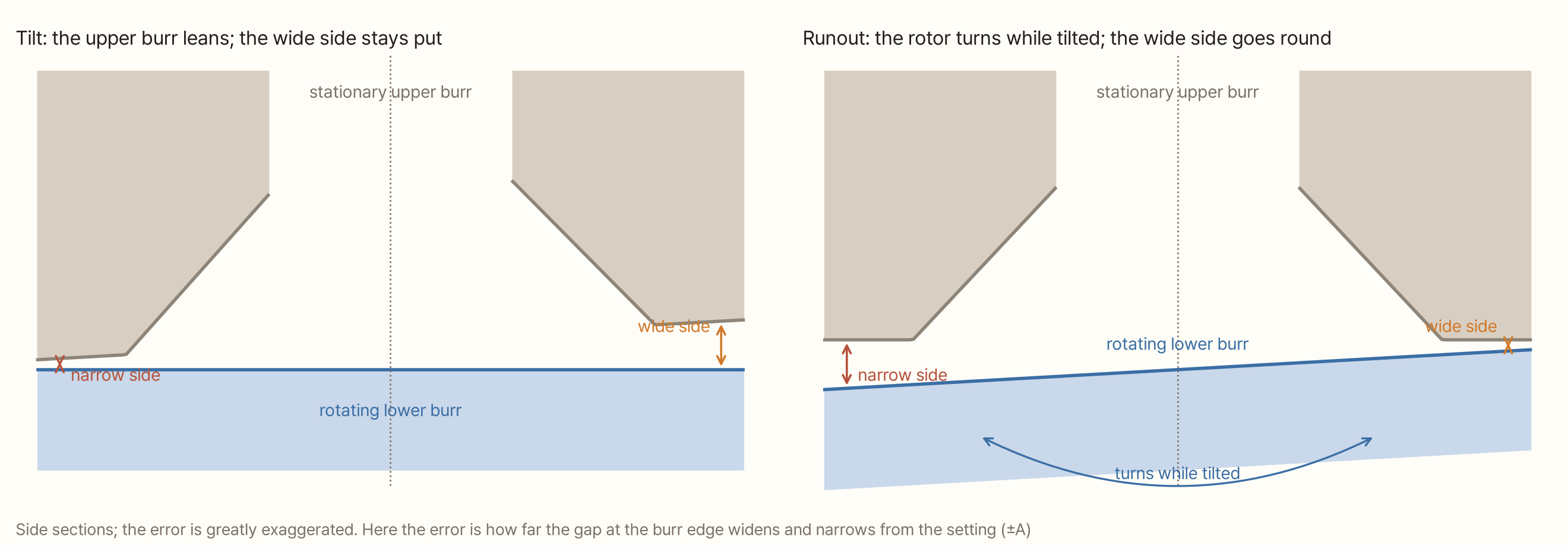
There are two ways for the burrs to be out of line. If the stationary burr sits at a slant to the axis, the gap is narrow on one side and wide on the other, always in the same place. I call this tilt. If the rotating burr sits at a slant, the wide side goes round and round with the burr. I call this runout. Both are measured as how far the gap at the burr edge widens and narrows from the setting (±A).
In the workshop, this is measured with a dial indicator: touch the needle to the burr face, turn the burr, and watch how far the needle rises and falls.
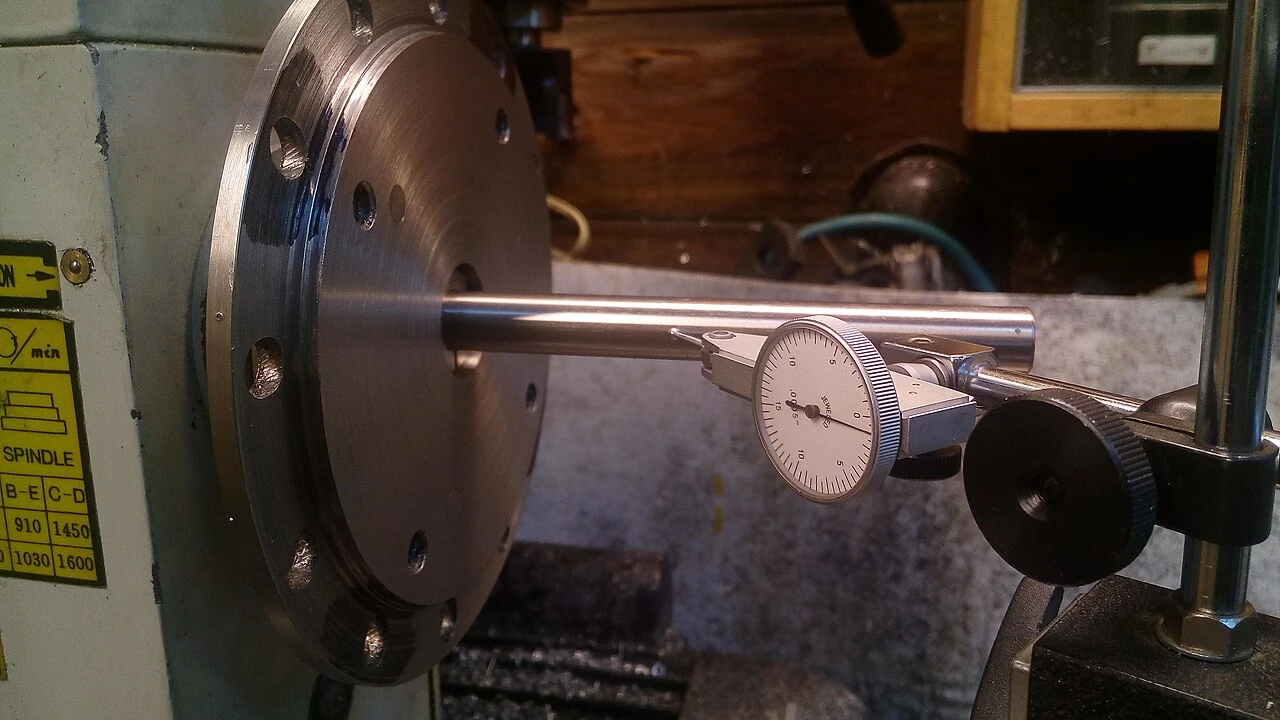
Checking the runout of a shaft with a dial test indicator · Photo: David English, Wikimedia Commons, CC BY-SA 4.0
How far off are real grinders? Most published numbers are measurements by users. One German user wrote that three EK43 limited editions, said to leave the factory aligned within 30 µm, measured 30–40 µm at the edge of the fixed burr, and that he sanded the back of the burrs down to 5 µm. Scott Rao has said that of more than 100 EK43s he had used, at most 10% were well aligned out of the box. Community dial measurements mostly fall between 5 and 90 µm, with 10–30 µm considered good (these are forum posts, so the evidence is weak).
The same 30 µm weighs differently against different gaps. At an espresso gap of about 250 µm it is ±12%; at a filter gap of 800 µm it is ±4%. So in the simulation I set the gap to 1.2 mm and the error to ±0.05–0.3 mm (±4–25% of the gap).
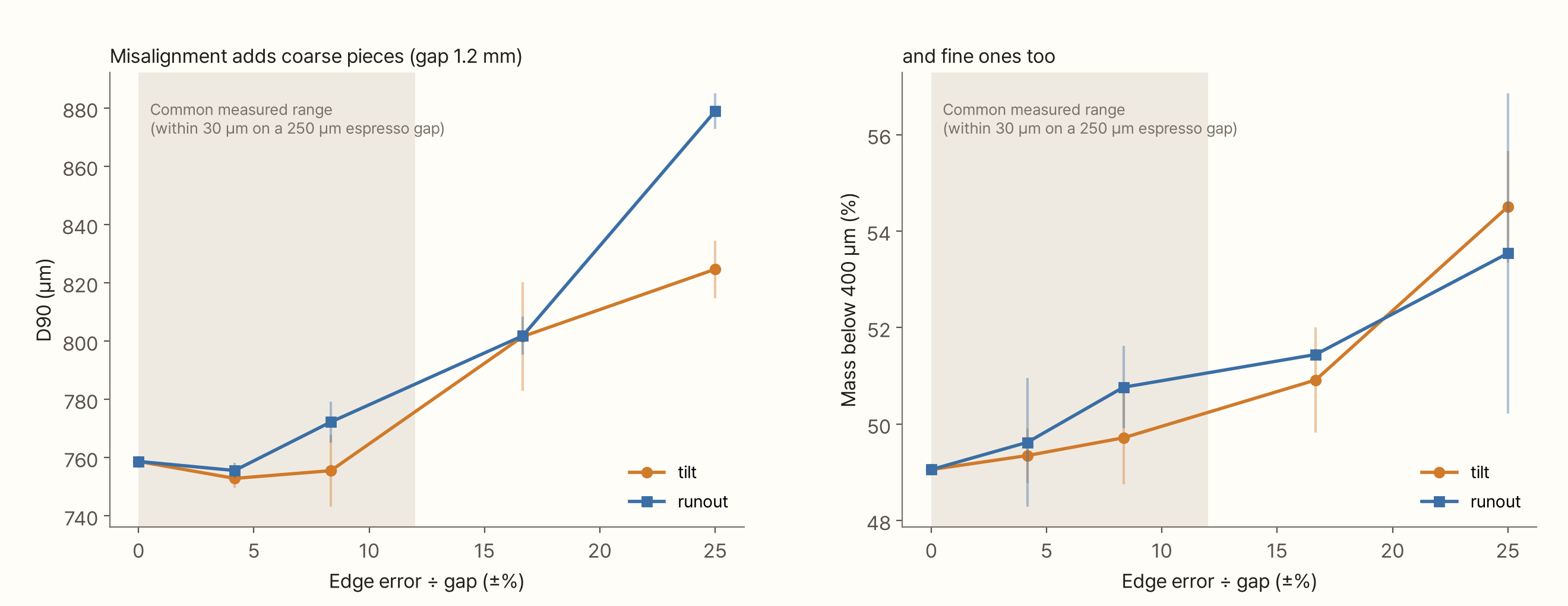
Up to ±8% of the gap at the edge, D90 was 753–772 µm, indistinguishable from the aligned burr (759 µm) within the simulation's scatter (about ±10 µm between seeds). At ±17%, both tilt and runout reached 802 µm, 6% coarser. At ±25%, tilt gave 825 µm (+9%) and runout 879 µm (+16%). The mass below 400 µm also rose from 49.1% to 54.5% (tilt) and 53.5% (runout). Misalignment adds both coarse and fine pieces, so the distribution spreads both ways.
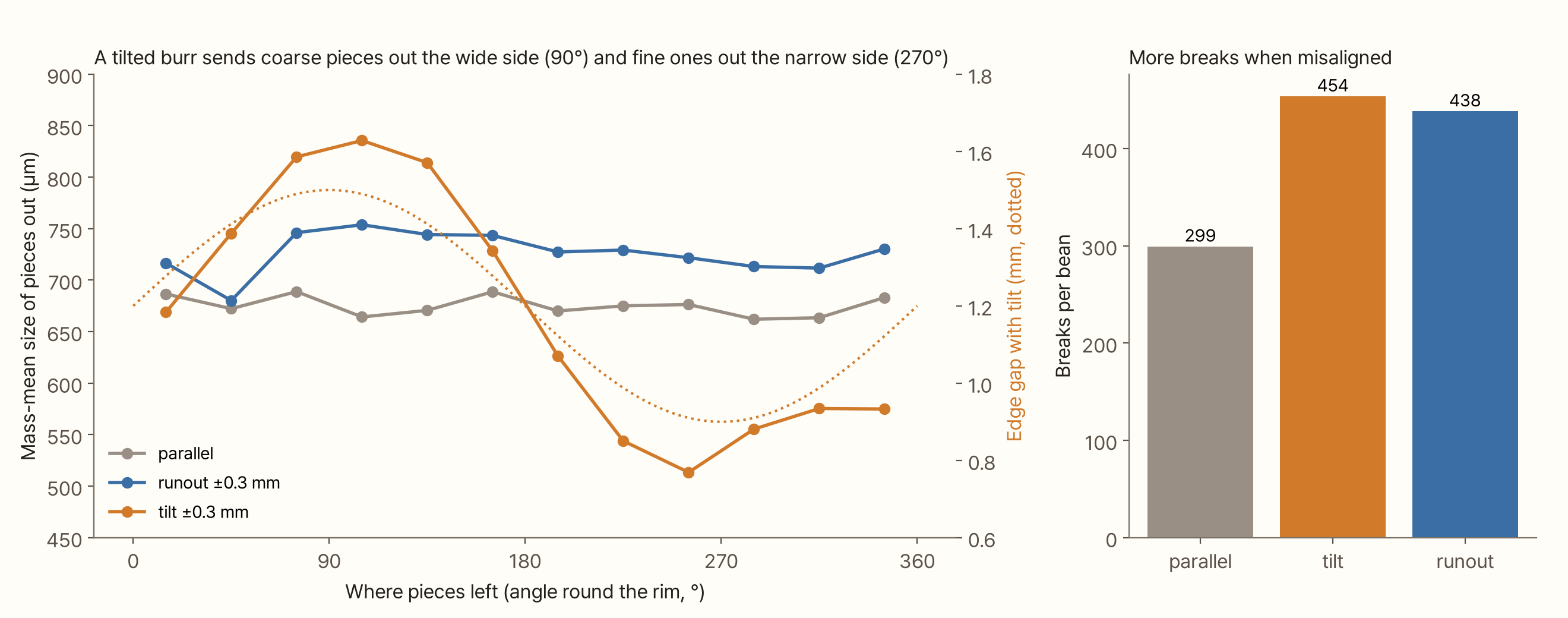
Where the pieces leave shows why. The tilted burr sent pieces averaging 840 µm out of the wide side (90°) and 510 µm out of the narrow side (270°). The parallel burr gave 670–690 µm on every side. The wide side lets big pieces straight out, and the narrow side grinds beans finer. The number of times a bean broke also rose from 299 to 454. It is as if one grinder contained several grinders with different gaps. Roller-mill research finds that how a particle breaks is set by the ratio of gap to particle size (Campbell and colleagues 2001); if the gap varies round the circumference, it is natural for the distribution to become a mixture of those different distributions.
With runout, the wide side turns with the burr, so the mean size was similar wherever pieces left. Even so, the coarse tail grew more than with tilt. The wide gap sweeps past every point once per turn, so a big piece gets a chance to slip out anywhere around the rim.
There is little measured data to compare with. Uman and colleagues (2016) compared two EK43s and attributed one machine's two-peaked curve to misalignment, but did not measure it in µm. Kornman and colleagues at Royal Coffee (2021) aligned four EK43s the same way and measured them with Kruve sieves. The four differed by a standard deviation of no more than 0.77 g (1.54%) on any sieve. In the same article, switching only to a darker roast added up to 23.4 points of fines below 400 µm. Differences between well-aligned units of the same model are far smaller than the differences beans make. I found no public measurement that recorded both the size of the misalignment and the change in the distribution.
Translated to real grinders: at filter fineness, a 30 µm error is about 4% of the gap and hardly matters. At espresso fineness, 30 µm is 12% of the gap, between the thresholds where this model starts to show a difference (8–17%). The 50–90 µm users sometimes measure is 20–36% of the gap, a range where this model has D90 growing 6–16% and fines rising a few points. Alignment matters more when grinding fine.
Seasoning
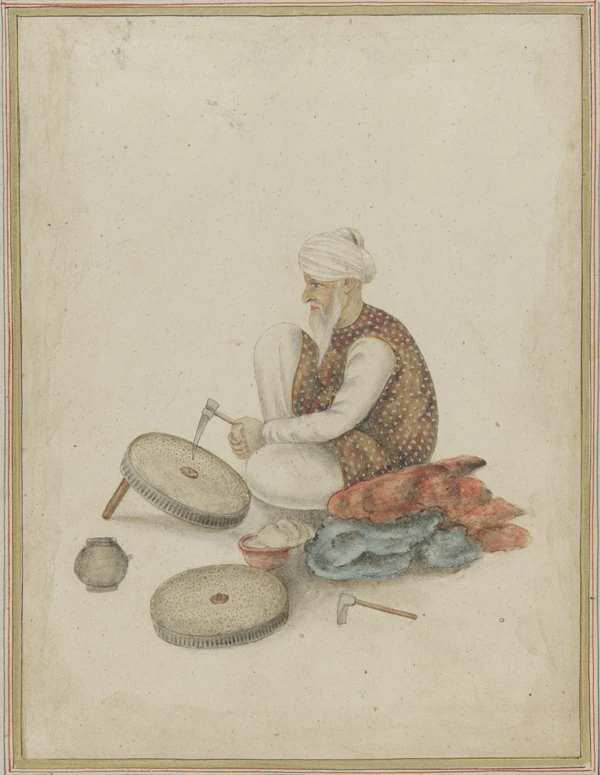
An old man dressing a millstone · Painting by an unknown artist, Wikimedia Commons, public domain
Millstones dulled with use and had their furrows re-cut regularly. Steel burrs are the other way round: when new, their edges are too sharp, so you break them in by grinding some beans. This is called seasoning. The most detailed record is Gagné's (2019). He fitted SSP burrs to a Weber EG-1 and ground about 24 lb (10.9 kg) of beans, periodically grinding the same sample and measuring about 15,000 particles per photo set. The distribution moved coarser as he went, levelling off around 10–12 lb. Uniformity kept improving even after the size stopped moving: the Q metric, mean area divided by its standard deviation, rose from 1.59 to 1.76. Gagné interpreted this as dulled edges letting slightly larger pieces through. Grinding the same beans 23 days later gave a finer, wider distribution, a difference caused by the beans ageing. To measure seasoning, bean age must be held fixed too.
This model cannot handle seasoning. The teeth are walls without thickness, with no rounded or sharp edge, and breakage is decided only by whether a force crosses a threshold. If the way beans break depends on whether an edge cuts or crushes, that would need to be added before seasoning could be computed.
Run it yourself
On the left of the tool below, you can replay 90 ms of the 3D simulation grinding six beans at a 1.2 mm gap, recorded every 0.5 ms. Switch between parallel burrs and burrs tilted ±0.3 mm at the edge, and drag to change the viewing angle. Heights are exaggerated three times. At the top right, the gap map shows how the gap round the rim changes as you vary the gap and the error; below it are the D90 values from the experiments above.
What this conclusion leaves out
- Particles are spheres. A sphere larger than the gap cannot pass, so the grounds come out finer than reality. Real fragments are elongated and flat, and at the same gap bigger pieces slip out
- I only computed at a 1.2 mm gap. Espresso gaps are below this model's resolution (400 µm), so I could not compute them directly. Translating the error into "a fraction of the gap" assumes that the same fraction has a similar effect
- The burr is still virtual. I chose the tooth shape, tooth height (40% of the gap) and the slope of the narrowing zone
- Twelve beans, ground twice. Changing the seed moved D90 by about ±10 µm and fines by ±1–3 points, so errors under 8% of the gap were lost in that scatter
- Seasoning was not computed. Edge shape and wear are absent
- The breakage rule is the same as before. Force threshold, no damage accumulation, 8% shed as crumbs at each break
Summary
- The simulation moved to 3D: particles are spheres, burrs are faces plus teeth with height. The invented 2D rules (passing over, the 60% tooth threshold) are gone, and breaks still bunched where the gap stops narrowing (65%)
- Growing the burr from 64 mm to 98 mm, at the same speed or the same edge speed, left the distribution unchanged (D90 749–759 µm)
- Edge errors within ±8% of the gap were indistinguishable from the simulation's scatter. From ±17%, D90 grew 6% and fines rose; at ±25%, tilt gave +9% and runout +16%
- A tilted burr sent coarse pieces (840 µm) out of the wide side and fine ones (510 µm) out of the narrow side. One grinder holds several grinders with different gaps, so the distribution spreads both ways
- The same 30 µm error is 4% of a filter gap and 12% of an espresso gap. Alignment matters more when grinding fine
- Seasoning can only be discussed through measurements. In Gagné's (2019) record, the distribution grew coarser until 10–12 lb and stopped, while uniformity kept improving after that
References
- Gagné J (2019). Seasoning grinder burrs and grind quality. Coffee ad Astra. link
- Gagné J (2023). What I learned from analyzing 300 particle size distributions for 24 espresso grinders. Coffee ad Astra. link
- Kornman C, Becker E, Loofbourow SE (2021). Grinder alignment: an evaluation of consistency, cupping settings, and the impact of roast degree. Royal Coffee (originally Roast Magazine, May/June 2021). link
- Uman E et al. (2016). The effect of bean origin and temperature on grinding roasted coffee. Scientific Reports 6, 24483. doi:10.1038/srep24483 — supplementary Fig. S1
- Campbell GM, Bunn PJ, Webb C, Hook SCW (2001). On predicting roller milling performance: Part II. The breakage function. Powder Technology 115(3), 243–255. doi:10.1016/S0032-5910(00)00349-100349-1) — abstract only
- Rao S (2019). A more effective way to align your grinder. link
- EK43 alignment measurements (user posts): Coffee Forums UK, "EK 43 alignment grinding chamber" thread, page 5 (2017). link — forum post
- Cundall PA, Strack ODL (1979). A discrete numerical model for granular assemblies. Géotechnique 29(1), 47–65. doi:10.1680/geot.1979.29.1.47
Image credits
- Dial test indicator: David English, Wikimedia Commons, CC BY-SA 4.0
- Old man dressing a millstone: unknown artist, Wikimedia Commons, public domain
- All other charts, the cover and the 3D simulation: made by me

