The Cost of One Americano: Korea's Coffee Chains Through Q3 2026
Converted to won, a kilogram of green coffee went from 2,642 won in June 2020 to 11,292 won in February 2025, more than four times as much. Yet Mega MGC Coffee's iced Americano is still 2,000 won. Meanwhile SCK Company, which runs Starbucks Korea, posted its first quarterly operating loss in 27 years in Korea in Q2 2026 (18.4 billion won), and in Q3 the loss widened to 45.3 billion won as sales fell 16.2%. In this installment of Wide and Shallow Economics, both scenes are explained by the same accounting: cost of sales and gross profit, and the contribution margin that separates fixed from variable costs. Using E-Mart IR, Fair Trade Commission franchise disclosures, ICO and Bank of Korea data, I follow how the price of one cup splits into VAT, beans, cup, rent and labor, why a bean price shock shrinks twice before reaching the menu price, and why the same structure magnifies a fall in sales. Then the strategies of Mega, Twosome and Compose, marketing like the Aerocano and Mega's ghost-story receipts, and five predictions to score against Q4 and Q1 2027 results. A calculator lets you change bean prices, exchange rates, menu prices and rent to find the break-even number of cups.
At half past eight in the morning, the budget coffee shop at the subway exit has three or four people waiting at the kiosk, and the pickup counter is lined with iced Americanos marked with order numbers instead of names. Across the street, people who ordered ahead on the Starbucks app (Siren Order, as it is called in Korea) walk in and out even at that hour. Over the past two years I have seen plenty of news about coffee getting more expensive, including headlines that world coffee prices had hit a 47-year high. Yet the price card at that budget shop still says 2,000 won for an iced Americano.
That struck me as odd. If the raw material costs several times what it used to and the price has not moved, then either somebody is eating the loss or the beans were never a big share of the price. And in the same year, at the other end of the market, Starbucks posted its first quarterly loss. The company with the largest sales in Korea's coffee market went into the red just as bean prices were coming down.
In this installment I put those two scenes on the same scale. I look at the latest numbers through the third quarter of 2026, break down where the price of one Americano goes, and use two accounting ideas to explain why a shock in bean prices shrinks by the time it reaches the cup while a shock in sales grows by the time it reaches profit. There are no fourth-quarter results yet. I am writing on 12 November, just as listed companies have finished reporting the third quarter.
The state of play in three numbers
Let me start with three numbers.
First, minus 45.3 billion won. That is the third-quarter 2026 operating loss of SCK Company, which runs Starbucks Korea. In the same quarter a year earlier it made a 60.0 billion won profit. Net sales fell 16.2%, from 810.5 billion won to 679.0 billion. It was the second loss in a row after the second quarter (minus 18.4 billion), and the first three quarters together come to a 34.4 billion won loss. SCK Company is a consolidated subsidiary of the retailer E-Mart, so its numbers come out with E-Mart's earnings. E-Mart's consolidated operating profit for the third quarter was 46.1 billion won, which means the loss at Starbucks alone was about as large as the whole group's profit.
Second, 3,969 outlets. That is the number of Mega MGC Coffee franchise stores. According to the franchise disclosure documents filed with the Korea Fair Trade Commission (the annual "information disclosure statements" every franchisor must publish), 658 stores opened and 14 closed during 2025, taking the chain from 3,325 to 3,969, a net gain of 644. In the same year Ediya Coffee opened 151 and lost 308, shrinking from 2,562 to 2,405. The brand that once had the most stores in Korea and the brand that has the most today moved in opposite directions in a single year.
Third, 7,705 won. That is what one kilogram of green (unroasted) coffee cost in won in October 2026. I got it by multiplying the International Coffee Organization's Composite Indicator Price (I-CIP), a monthly average of 261.26 US cents per pound, by the Bank of Korea's monthly average exchange rate of 1,337.66 won to the dollar. That is 32% below the peak in February 2025 (354.32 cents at 1,445.56 won, or 11,292 won per kg). Bean prices have already fallen about a third from the top. Still, the price cards did not come down, and Starbucks turned to losses in the meantime.
By company, the picture looks like this. Most of these firms are unlisted, so the latest figures are from annual audit reports (fiscal 2025) and franchise disclosures. The year and quarter matter in every row.
| Company (brand) | Period | Revenue | Operating profit | Stores (as of) |
|---|---|---|---|---|
| SCK Company (Starbucks) | Q3 2026 | KRW 679.0bn (year earlier 810.5bn) | −KRW 45.3bn (year earlier 60.0bn) | 2,219 (end of Q3 2026, reported) |
| SCK Company (Starbucks) | FY2025 | KRW 3,238.0bn | KRW 173.0bn | 2,115 (end of 2025, all company-run) |
| MGC Global (Mega MGC Coffee) | FY2025 | KRW 646.9bn | about KRW 111.3bn | 3,969 franchised (end of 2025) |
| Twosome Place | FY2025 | KRW 582.4bn | KRW 36.3bn | 1,484 franchised (end of 2023, latest disclosed) |
| Compose Coffee | FY2025 | KRW 300.3bn | about KRW 39.9bn | 2,649 franchised (end of 2024) |
| Ediya | FY2025 | KRW 238.7bn | KRW 9.6bn | 2,405 franchised (end of 2025) |
| M's Seed (Paul Bassett etc.) | FY2025 | KRW 213.6bn (Paul Bassett 165.1bn) | KRW 4.4bn (Paul Bassett 4.6bn) | — |
| Coffee Bean Korea | FY2025 | KRW 143.5bn | −KRW 3.3bn | 203 (2025) |
I checked the 2025 Starbucks figures and store count directly in E-Mart's IR materials, and franchise store counts directly in the Fair Trade Commission disclosures. The 2026 quarterly figures for Starbucks and the results for the other companies come from press reports citing audit and half-year reports. For Twosome, the latest store count in its disclosure is as of the end of 2023, so that is what I used.
For the market as a whole, Korea's national statistics office counts 89,852 coffee shops in 2020 and 107,055 in 2024. In Seoul, though, the city's commercial district analysis service put coffee franchise outlets at 6,766 in the fourth quarter of 2025, 368 fewer than a year earlier (as reported by Newsis). Some brands are still growing nationwide, but in places like Seoul more shops are now closing than opening.
Where the money in this business comes from
Cost of sales and gross profit
An income statement is a table you read from top to bottom, subtracting as you go. Start with revenue, subtract cost of sales (the money spent directly on what was sold), and you get gross profit. Cost of sales divided by revenue is the cost ratio; gross profit divided by revenue is the gross margin. Then subtract selling, general and administrative expenses (SG&A), the cost of running the business such as rent, wages, advertising and card fees, and you arrive at operating profit.
Take Starbucks. According to a Daehan Economic Daily report of 15 April 2026 citing the audit report, SCK Company's cost ratio in 2025 was 46.4%, down from 47.5% in 2024. Out of every 100 won of sales, a little over 46 won went on beans, milk, cups, food and merchandise, and about 54 won was left as gross profit. But SG&A came to 48.3% of sales, so the operating margin was only 5.3%. The operating margin was 10% in 2021, then 4.7% in 2022, 6.2% in 2024 and 5.3% in 2025.
There is something worth noticing here. 2025 was the year of record bean prices, yet Starbucks' cost ratio went down. On 24 January 2025 it raised the price of 22 drinks, including the tall Americano from 4,500 to 4,700 won, so price increases and cost control appear to have outrun the rise in beans. I could not find a cost breakdown by item in the filings. Even so, operating profit fell 9.3%, from 190.8 billion to 173.0 billion won. E-Mart's IR materials list the reason as "the effect of rising costs," and the company's own explanation was "the high exchange rate and higher raw material costs such as beans." But the numbers say SG&A, which rose 8.9% in a year, mattered more. What cut into profit was the SG&A ratio, not the cost ratio.
Breaking down one cup
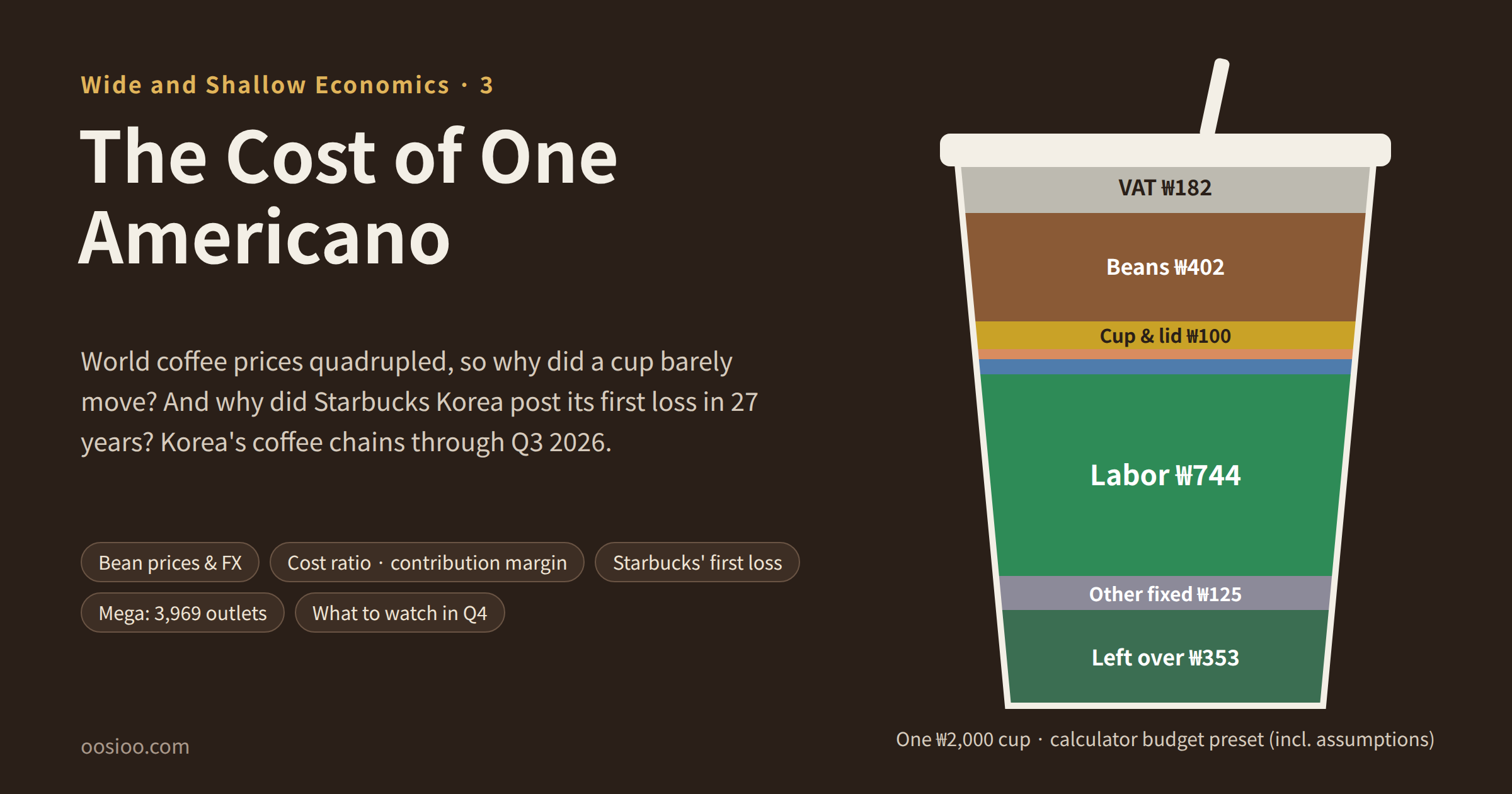
Now down to a single Americano. The figures below are what this article's calculator (further down) gives when you pick "Budget takeout · Mega-style." They mix sourced numbers with my own assumptions, so I will flag each one.
- Price: 2,000 won. That is Mega MGC Coffee's iced Americano. It includes 10% VAT, so 1,818 won is booked as the shop's revenue and 182 won is tax.
- Beans: 402 won. I assumed roasted beans at 20,089 won per kg and 20 g per cup (two espresso shots). Ten grams per shot is the figure the Korea National Council of Consumer Organizations used in its cost analysis of September 2025. I explain the per-kg price separately below.
- Cup, lid and straw: 100 won. On an online wholesale site, a PET iced cup costs 68 won and a lid a little over 26 won (checked 12 November 2026). I added a straw and sleeve to round it to 100 won. I could not confirm what franchisees pay their head office.
- Card fees and the like: 36 won. Assumed at 2% of revenue.
- Rent: 58 won. The Korea Real Estate Board put the national average monthly rent for small ground-floor retail units at 20,700 won per square meter in the third quarter of 2026. Multiply by 33 square meters, the reference store size in Compose Coffee's franchise disclosure, and you get 680,000 won a month. At 400 cups a day for 30 days, that is 58 won a cup. Spots near Seoul subway stations cost far more.
- Labor: 744 won. I assumed 24 staff hours a day (two people working twelve hours each, say) at 12,400 won an hour, which is the 2026 minimum wage of 10,320 won plus Korea's mandatory paid weekly holiday allowance. Social insurance and the owner's own labor are left out.
- Other fixed costs: 125 won. Electricity, water, building fees and royalties, assumed at 1.5 million won a month.
- Left over: 353 won.
The 400 cups a day is an assumption too. According to the franchise disclosure, Mega MGC Coffee franchisees averaged 412.87 million won in sales in 2025. Divided by 365 days, that is 1.13 million won a day; at an average of 2,800 won per cup (or item), it comes to about 400. A real shop sells lattes, smoothies and desserts too, so this number simplifies things by pretending the shop sells only Americanos.
Broken down like this, two things stand out. One: beans are not a small share at all, about 20% of the price. The consumer council said beans were 12.4% to 13.1% of a budget-brand Americano, but that calculation priced 10 g at 111 won using world market prices. Franchisees buy roasted beans from head office, so in practice they pay more. Two: even so, the biggest chunk is people, not beans. Under these assumptions, labor costs almost twice as much as beans.
Variable costs, fixed costs and contribution margin
Those items fall into two kinds. Beans, cups and card fees are variable costs: sell one more cup and they go up by that much. Rent, labor and building fees are fixed costs: whether you sell 100 cups today or 500, roughly the same amount goes out each month. (If you cut part-timers' hours to match the number of customers, some labor behaves like a variable cost, but here I treat it as fixed.)
What is left of the price after VAT and variable costs is called the contribution margin: the money each cup "contributes" toward paying the fixed costs. With the Mega-style defaults, that is 1,818 won minus 402 won for beans, 100 won for the cup and 36 won in fees, or 1,280 won. That is 64% of the price.
Monthly fixed costs add up to 11.11 million won: 680,000 in rent, 8.93 million in labor and 1.5 million in other costs. To cover that at 1,280 won per cup, the shop has to sell about 8,700 cups a month, or 290 a day. That point is the break-even point. Up to 290 cups, the shop loses money; from the 291st cup on, every 1,280 won goes straight to profit.
Accounting textbooks distinguish gross profit (revenue minus cost of sales) from contribution margin (revenue minus variable costs). Cost of sales can include fixed items such as factory depreciation, and SG&A can include variable items such as card fees. Published income statements are built around gross profit, but a shop owner deciding how to run the business is better off thinking in contribution margin. Separating the two shows why bean prices and falling sales hit profit with such opposite force.
Why a fourfold rise in beans barely moves the cup
Green coffee converted to won cost 2,642 won per kg in June 2020. In February 2025 it cost 11,292 won, 4.27 times as much. That shock gets smaller twice before it reaches the cup.
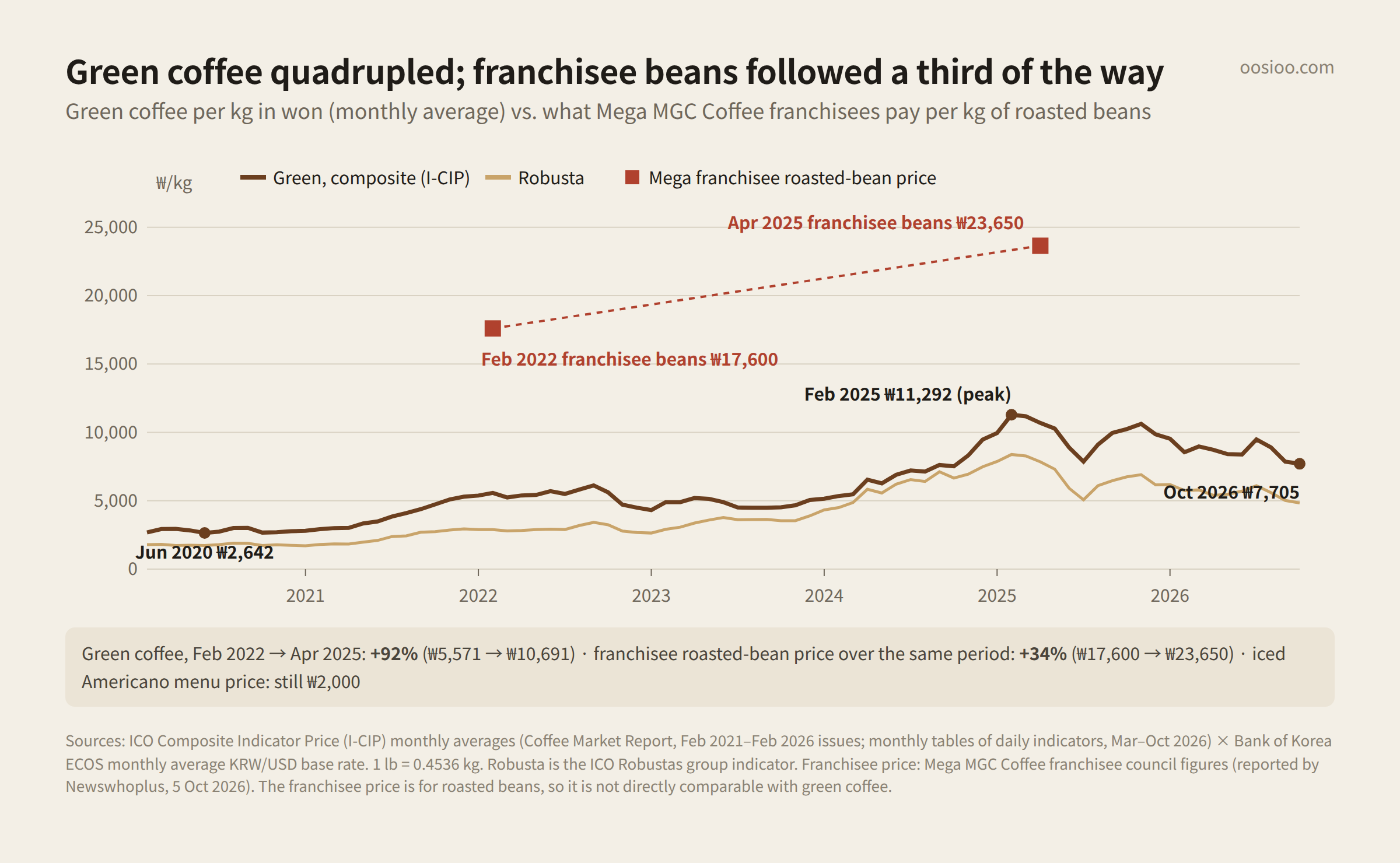
The first cushion is the bean supply price. According to a Newswhoplus report of 5 October 2026 citing figures from Mega MGC Coffee's franchisee council, the price franchisees pay head office for a kilogram of beans rose 34.4%, from 17,600 won in February 2022 to 23,650 won in April 2025. Over the same period, green coffee in won rose 92%, from 5,571 to 10,691 won.
Why did it follow only a third of the way? The price of roasted beans includes not just green coffee but roasting, packaging, logistics and the franchisor's cut. Roasting also makes beans lose 11% to 24% of their weight (Barista Hustle). Assume an 18% loss and convert the two green-coffee prices to a roasted basis, and you get 6,794 won and 13,038 won. Subtract those from the supply price and what remains is 10,806 won in February 2022 and 10,612 won in April 2025. In three years green coffee nearly doubled, while everything else in the price stayed almost flat. If this estimate holds, green coffee made up 39% of the franchisee bean price in 2022 and 55% in 2025. About half of what franchisees pay for beans moves independently of green coffee, so a 92% rise in green coffee became a 34% rise in beans. I could not find public data on the ratio of Arabica to Robusta in Mega's blend, or on how much head office buys ahead through futures or long-term contracts. The calculation above is an approximation based on a single composite index.
The second cushion is the price of the cup. If a kilogram of beans goes up by 6,050 won, the beans in a 20 g cup go up by 121 won. On a 2,000-won cup, that is just over 6%. The other 94% of the price is VAT, cup, rent, labor and profit. That is how Mega could raise the hot Americano by 200 won, from 1,500 to 1,700, on 21 April 2025, while keeping its best seller, the iced Americano, at 2,000 won. Compose Coffee raised its iced Americano from 1,800 to 2,100 won on 13 February 2025.
To sum up, a fourfold rise in green coffee shrinks to about 1.3 times in the bean supply price, and to a few percent of the menu price in the cost of beans per cup. Using the calculator defaults to compare October 2026 prices with June 2020, green coffee is 2.9 times as expensive, but the beans in one cup go from 278 won to 402 won, 1.4 times, a difference of 123 won. Passing all of that on to customers would raise the price by 136 won including VAT, or 6.8%.
Franchisees, of course, see it differently. The council's chair argued that the supply price had not come down enough after world bean prices fell from their peak, and Mega called it a biased claim by some franchisees (same report). I could not confirm whether the supply price has been cut since April 2025. Green coffee in won fell 28%, from 10,691 won in April 2025 to 7,705 won in October 2026. By the estimate above, that leaves room for the supply price to drop by about 3,600 won.
When the same principle runs in reverse
High fixed costs soften a bean price shock, but they become a blade when sales fall. In a business with a high contribution margin, every lost customer takes their whole contribution margin with them, and rent and wages do not shrink just because customers do.
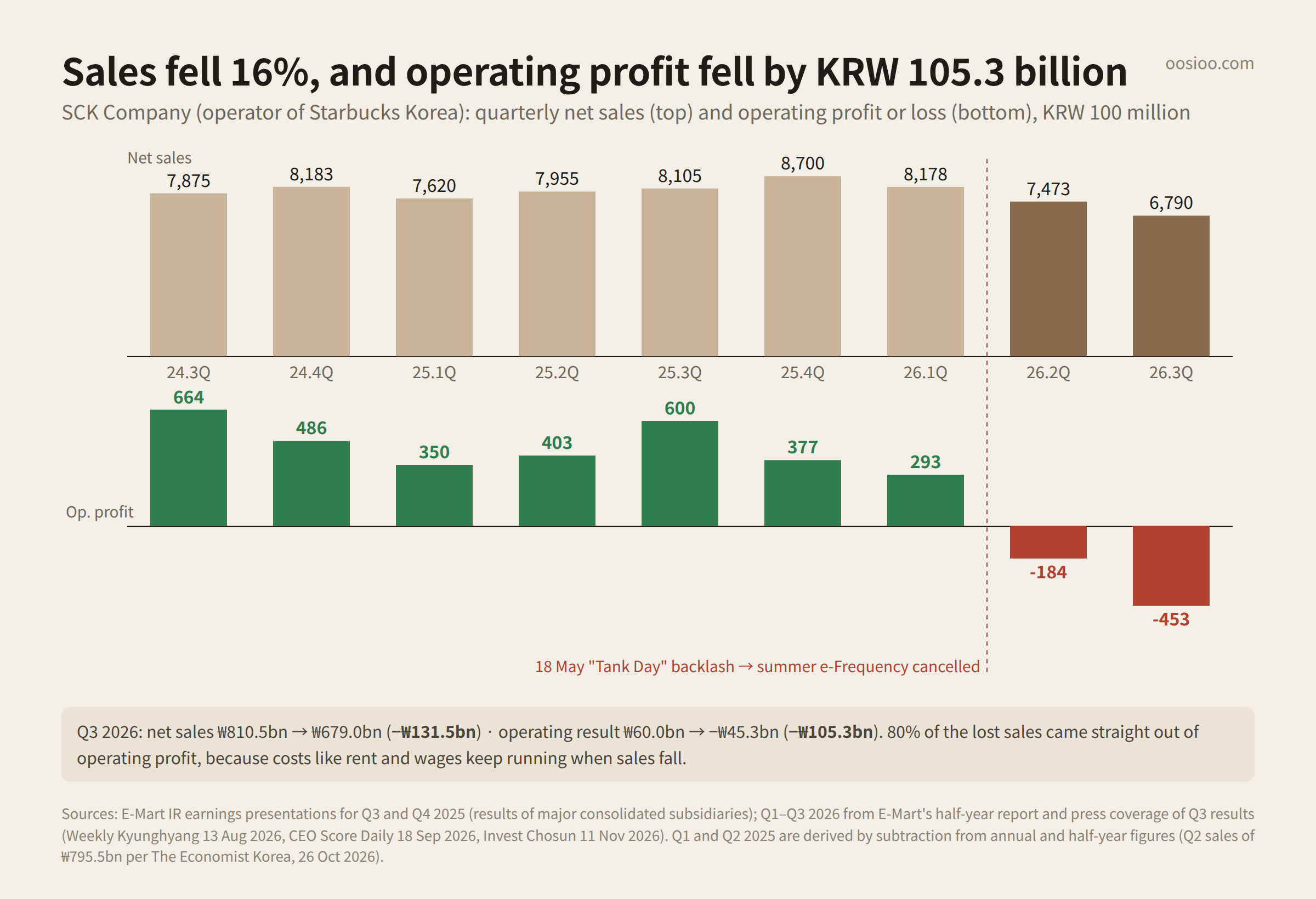
That is what happened to Starbucks in the third quarter of 2026. Net sales fell by 131.5 billion won from a year earlier, and operating profit fell by 105.3 billion. Eighty percent of the lost sales came straight off the bottom line. Starbucks runs every one of its stores in Korea itself, with no franchisees, so rent and wages for more than 2,000 stores go out regardless of sales. When sales fall at a company with a gross margin above 50%, gross profit shrinks while SG&A stays put. In the second quarter, sales fell by 48.2 billion won, from 795.5 billion to 747.3 billion, while operating profit worsened by 58.7 billion. Profit falling by more than sales means other costs also rose during that time.
Briefly, here is why sales fell. On 18 May 2026, Starbucks Korea used slogans like "Tank Day" and "Slam it on the desk!" in a tumbler promotion. Critics said they evoked the 18 May 1980 Gwangju Democratization Movement, which was crushed by troops and tanks, and the 1987 death under police torture of student Park Jong-chul, whose death police initially explained by saying they had slammed the desk and he collapsed. The backlash was fierce. The company stopped the promotion and apologized. On 20 May, Shinsegae Group dismissed CEO Sohn Jung-hyun, and group chairman Chung Yong-jin issued an apology. The "Summer e-Frequency," the stamp-collecting promotion that lifted sales every summer, was not held (as reported by The Fact and SBS Biz). The company named the cancelled Frequency promotion, rather than the controversy itself, as the cause of the weak second quarter.
There are also estimates that customers moved to other brands in the same period. Mobile Index estimated second-quarter card spending at Starbucks at 355.9 billion won, down 18.5% from a year earlier, while Twosome Place rose 28.5% and Mega MGC Coffee rose 34.1% (Weekly Kyunghyang, 13 August 2026). These are estimates from card-company samples and may differ from actual sales.
When "revenue" means something different
One last point. A franchisor's revenue is not the shops' revenue. It is what head office sells to franchisees: beans, milk, cups, syrup. Of MGC Global's 646.9 billion won in 2025 revenue (MGC Global runs Mega MGC Coffee), 94.0%, about 608.2 billion, was merchandise sales (press reports citing the audit report). Multiply average franchisee sales of 412.87 million won by the average number of franchise stores (the mean of the start and end of the year, 3,647) and franchisee sales come to roughly 1.5 trillion won in total. Head office merchandise sales work out to about 40% of that. In other words, about 4,000 won of every 10,000 won a franchisee takes in goes back to head office as payment for supplies. This is an estimate, and it would change if company-run store sales or non-franchise sales are mixed in.
Because of this structure, a franchisor's cost ratio and operating margin swing widely depending on how it supplies its stores. Compose Coffee is a good example. Its 2025 revenue rose 236% to 300.3 billion won, but operating profit stayed about the same at roughly 39.9 billion won. Its operating margin fell from 48% to 13%. Business did not get worse. It changed the way it supplies raw materials, which meant booking the full purchase and sale amounts as revenue (NewsSpace, 4 August 2026), and cost of sales rose along with revenue. The same profit can produce margins nearly four times apart depending on whether revenue is booked as "the fee only" or "the full price of the goods." That is why, when comparing operating margins across companies, you have to look first at what the revenue is made of.
Playground
The calculator has three panels. In ① Beans, you pick a world price and exchange rate and get the price of a kilogram of roasted beans, using exactly the estimate described above: divide the green-coffee price by the roasting loss and add 10,700 won for roasting, logistics and the franchisor's share, backed out from Mega's franchisee price. That share has its own slider. Panel ② covers per-cup costs like the cup and fees, and panel ③ the menu price and the shop's fixed costs.
In the chart at the bottom, the green line is the monthly contribution margin, which grows with cups sold per day, and the gray line is monthly fixed costs. Where the two lines meet is the break-even point. Here are a few things to try.
- Press "Feb 2025 · peak" and see what share of the price the beans take. With the Mega-style defaults it is just over 24%. Press "Jun 2020" and it drops below 14%.
- With Mega-style, raise staff hours per day from 24 to 30. The break-even point moves from 290 cups to close to 350, a bigger shift than pushing bean prices to the peak.
- Pick Starbucks-style and lower cups sold per day from 700 to 590, a 16% drop. The monthly profit disappears. That is what happened to Starbucks in the third quarter, shrunk down to a single store. Rent, staffing and other fixed costs for the Starbucks-style store are not disclosed, so they are all assumptions.
The calculator assumes the shop sells only Americanos. A real shop also sells lattes with milk and desserts and food with high cost ratios. The head of Mega's franchisee council claimed some desserts cost more than 60% of their price. The Americano is among the menu items with the highest contribution margin in a coffee shop.
Companies with interesting strategies
Mega MGC Coffee: a logistics company that sells coffee
MGC Global (formerly Andhouse), which runs Mega MGC Coffee, was bought in 2021 by Wooyoon (then Wooyoon Partners) and the private equity firm Premier Partners for 142 billion won (NewsSpace, 30 April 2025). Since then revenue has grown from 368.3 billion won in 2023 to 646.9 billion in 2025, and operating profit from 69.3 billion to about 111.3 billion. Dividends alone came to about 124.2 billion won from 2021 to 2023.
Mega's strategy comes down to "cheap, lots, and big." In 2025 it reached 3,969 franchise stores, adding 644 in a year while losing only 14. Average sales per franchisee also rose, from 362.62 million won in 2023 to 412.87 million in 2025. It is rare for sales per store to rise while the number of stores grows that fast. And as we saw, 94% of head office revenue comes from selling supplies to franchisees. More stores means more places to sell beans and cups to.
There is tension too. Head office's operating margin fell from 21.7% in 2024 to 17.2% in 2025, and the franchisee council is taking issue with bean supply prices and dessert cost ratios. Whether the 2,000-won iced Americano is being held by squeezing franchisees' profits or by trimming head office's share is the thing to watch from here. Mega runs eight stores in Mongolia, has signed with a partner in Cambodia and is preparing to enter the United States (Newsis, 6 April 2026).
Twosome Place: cake before coffee
Twosome Place posted record results for the third year running in 2025, with revenue of 582.4 billion won and operating profit of 36.3 billion. Consumer sales including franchisees, as tallied by the company, came to 1.0874 trillion won. In its 2023 disclosure, average sales per franchisee were 522.12 million won, 2.7 times Ediya's 195.29 million that year. Its weapon for raising spend per customer is dessert, and the company itself credits its "dessert focus." When it raised 23 regular coffee drinks by 200 won each on 26 March 2025, it raised whole cakes by an average of 2,000 won and slices by 400 won.
The interesting part is the second quarter of 2026. In the same quarter that card spending at Starbucks fell, Twosome's estimated card spending rose 28.5%. Among mid-to-large cafés where people sit and stay a while, Twosome seems to have been the first alternative to Starbucks that came to mind. The Carlyle Group bought Twosome in November 2021 for about 1 trillion won. When Twosome announced plans to enter the US market in September 2026, some in the market read it as Carlyle pumping up the price ahead of a sale; Twosome said it had nothing to do with a sale (Dealsite). I could not confirm any formal steps such as appointing a sale adviser.
Compose Coffee: a Korean budget coffee chain bought by a Philippine company
In July 2024, Jollibee Foods, the Philippines' largest restaurant company, bought 70% of Compose Coffee for about 238 million dollars (about 330 billion won), valuing the whole company at about 470 billion won (Money Today, 2 July 2024). The reason Jollibee bought a Korean budget coffee chain is in the numbers. In the financial statements included in its franchise disclosure, Compose had 2024 revenue of 89.7 billion won and operating profit of 40.0 billion, an operating margin of 44.5%. Franchise stores doubled in three years, from 1,285 at the start of 2022 to 2,649 at the end of 2024.
After the acquisition, Compose moved bean roasting and raw-material production into an affiliate, Compose Coffee Smart Factory. In 2025 it bought about 72.5 billion won worth of goods from that company, and the result was the "236% revenue growth, 13% margin" described above. When buying, roasting, shipping and selling are all tied together inside one group, the group keeps the margin that used to be added at each step. The same report said cash dividends actually paid in 2025 came to 22.1 billion won, and that a capital reduction in January 2026 would return about 40 billion won to shareholders. In April 2026 Compose formally opened its first store in Taiwan, its second overseas market after Singapore in 2023.
A side note: coffee chains chosen by private equity
An unusually large share of Korean coffee brands are owned by private equity or foreign capital. On top of Twosome (Carlyle), Compose (Jollibee and Elevation Equity Partners) and Mega (Wooyoon and Premier Partners), Orchestra Private Equity agreed on 8 January 2026 to buy 100% of Mammoth Coffee Lab. That business has about 900 franchise stores and about 75 billion won in revenue, and the deal included the roaster Seojin Roasters (Asia Economy). Fair Trade Commission disclosures show 813 franchise stores for its budget brand, Mammoth Express, at the end of 2025. Orchestra said it was looking at entering Japan's budget coffee market.
Why private equity likes coffee is already covered by the accounting above. A franchisor does not build stores itself, so it needs little investment, and selling supplies to franchisees brings in steady cash. That cash pays dividends, and a few years later the business is sold for more. Company-run chains like Starbucks or Coffee Bean, by contrast, carry their fixed costs themselves. Coffee Bean Korea went from 291 stores in 2019 to 203 in 2025, and in September 2025 it opened a company-run budget brand, "Box Coffee," through an affiliate (Korea Economic Daily, 23 April 2026).
Marketing worth a look
Aerocano: air instead of ice
On 26 February 2026, Starbucks Korea launched the "Aerocano," a world first for the company. It is an iced Americano made by aerating the espresso until it turns soft and foamy. According to the company, it sold a million cups in seven days and 5.5 million by 26 July. It has since gone on sale in India, Malaysia, Singapore, Taiwan and Vietnam (Etoday, Wikitree). It is a rare case of a menu item built first in Korea, aimed at the Korean habit known as "eoljuka" (iced Americano even if you freeze to death), and then exported to other countries. By the contribution-margin logic above, it is also a clever product: one extra step added to an Americano gives a reason to charge more.
Mega's ghost-story receipts
On 9 July 2026, Mega MGC Coffee launched six summer drinks under a spooky theme it called "Chilling Summer Nights at MGC." The receipts printed by its kiosks carried creepypasta-style rules such as "Leave no trace of the red smoothie" and "Do not look behind you when the cheese stretches," and the screens that display order numbers played eerie videos. The company said the new drinks sold more than a million units in two weeks (Sports Kyunghyang, 25 July 2026). In effect it turned the receipts and screens of nearly 4,000 stores into ad space. Rather than buying new media, it turned equipment already in its stores into a channel.
In June of the same year, when it ran a TV ad for the North American World Cup featuring Son Heung-min, it also held an event where viewers could leave cheering comments on the YouTube version of the ad and selected messages would appear on kiosks in stores nationwide (Sports Kyunghyang, 12 June). Another case of using the kiosk as a billboard.
The return of e-Frequency, and the going rate for stickers
After skipping its summer promotion, Starbucks brought back the winter e-Frequency on 22 October 2026. Buy 17 made-to-order drinks, including three designated mission drinks, and you get a gift. There were reports that a single e-sticker was trading for 6,000 to 7,000 won on Danggeun (Karrot), the secondhand marketplace app (The Economist Korea, 26 October 2026). Since you have to buy a drink to get a sticker, a sticker trading near the price of a drink means plenty of people still want the gifts. How much this promotion lifts fourth-quarter numbers is the crux of the first prediction below.
What to watch next quarter
I will score the five predictions below in coming installments, and whether they turn out right or wrong, I will write down what went off.
- SCK Company (Starbucks) will return to an operating profit in Q4 2026. It lost 45.3 billion won in the third quarter, and E-Mart said monthly results were gradually recovering. The winter e-Frequency started on 22 October. Scored by: E-Mart's Q4 2026 results in February 2027 (IR section on major consolidated subsidiaries).
- Even so, SCK Company's Q4 2026 net sales will be lower than a year earlier (870.0 billion won). Given its fixed-cost structure, I think it can return to profit without sales fully recovering. Scored by: the same source as prediction 1.
- The ICO Composite Indicator Price (I-CIP) monthly average for March 2027 will be lower than October 2026 (261.26 cents per pound). This rests on Rabobank's forecast of a 2026/27 supply surplus (about 8.64 million bags), cited in the ICO's February report, and on the outlook for Brazil's harvest. On the other side, certified US Arabica stocks at the end of October were the lowest since January 2002, which could push prices up. Scored by: the ICO's March Coffee Market Report, published in April 2027.
- Mega MGC Coffee's iced Americano will still be 2,000 won on 31 March 2027. The minimum wage rises 3.7% to 10,700 won on 1 January 2027, but in both 2025 and 2026 Mega raised other items while holding this one. Scored by: prices on the official app and website on 31 March 2027, and any reports of increases up to then.
- The Starbucks tall Americano will still be 4,700 won on 31 March 2027. It is hard to raise the price of a signature item while trying to win customers back. Scored by: the Starbucks app price on the same day and any reports of increases.
There are also things I am watching without scoring. The Born Korea, which runs Paik's Coffee, reports its third-quarter 2026 results in mid-November. According to the franchise disclosures, average sales per Paik's Coffee franchisee fell 9%, from 324.49 million won in 2024 to 295.08 million in 2025. The won-dollar rate came down from a monthly average of 1,527 won in June 2026 to 1,338 won in October, which is good news for the cost of imported beans. How much of that shows up in fourth-quarter costs will be visible in filings from February to April 2027.
Closing
In a cup of Americano, the beans are bigger than you might think, and the people and the space are bigger still. That is why the cup price moved only a few percent when world bean prices quadrupled, and why Korea's largest coffee company went into the red when its customers fell by 16%. The two scenes are two sides of the same principle. In a business with high fixed costs, raw material shocks get diluted and sales shocks get amplified.
A long line at the budget coffee shop on the way to work means its contribution margin has cleared its fixed costs; a big, empty café means the opposite. Next time you pick up a 2,000-won cup, it might be worth remembering that inside it are about 400 won of beans and more than 700 won of someone's time.
This piece is a summary of public information and does not recommend buying or selling any security.
Sources
- World coffee prices: ICO Coffee Market Report, February 2026 · February 2025 · ICO monthly table of daily indicator prices, October 2026 (March to September in the same format) · Tea & Coffee Trade Journal on the ICO October report (11 Nov 2026) · Global Coffee Report (12 Nov 2026)
- Exchange rate: Bank of Korea Economic Statistics System (ECOS) 731Y004, KRW/USD base rate, monthly average
- Starbucks: E-Mart IR earnings and business presentations, Q3 2025 · Q4 2025 · Invest Chosun (11 Nov 2026) · BusinessPost (11 Nov 2026) · Weekly Kyunghyang (13 Aug 2026) · CEO Score Daily (18 Sep 2026) · Daehan Economic Daily (15 Apr 2026) · The Fact (21 May 2026) · The Economist Korea (26 Oct 2026) · Etoday on the Aerocano · Segye Ilbo (20 Jan 2025)
- Franchise store counts and average sales: Korea Fair Trade Commission franchise disclosure statements for Mega MGC Coffee · Compose Coffee · Ediya Coffee · Paik's Coffee · Twosome Place · Mammoth Express (accessed 12 Nov 2026)
- Company results and deals: Newswhoplus (5 Oct 2026) · Straight News (17 Oct 2026) · NewsSpace on Compose (4 Aug 2026) · NewsSpace on Mega (30 Apr 2025) · Money Today on the Jollibee deal (2 Jul 2024) · The Report on Twosome · Report on Ediya's results (23 Apr 2026) · Dealsite on M's Seed · Korea Economic Daily on Coffee Bean (23 Apr 2026) · Asia Economy on the Mammoth Coffee deal (8 Jan 2026) · Newsis (6 Apr 2026)
- Price increases: Womaneconomy (31 Mar 2025) · Korea Economic Daily (4 Nov 2026)
- Cost structure: Kyunghyang Shinmun on the Korea National Council of Consumer Organizations analysis (15 Sep 2025) · Gukje News on the Korea Real Estate Board Q3 2026 rent survey (29 Oct 2026) · Report on the 2027 minimum wage decision (15 Jul 2026) · Barista Hustle on roasting weight loss
- Marketing: Sports Kyunghyang on the ghost-story receipts (25 Jul 2026) · Sports Kyunghyang on the Son Heung-min ad (12 Jun 2026)