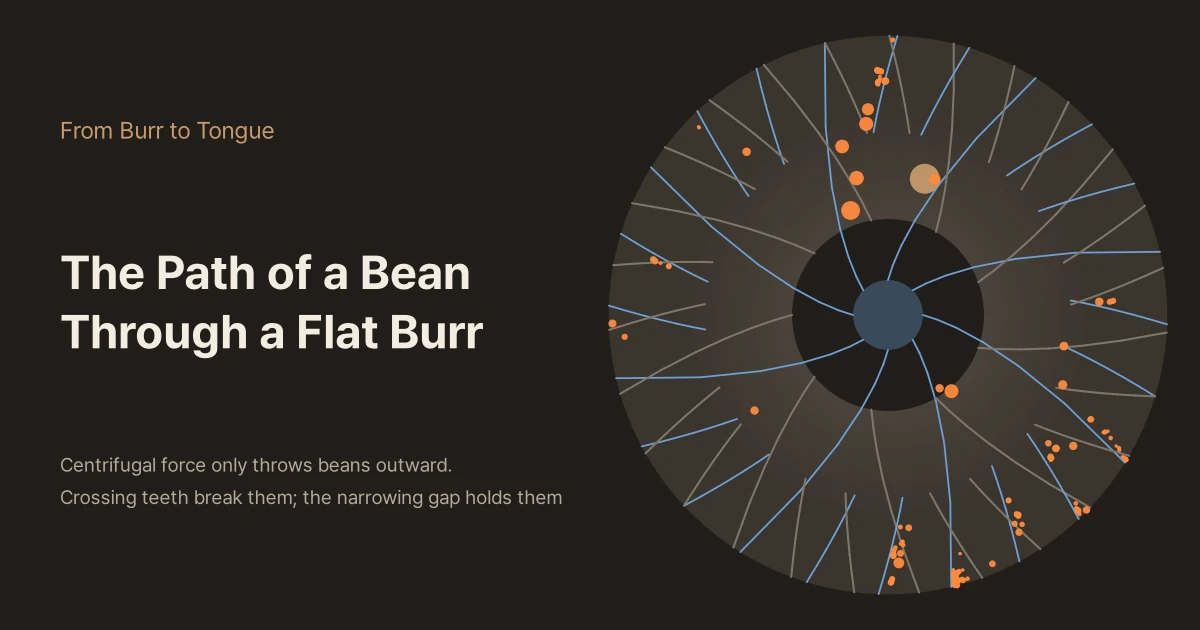
The Path of a Bean Through a Flat Burr
What path does a bean take between two flat burrs, and how long does it stay? With no study that measured the inside of the burrs, I built a virtual 64 mm flat burr in a 2D DEM and ground beans in it. Centrifugal force is a few thousandths of the breaking force, so it only sends beans outward; 82% of breaks piled up between crossing teeth where the gap finishes narrowing. At any speed from 300 to 2,000 rpm, a bean passed through while the burr turned half a revolution, and the gap changed how often beans broke rather than how long they stayed. With a simulation you can run yourself.
Pour 20 g of beans into a commercial flat-burr grinder and it is all ground in a little over a second. Uman and colleagues (2016) give the rated output of the EK43 (1,480 rpm) as 1.2–1.5 kg per minute and estimate that a 20 g dose is exposed to the air for no more than about a second. In that second the beans pass between two burrs 98 mm across. What path do they take from the centre to the rim, how long do they stay, and where do they break?
I could not find a study that answers this. There is no experiment that filmed particles moving inside the burrs, and no peer-reviewed paper that computed it. So I took the 2D DEM from "How to Simulate Breakage" and put it inside a flat burr instead of between rolls. The short version: centrifugal force only sends the beans outward. What breaks a bean is the crossing teeth, where the gap finishes narrowing. And the time a bean takes to pass through the burrs was the time the burr takes to make half a turn, whatever the speed.
Two discs that look like millstones
A flat burr is a descendant of the millstone. Like the stone below, it has a hole in the middle and slanted grooves cut across its face. One stone turns and the other stands still. Grain goes in through the central hole, is ground between the two stones and comes out at the rim.
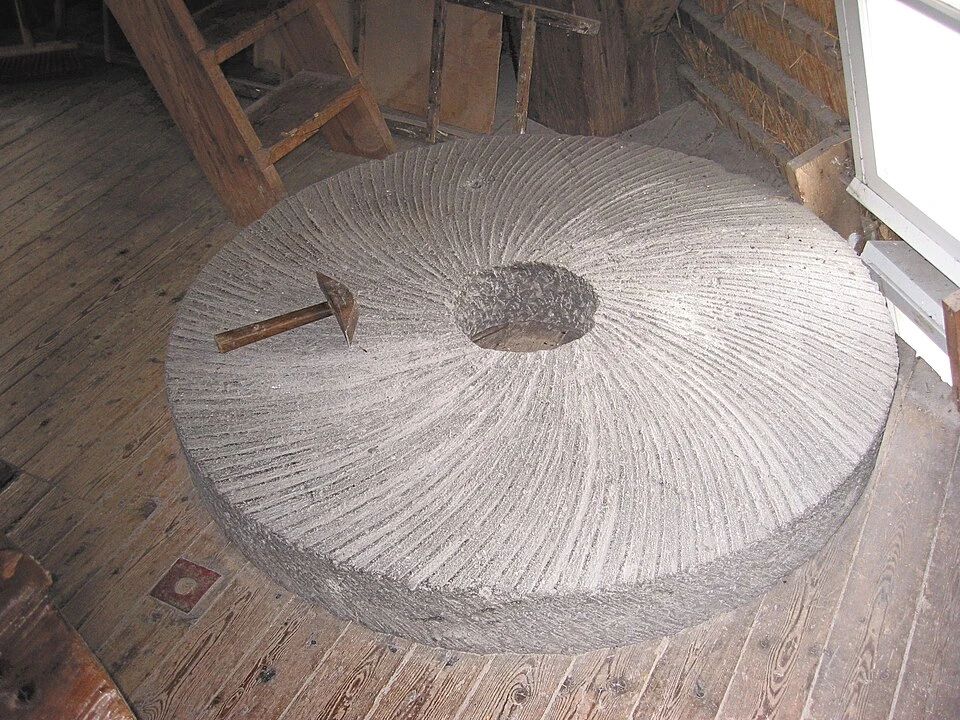
Millstone and dressing hammer at the Walderveen windmill, the Netherlands · Photo: Rasbak, Wikimedia Commons, CC BY-SA 3.0
A 19th-century encyclopaedia drawing shows the principle more clearly. The upper drawing is a side cut through the two stones. The grooves of the turning runner stone (Läufer) and the resting bed stone (Bodenstein) cross, and a grain caught between them is cut between the edges. The lower drawing shows the groove layout from above.
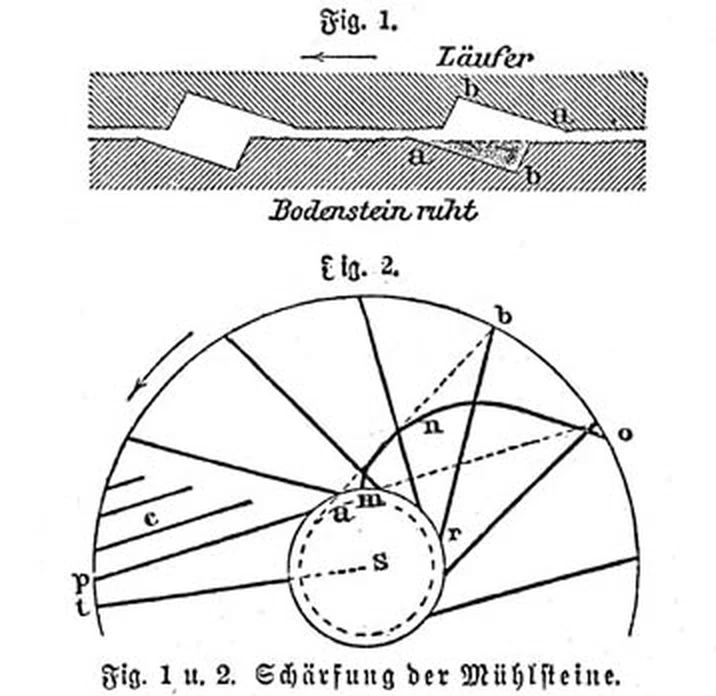
Dressing millstones (Schärfung der Mühlsteine) · Meyers Konversations-Lexikon (c. 1885), Wikimedia Commons, public domain
A coffee flat burr has the same structure, except that it is steel instead of stone, each disc is only about 50–100 mm across, and it turns much faster. 64 mm is common for home grinders; the EK43 uses 98 mm. According to retailer specifications, the EK43 turns at 1,450 rpm without load on 50 Hz mains.
The burr in this piece is a virtual one modelled on a 64 mm flat burr. I chose the dimensions; they were not measured from a real product.
- Eye (radius 11 mm): where beans drop in. Eight large vanes on the rotating burr hit the beans here
- Narrowing zone (11–24 mm): the gap between the burrs closes in a straight line from 8 mm
- Outer band (24–32 mm): the gap stays at g, the value you change with the grinder's dial. Fine teeth are packed close
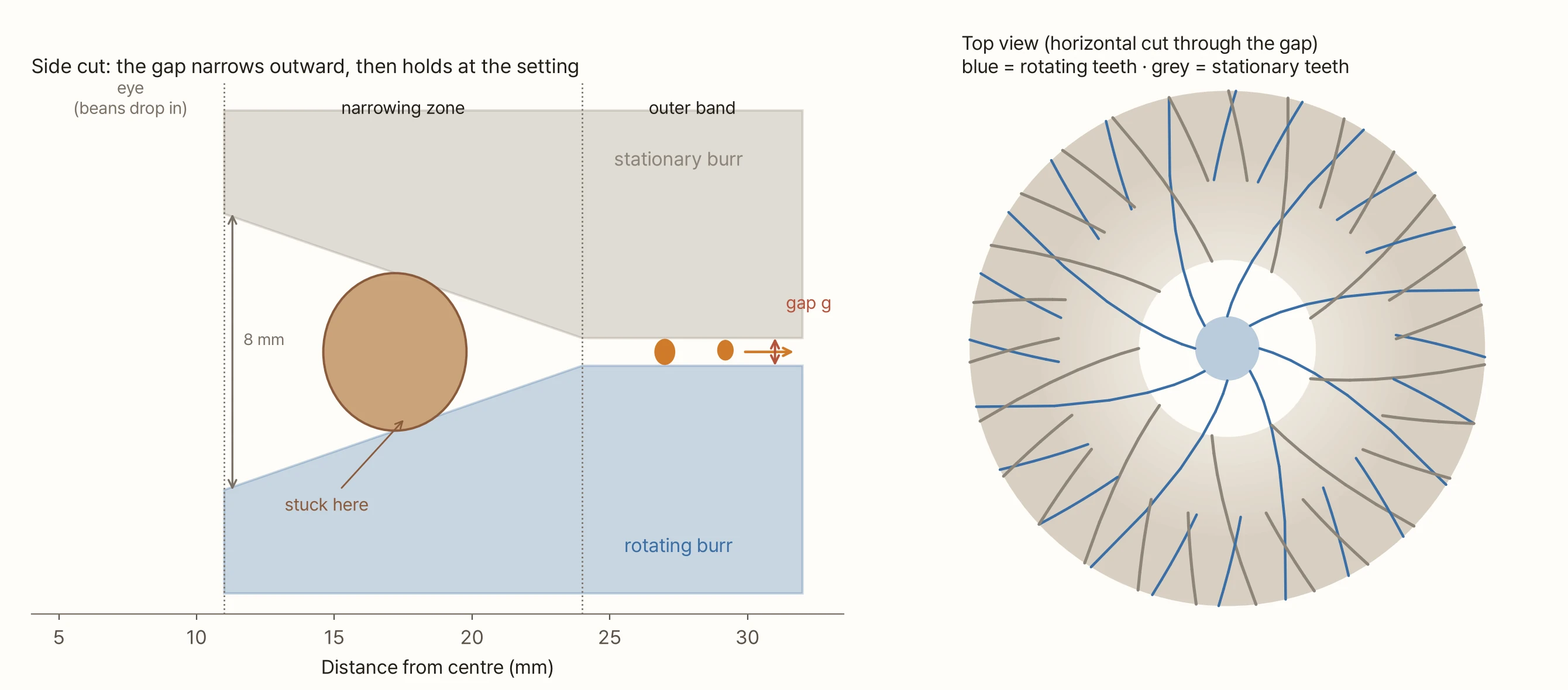
The two drawings cut the same burr in different directions. Slice horizontally through the middle of the gap, as on the right, and you get a 2D plane. The simulation in this piece runs on that plane. Each bean is a disc, and I keep its height separately as 0.6 times its diameter (an assumption that roasted bean pieces are flat; in this piece I call this value "flatness"). The gaps that a flat picture leaves, I filled in with that height. The rules are these.
- If a particle is taller than the gap where it sits, it is "stuck". The burrs press it from above and below (this force also counts toward breaking), the rotating face drags it, and the stationary face holds it back. Because the gap narrows outward, the faces also push it inward like a wedge
- Every particle, whatever its size, is taken to sit in the grooves between the rotating burr's teeth, and slides outward along them. The stationary burr's teeth catch a particle only if it is taller than 60% of the gap; anything lower passes over them
- If two particles' heights add up to less than the gap, they can pass one over the other, so they do not collide
- Breaking works as in "How to Simulate Breakage". When a particle feels more force than its breaking force, it is replaced by 2–4 fragments, and sibling fragments do not push each other until they separate. This time volume is conserved instead of area
How strong is centrifugal force?
At 1,000 rpm, the rim of a 64 mm burr moves at 3.4 m/s, and anything sitting there is pushed outward at 36 times gravity. The rim of an EK43 moves at 7.4 m/s, at 115 times gravity.
Agricultural engineering solved the problem of grains sliding outward on a spinning disc first. A spinning-disc spreader is just such a machine. As a vaned disc turns, granules slide along the vanes and are flung out. Villette and colleagues (2005) and Cerović and colleagues (2018) worked out analytical solutions for particle motion along a vane.
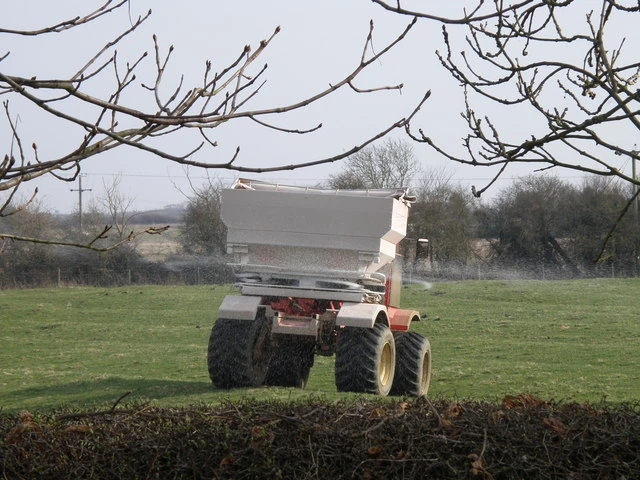
Spreading fertiliser with a spinning-disc spreader · Photo: Michael Trolove, Wikimedia Commons (geograph.org.uk), CC BY-SA 2.0
A particle sliding along a single radial vane obeys r̈ = ω²r − 2μωṙ in the rotating frame. Centrifugal force pulls it outward, and friction proportional to the Coriolis force pressing it against the vane holds it back. Without friction the solution is r₀·cosh(ωt); with a friction coefficient μ it grows with the exponent ω(√(1+μ²) − μ). I first checked that the simulation follows this formula.
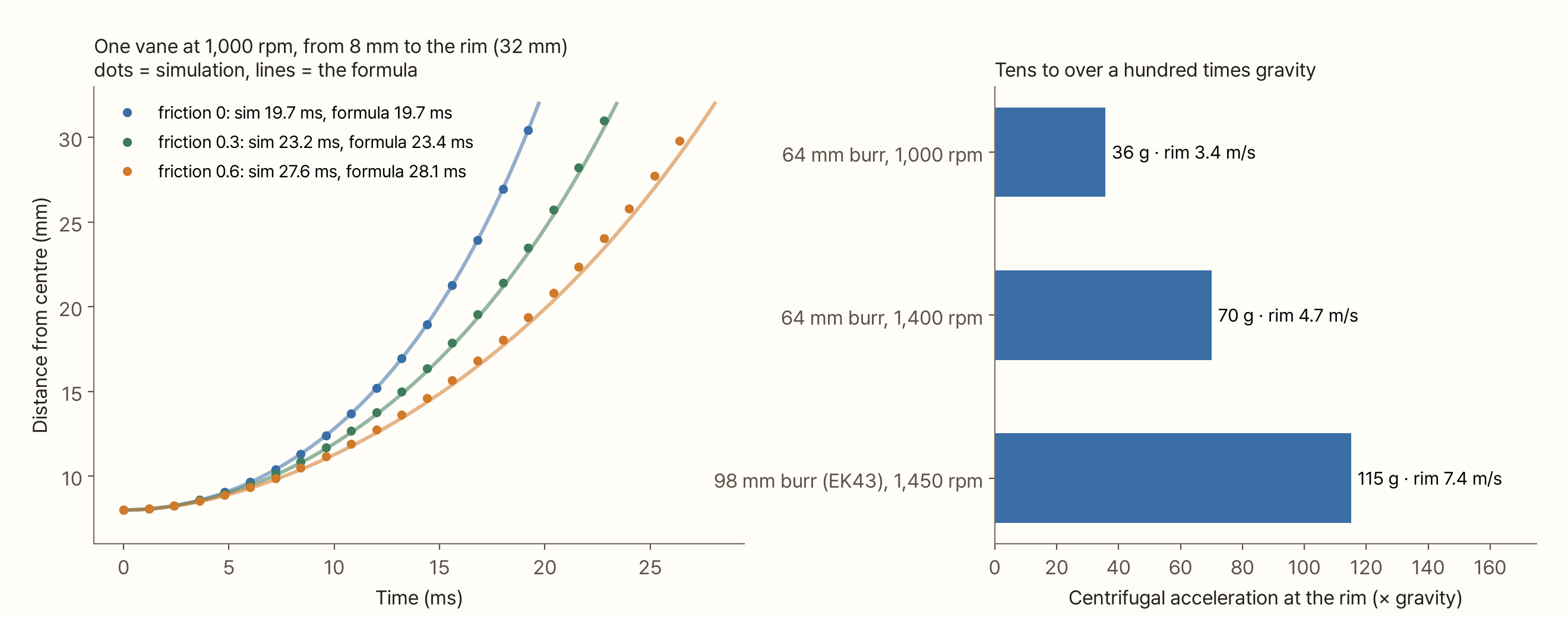
At 1,000 rpm a particle placed at 8 mm reaches the rim in 19.7 ms without friction, and in 28 ms even with a friction coefficient of 0.6. The simulation matched the formula within 2%. The mismatch grows with friction because the centre of the disc sits one radius away from the vane.
Here is the first number. Without breaking, a particle leaves the burrs in a few tens of milliseconds. In a simulation with crossing teeth like a real burr, with the gap opened as wide as the inlet and 1 mm pieces that never get stuck anywhere, the trip took 25 ms on average at 1,000 rpm, the same order as the single-vane formula.
Where do beans break?
Can centrifugal force break a bean? At 1,000 rpm and a radius of 18 mm, one bean (about 80 mg in this model) feels 0.016 N of centrifugal force. Moved to the rim of an EK43, it is 0.09 N. Breaking a bean takes 30–60 N (Nedomová and colleagues, 2013). Centrifugal force is a few thousandths of the breaking force.
Then what breaks it? Pushed by the rotating teeth, a bean slides outward until it touches both burrs where the gap is as high as the bean. For a bean 3.9 mm high, that is at a radius of about 18.4 mm. From a little inside that point, the stationary burr's teeth catch it too. When a rotating tooth pushes from behind and a stationary tooth blocks in front, the bean is caught between the two teeth. The teeth are driven by the motor, so the force keeps rising as long as the bean resists, until it breaks.
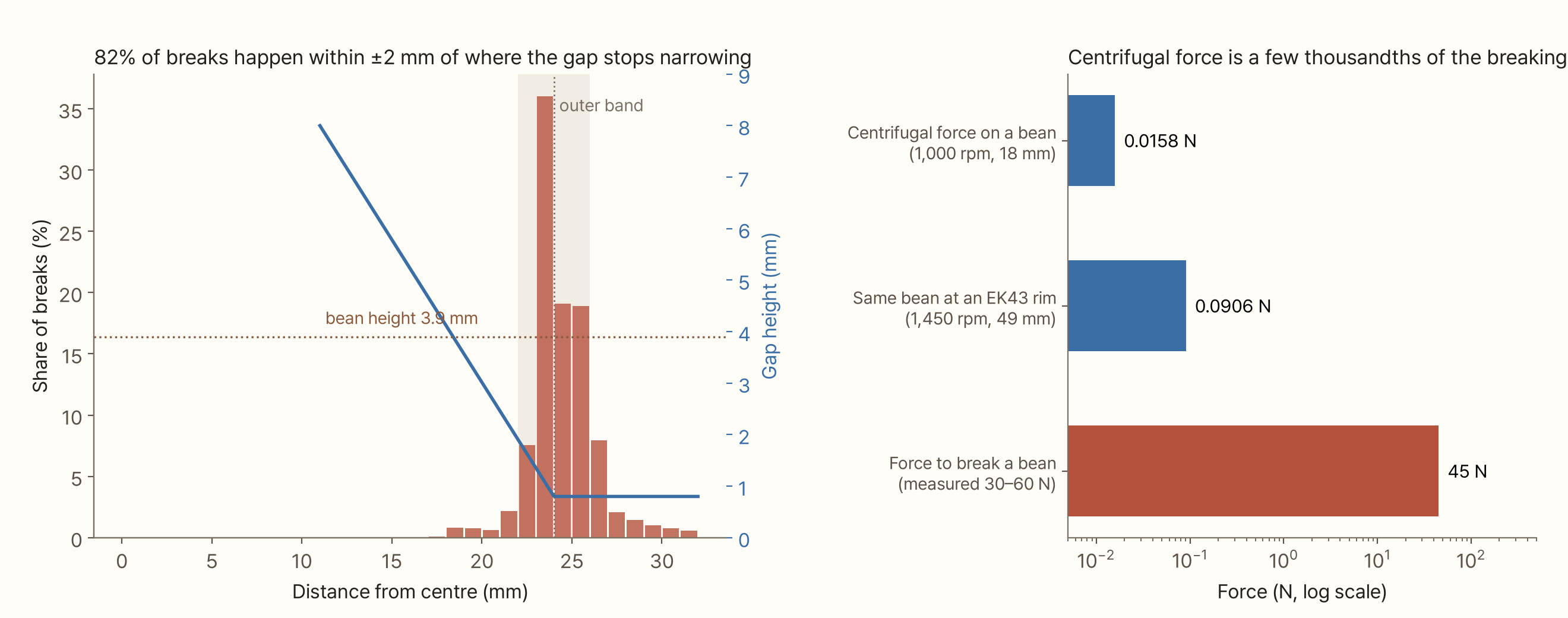
Counted by radius, the breaks pile up where the gap finishes narrowing. Across three runs of 24 beans, 82% of breaks happened within 2 mm on either side of that point (22–26 mm). Only 5% happened around 18 mm, where beans first get stuck. There a bean splits a few times into coarse pieces, and most breaks come after, when those pieces are pushed to the tip of the wedge and crushed fine. By the time one bean had left, the bean and its fragments had broken more than 260 times.
This result comes from the shape of the burr I made. Real burrs vary tooth size and layout from zone to zone, and some add large teeth in the middle (pre-breakers) that crack beans in advance. In such a burr the breaks would spread further inward.
Paths
Plotting two beans and their fragments every 0.25 ms gives this.
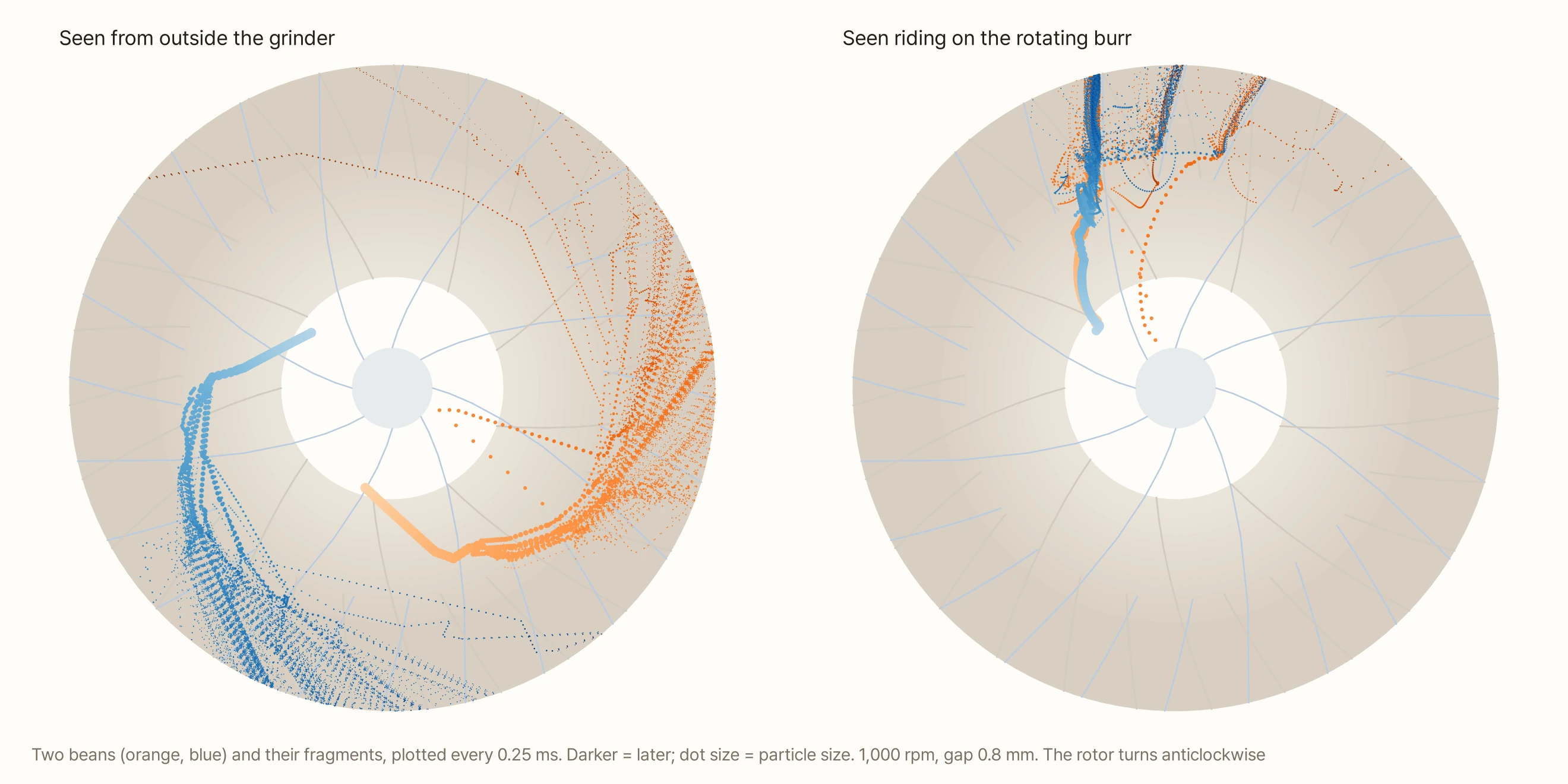
From outside the grinder, a bean curves outward in the same direction as the burr. Riding on the burr, it goes almost straight out, because the bean leans on one rotating tooth and slides along it. It is the same motion as the particle on the single vane above. Once in the outer band, it catches on the stationary teeth and is pressed by the faces, falls back a little, and its pieces scatter.
A piece that becomes smaller than gap ÷ flatness (0.8 ÷ 0.6 = 1.33 mm) no longer gets stuck and leaves. It leaves at 4.0 m/s on average, faster than the rim speed (3.4 m/s), because the outward speed it picked up sliding along the tooth adds to the burr's speed in the tangential direction.
Half a turn
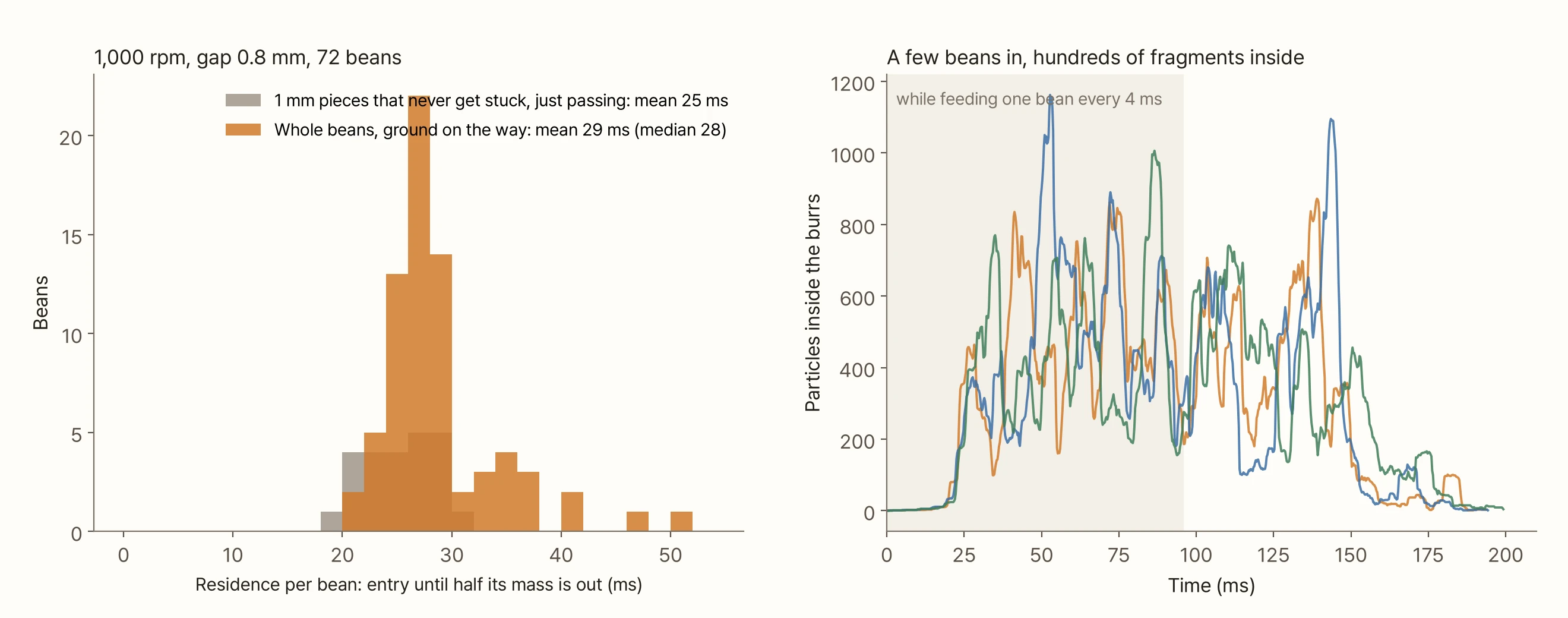
The 72 beans stayed 29 ms on average, with a median of 28 ms. That is almost exactly the time the burr takes to turn half a revolution at 1,000 rpm (30 ms), and only 14% longer than the 25 ms a piece takes when it never gets stuck.
At first I expected beans to sit stuck inside the burrs for a long time, waiting to break. The calculation said otherwise: beans break while they slide outward along the teeth. At 1,000 rpm, the rotating teeth pass any one spot on the stationary burr 400 times a second (24 teeth in the outer band × 16.7 turns a second). A stuck bean never waits more than 2.5 ms for the next tooth. Breaking costs little time, so the residence time is set almost entirely by the time it takes to slide out.
Even with only a few beans inside, the burrs fill with hundreds of particles. Feeding one bean every 4 ms, as on the right, raised the count to around 1,000. Knowing the residence time also lets you estimate how much coffee sits inside the burrs (Little's law: amount inside = rate in × time spent). If an EK43 grinds 20 g per second and a bean weighs 0.13 g, about 150 beans go in each second. If the residence time is half a turn, as in this model (21 ms at 1,450 rpm), three or four beans, about 0.5 g, are inside at any moment. That is not out of line with Uman and colleagues' "20 g in a second or less". But this model is 2D and the burr dimensions differ, so only the order of magnitude counts.
Turning the dial and the speed
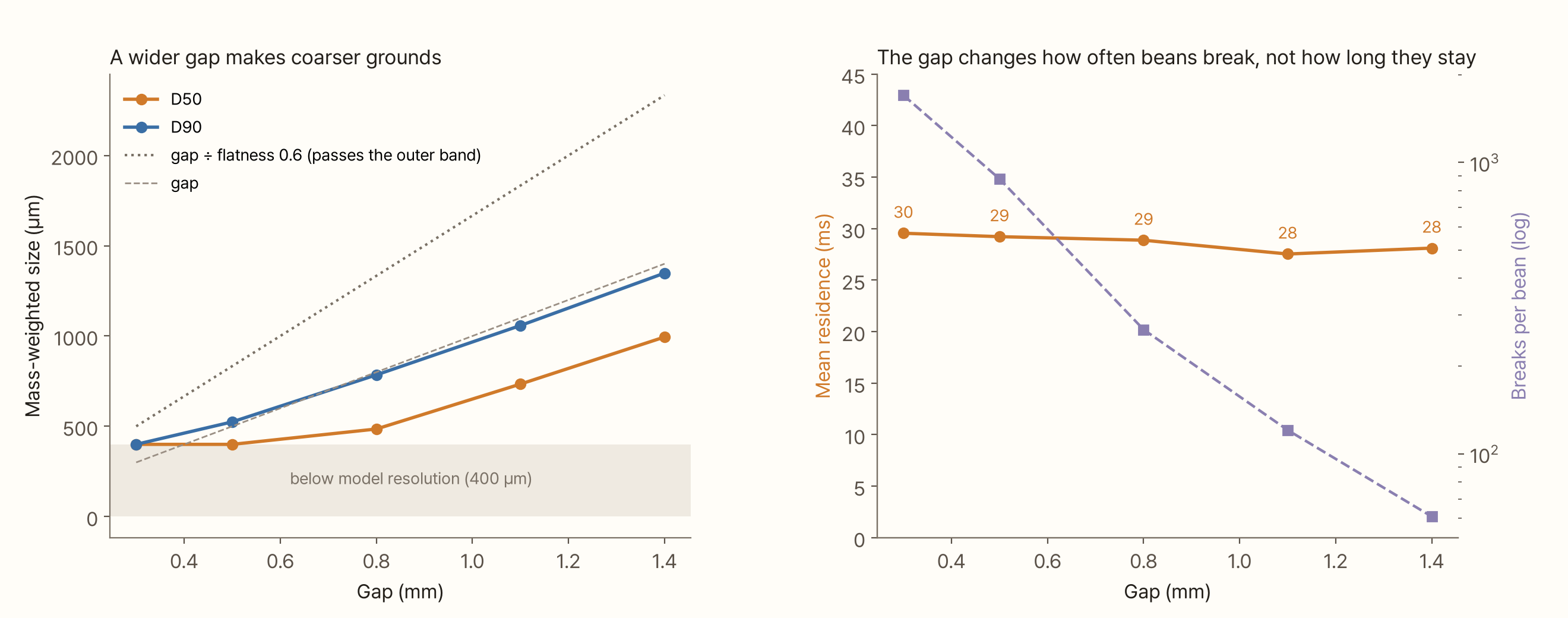
A wider gap makes coarser grounds. That is no surprise, but two things stand out. First, D90 was almost equal to the gap (D90 0.78 mm at a 0.8 mm gap, 1.35 mm at 1.4 mm), well below the size that can slip through the outer band (gap ÷ flatness). A stuck piece splits into 2–4 pieces with plenty of room to spare when it breaks, so pieces rarely come out at exactly the size that just fits. Second, changing the gap left the residence time at 28–30 ms. What changed was how often things broke: a bean and its fragments broke 61 times at a 1.4 mm gap, 270 times at 0.8 mm and 1,700 times at 0.3 mm. In the same time, more breaking.
At 0.3 mm and 0.5 mm, D50 fell below this calculation's resolution (400 µm). To see the distribution at espresso fineness, particles would have to be resolved finer, which, as "How to Simulate Breakage" showed, slows the calculation accordingly.
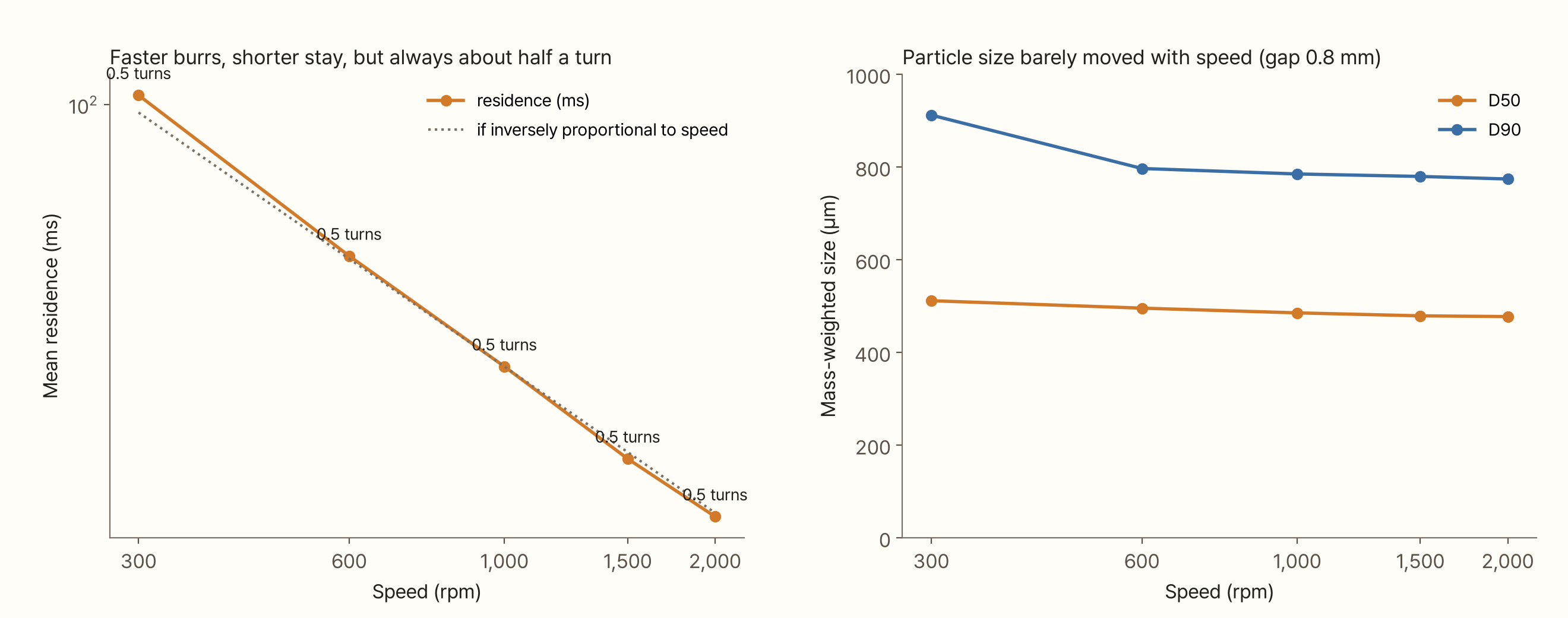
Changing the speed made the residence time exactly inversely proportional to it: 105 ms at 300 rpm, 49 ms at 600 rpm, 14 ms at 2,000 rpm. In turns, all of them come to 0.47–0.52. Whatever the speed, a bean passes through while the burr turns half a revolution. In the single-vane formula, too, time shrinks only as 1/ω. Centrifugal force and the push of the teeth both grow with the square of the speed, so measured in turns it is the same motion.
Particle size barely moved with speed. D50 was 510 µm at 300 rpm and 480 µm at 2,000 rpm; only D90 got coarser at 300 rpm, at 910 µm. In this model breaking is decided only by whether force crosses a threshold, and a bean caught between teeth is pressed up to that threshold at any speed. So the fact that speed does not change size is close to an answer already built into the model. Industry claims that speed raises or lowers fines point in opposite directions and have no peer-reviewed backing. This model cannot settle that argument, because it lacks breaking rules that depend on impact speed, heat, and accumulated damage.
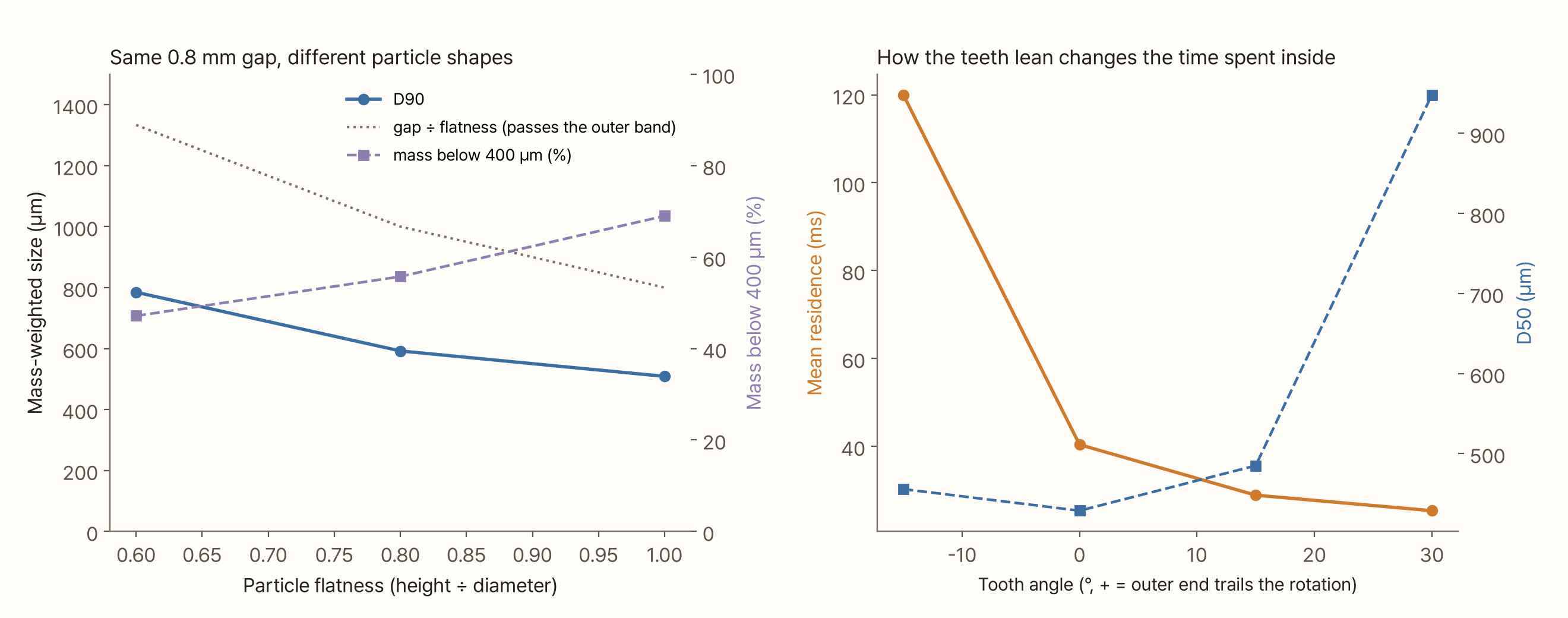
Even at the same 0.8 mm gap, the grounds depend on particle shape. Changing flatness from 0.6 to 1.0 (ball-like particles) shrank D90 from 790 to 510 µm. A ball-like particle is as tall as it is wide, so anything larger than the gap gets stuck and broken. Conversely, a camera measures projected area, so the flatter the particle, the larger it looks compared with the gap. It is the same story as why sieves, lasers and cameras give different answers. I found no direct measurement of flatness; the 0.6 in this piece is an assumption. I also ran flatness 0.4, but the beans settled at a radius where they neither got stuck nor got through, so I left it out. That comes from my rule that cuts the height at which teeth catch a particle sharply at 60% of the gap.
The tilt of the teeth changed the time spent inside a great deal. The more the outer end trails the rotation (+), the faster beans are pushed out. A residence of 29 ms at +15° grew to 40 ms with radial teeth (0°) and 120 ms with teeth tilted the other way (−15°). Laid back to +30°, the teeth sped it up to 25 ms, but beans left less broken and D50 doubled to 950 µm. Even at the same gap, tooth shape changes the grind. That points the same way as Gagné's (2023) guess that burr geometry may matter more than burr size. Of course, this is a story about a virtual burr.
Grind it yourself
The simulation below runs the virtual burr above in your browser. You can change the speed, gap, particle flatness, tooth angle, number of beans and smallest fragment size; let go of a slider and it starts again from the beginning. The red particle is the first bean, and its path stays behind as dots. Press "Riding the rotor" to switch to a frame in which the rotating teeth stand still, and you can see beans going out along the teeth. At the bottom right, the mass distribution of what came out and the places where breaks happened build up.
The calculation runs much slower than reality. The time step is around 1 µs, so one second on screen is a few tens of milliseconds in the simulation.
Narrow the gap to 0.3 mm and you can watch far more breaking in the same time; lower the speed and the same thing happens, only slower; turn the tooth angle negative and the beans circle for a long time.
What this conclusion leaves out
- It is a 2D section. I rolled discs on a horizontal plane between the burrs and kept height only as a number. The rules for passing over each other and passing over teeth (60% of the gap) are mine, made to fill the gaps of a flat picture
- The burr shape is virtual. I found no data measuring the number, shape and height of teeth on a real burr, or how steeply the gap narrows. The teeth are log spirals approximated by polylines, and there is no edge radius (how dull the edges get with seasoning)
- Breaking is force-based, with no accumulated damage. Same limitation as in "How to Simulate Breakage". Fragments were split 2–4 ways at random, and each break sent 8% to sub-resolution fines. Anything under 400 µm is outside the calculation
- There is no air. A real grinder has wind from the burrs, and fines can ride out on it
- There is no static, heat or bean moisture
- I could not check residence time against measurements. There are none to compare with. I only confirmed that it is not out of line with Uman and colleagues' "20 g in a second or less"
- The height at which teeth catch a particle is cut sharply at 60% of the gap. Because of this threshold, beans got trapped at one radius at flatness 0.4, and I left that run out. Knowing real tooth heights and groove depths would fix it
- Bean size and mass are simplified. Each bean is a disc of about 6.5 mm with height 0.6 times that. Real beans are elongated and flat on one side
Summary
- Particles in a flat burr slide outward along the teeth, like granules on a spinning disc. The simulation matched the analytical solution for a single vane within 2%
- Centrifugal force cannot break a bean: the force on one bean is a few thousandths of the breaking force (30–60 N). A bean starts getting stuck where the gap closes to its height and breaks between two crossing teeth. 82% of breaks happened within 2 mm of where the gap finishes narrowing
- At 1,000 rpm a bean stayed 29 ms on average, only 14% longer than a piece that never gets stuck (25 ms). From 300 to 2,000 rpm the residence time was inversely proportional to speed, always 0.47–0.52 turns
- The gap changed how often beans broke and left the time spent inside alone. From 0.3 to 1.4 mm, residence stayed at 28–30 ms while breaks fell from 1,700 to 61. D90 was almost equal to the gap
- Speed barely changed particle size (D50 480–510 µm); tooth angle changed both residence (25–120 ms) and coarseness (D50 430–950 µm)
- There is still no study that measured how beans move inside burrs, and no peer-reviewed paper that computed it. The numbers above are model estimates from a virtual burr
References
- Uman E, Colonna-Dashwood M, Colonna-Dashwood L, Perger M, Klatt C, Leighton S, Miller B, Butler KT, Melot BC, Speirs RW, Hendon CH (2016). The effect of bean origin and temperature on grinding roasted coffee. Scientific Reports 6, 24483. doi:10.1038/srep24483 — EK43 at 1,480 rpm, rated 1,200–1,500 g/min, 20 g exposed for a second or less
- Villette S, Cointault F, Piron E, Chopinet B (2005). Centrifugal spreading: an analytical model for the motion of fertiliser particles on a spinning disc. Biosystems Engineering 92(2), 157–164. doi:10.1016/j.biosystemseng.2005.06.013 — abstract only
- Cerović V, Petrović D, Radojević R, Barać S, Vuković A (2018). On the fertilizer particle motion along the vane of a centrifugal spreader disc assuming pure sliding of the particle. Journal of Agricultural Sciences (Belgrade) 63(1), 83–97. doi:10.2298/JAS1801083C — abstract only
- Nedomová Š, Trnka J, Stoklasová P, Buchar J (2013). Strength of coffee beans under static and dynamic loading. Acta Universitatis Agriculturae et Silviculturae Mendelianae Brunensis 61(3), 743–749. doi:10.11118/actaun201361030743
- Cundall PA, Strack ODL (1979). A discrete numerical model for granular assemblies. Géotechnique 29(1), 47–65. doi:10.1680/geot.1979.29.1.47
- Gagné J (2023). What I learned from analyzing 300 particle size distributions for 24 espresso grinders. Coffee ad Astra. link
- Mahlkönig EK43 retailer specifications (Pro Coffee Gear and others) — 98 mm burrs, 1,450 rpm (50 Hz) / 1,760 rpm (60 Hz), 19–21 g/s. I could not find the manufacturer's original sheet
Image credits
- Millstone at the Walderveen windmill: Rasbak, Wikimedia Commons, CC BY-SA 3.0
- Dressing millstones engraving: Meyers Konversations-Lexikon (c. 1885), Wikimedia Commons, public domain
- Spinning-disc spreader: Michael Trolove, Wikimedia Commons (geograph.org.uk), CC BY-SA 2.0
- All other figures, the cover and the simulation: made by the author


