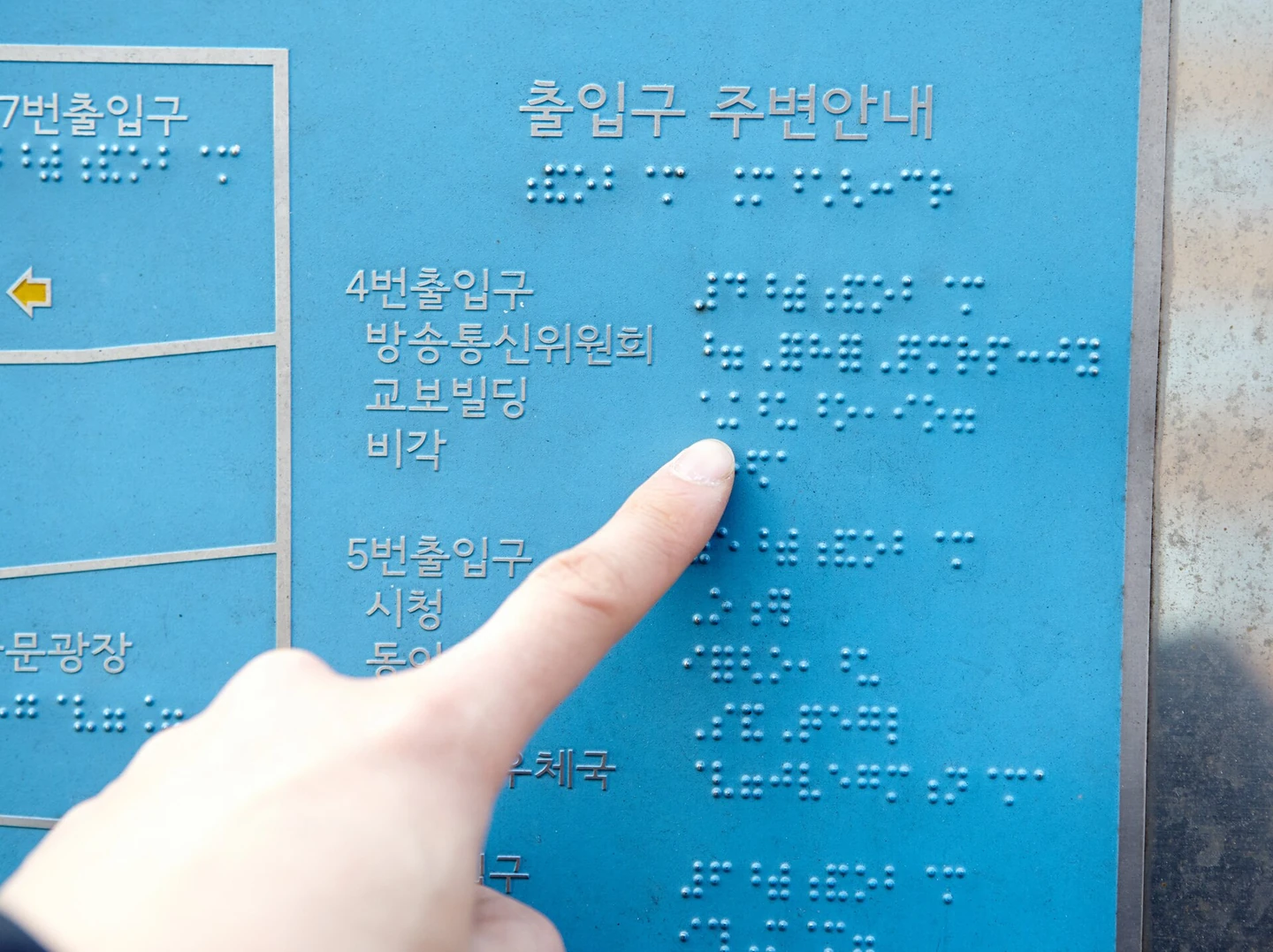
Thinking About the Story of Someone Who Can't Say What They Need to Say
The sentence written in my notebook read: 'There is a person who cannot say what they need to say. Think about their story.' This piece follows the technology that has spoken on people's behalf — from braille and Stephen Hawking's robotic voice to voices rebuilt from family members' speech, devices that turn brain signals directly into sentences, and the difficulties of sign-language translation. I also built a small tool of my own that transcribes speech into braille and lets you tap pictures to speak instead. Finally, it looks at companion animals that can't say they're in pain even when they are, and tomatoes that emit ultrasound when they're thirsty. The eleventh piece in the 'One Page Today' series.
When I opened my idea notebook today, this sentence was written in it.
There is a person who cannot say what they need to say. Think about their story.
I read it and sat with it for a long while. It was probably originally about someone who, in a meeting, never managed to speak up, someone who swallowed the words they wanted to say. But today I read it literally. There are people who want to speak but no sound comes out. Some were born that way, and some became that way one day through illness or accident. How frustrating that must be. Even when their stomach hurts, even when they want water, even when they want to say "I love you," the path to convey it is blocked.
Today I want to follow the technology that has stood beside those people and spoken in their place. I'll start with braille and move through synthesized voices and reconstructed voices, all the way to devices that turn brain signals directly into sentences. And I built one very small tool using AI — a board that transcribes speech into braille, and that speaks for you when you press a picture. Finally, I'll talk about how it isn't only humans who can't speak: companion animals who can't say they're in pain even when they are, and tomatoes that are said to make a sound when they're thirsty.
There isn't just one reason someone can't speak
Speech can be blocked at many different points. Some people never learned to speak because they couldn't hear. Some had their vocal cords removed due to laryngeal cancer. Some have ALS or cerebral palsy, where the muscles that move the mouth and tongue won't obey; others have aphasia, where a stroke has damaged the brain region that produces speech. And there's one more case: the speaker is talking just fine, but the listener doesn't know that language. That's the situation for Deaf people who use sign language.
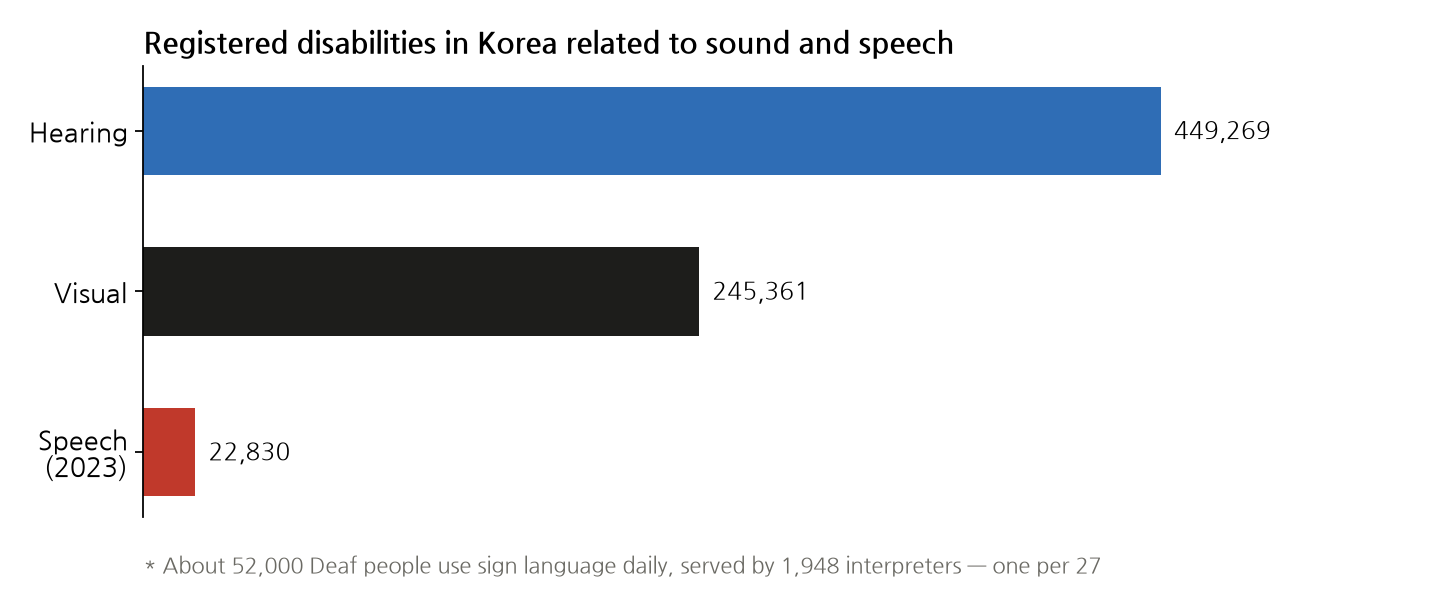
Here are the numbers. According to the Ministry of Health and Welfare, there were 2,627,761 registered people with disabilities at the end of 2025, of whom 449,269 — 17.1% — had hearing impairments (news report). Among newly registered cases, hearing impairment is the most common at 30.6%, largely because many people lose their hearing as they age. As of 2023, 22,830 people were registered with speech impairments. The World Health Organization estimates that 430 million people worldwide have hearing loss severe enough to affect daily life.
About 52,000 Deaf people are estimated to use sign language daily, while there are 1,948 sign language interpreters (a study based on a survey of Korean Sign Language use). That works out to one interpreter for every twenty-seven Deaf people. An interpreter can't always be on hand at a hospital, a government office, or a bank counter.
200 years of machines speaking in people's place
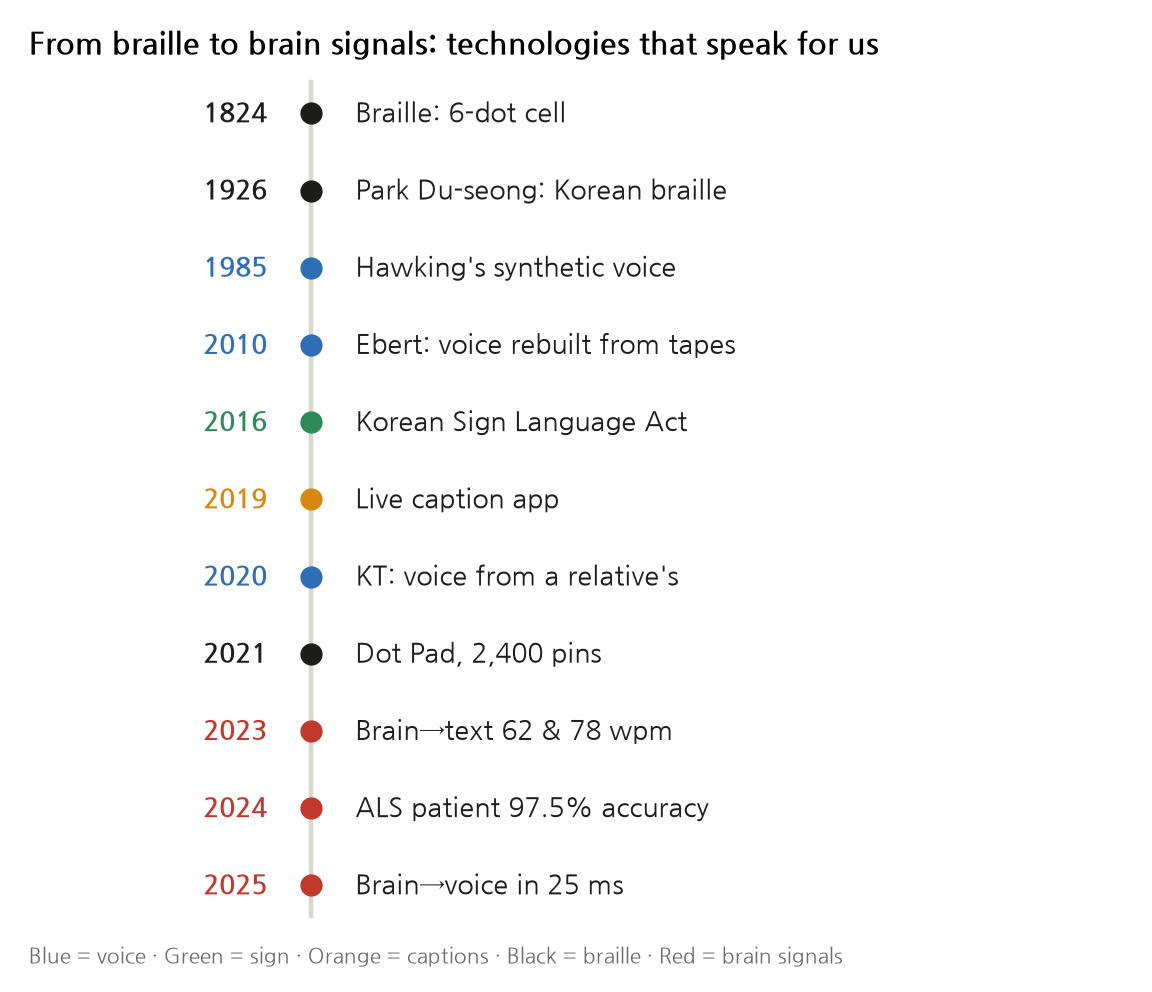
It began at the fingertips. France's Louis Braille lost his sight in an accident at age three, and in 1824, at fifteen, he devised a system for representing letters with six dots. Korean braille came about a century later: the Hunmaengjeongeum, proclaimed by Park Du-seong (pen name Song-am) on November 4, 1926. This November 4 marks exactly its 100th anniversary, and a commemorative exhibition is currently running (Segye Ilbo).
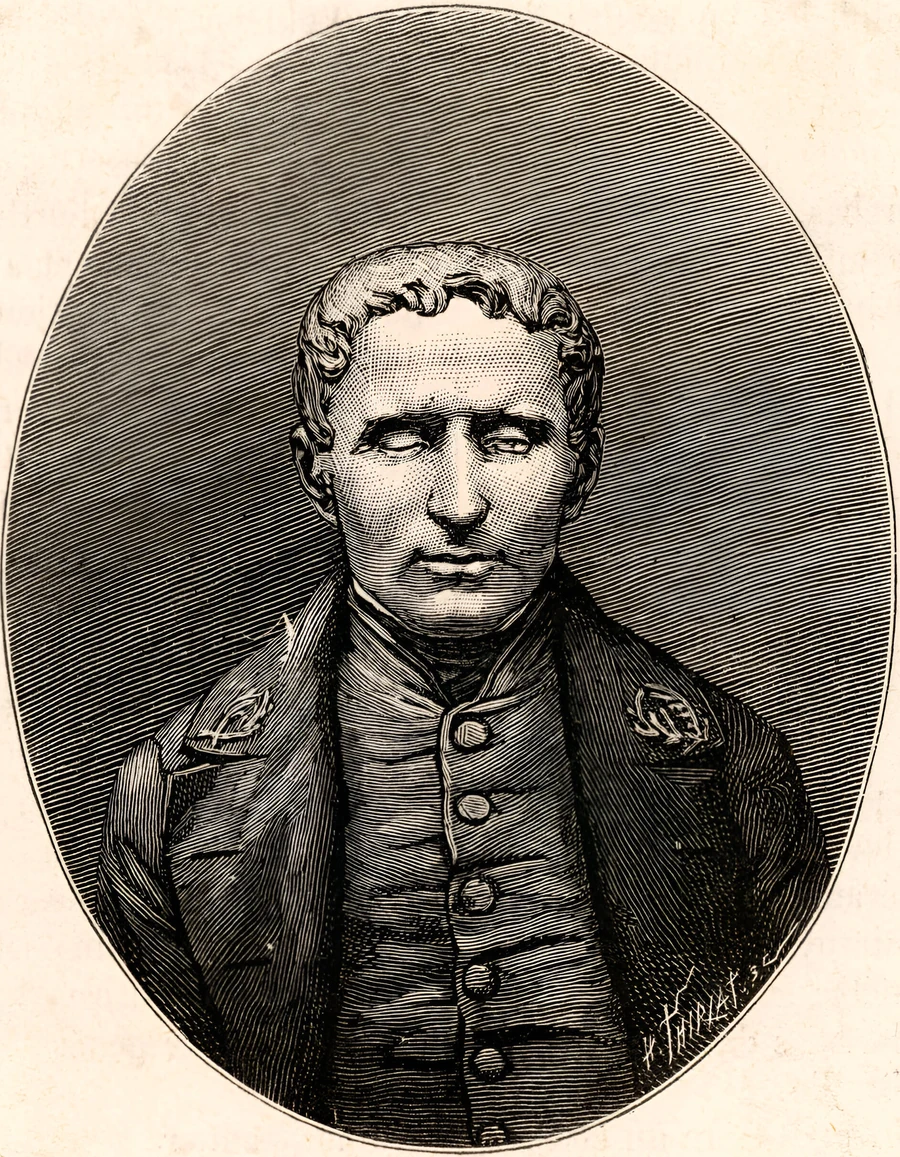
*Image: Henri Thiriat, "Engraving of Louis Braille" (1887), public domain, Wikimedia Commons.jpg)*
The most famous machine to speak on someone's behalf belongs to Stephen Hawking. After losing his voice following a tracheostomy in 1985, he spoke through synthesized speech read aloud by a computer. That voice was named "Perfect Paul," created by MIT phonetician Dennis Klatt based on his own voice. Hawking used the device that produced that voice, the DECtalk 5010, until his death in 2018 (Computer History Museum). From 1997 on, Intel helped build his input device as well. That software was later made public so that anyone could use it.
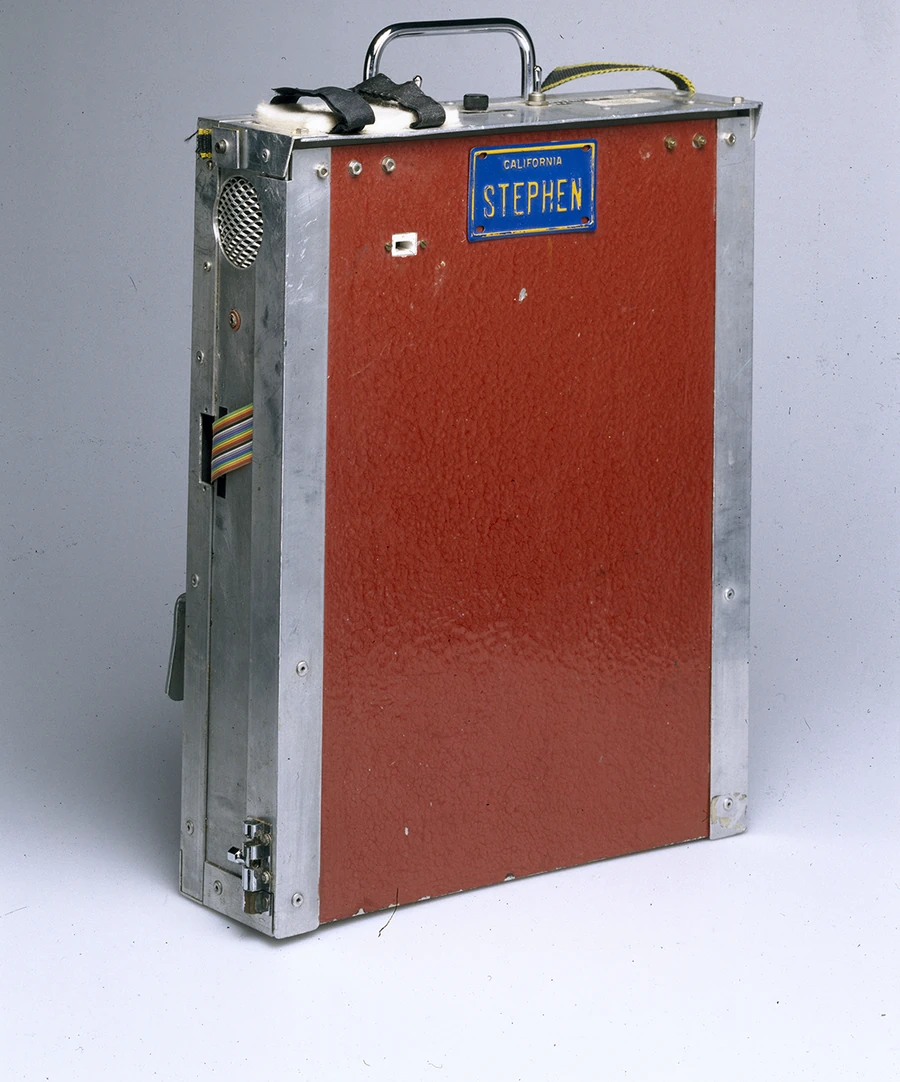
*Image: Science Museum London / Science and Society Picture Library, "Computer and speech synthesiser housing, 1999," CC BY-SA 2.0, Wikimedia Commons.jpg)*
Film critic Roger Ebert lost his voice to thyroid cancer surgery. The Scottish speech-synthesis company CereProc gathered Ebert's own DVD commentary recordings and reconstructed his voice, debuting it on The Oprah Winfrey Show in March 2010 (ABC News). From that point on, it became possible to recover one's own voice rather than relying on someone else's synthesized tone. Still, he had the good fortune of having hours of recordings already on hand.
AI that gives voices back
The first thing AI changed was the threshold for that kind of luck. In 2023, Apple added a "Personal Voice" feature to the iPhone. If you read and record fifteen minutes of randomized sentences, the device learns your voice on-device, and it will read typed text aloud in that voice (9to5Mac). It was built so that someone diagnosed with ALS could save their voice in advance, while it still remained.
What about people with no recordings left at all? KT launched its "Finding My Voice" project in 2020. It selected twenty people who had lost their voices, whether congenitally or later in life, none of whom had any recordings of their own speech. So a family member of the same gender read 1,000 sentences in their place, about six hours in total. From that audio, the person's own voice was estimated and recreated (Ajou Economy). In 2022, together with the Seungil Hope Foundation, KT restored the voices of eight ALS patients (Segye Ilbo) — a daughter's voice resembling her mother's, a younger brother's voice resembling his older brother's. The fact that family members resemble one another became raw material for the technology.
Straight from the brain to speech
When muscles don't move at all, even typing becomes difficult. That's why research attaching electrodes to the brain to read the signal of an intended utterance directly has advanced enormously in the past few years.
| Study | Subject | Result |
|---|---|---|
| Stanford, 2023 (Nature) | ALS patient | 62 words per minute turned into sentences |
| UCSF, 2023 (Nature) | A 47-year-old woman who lost speech after a brainstem stroke | 253 electrodes, 78 words per minute, delivered through a voice and facial avatar modeled on her wedding video |
| UC Davis, 2024 (NEJM) | ALS patient Casey Harrell | 97.5% accuracy across a 125,000-word vocabulary, used in daily life for more than 248 hours |
| UC Davis, 2025 (Nature) | Same study participant | Brain signals converted directly to voice without passing through text, with a delay of about 0.025 seconds. He could vary his intonation and even sing short songs |
Here AI does double duty. A neural network reads sound fragments out of the electrode signals, and a language model corrects those fragments into coherent sentences — much like how a person, in conversation, uses context to make sense of a mumbled word. Still, this currently requires open-brain surgery, and each study involves only one or two participants. It will take more time before this becomes a treatment available to anyone at a hospital.
Speech that requires the listener to change
There are also many cases where someone isn't unable to speak at all — it's that their speech sounds different enough that machines fail to understand it. Voice assistants have historically understood almost nothing said by people with cerebral palsy or Parkinson's disease, because the voices these systems were trained on were overwhelmingly "typical" in pronunciation.
Google's Project Euphonia gathered such voices, collecting more than 950,000 utterances from over 1,000 people, and in 2021 released an app built from that data called Project Relate (Google). The Speech Accessibility Project, led by the University of Illinois, received joint funding from Apple, Google, Meta, Microsoft, and Amazon. By September 2025, about 2,000 people had participated, and once that data was incorporated, Microsoft's speech recognition understood this kind of speech 18–60% better (University of Illinois). Rather than fixing the speaker, they fixed the listening machine.
Transcription follows the same logic. In 2019, Google partnered with Gallaudet University in the U.S. to release Live Transcribe, which converts speech into real-time captions (Google). In Korea, Sovoro, which began as real-time captioning for Deaf and hard-of-hearing people, was in use at more than 600 institutions by 2022 (Google Korea). Today it's also used for meeting minutes and lecture summaries — a common path by which technology built for accessibility becomes technology for everyone.
Sign language is not Korean spoken through the hands
Sign-language translation is the hardest and most contested field among all of these. The Korean Sign Language Act, enacted in 2016, defines Korean Sign Language as "the Deaf community's own language, holding status equal to the national language" (Ministry of Culture, Sports and Tourism). That means sign language isn't Korean words translated into hand shapes — it's a separate language with its own grammar. Grammar is carried not just by hand shape but by facial expression, head movement, and the space in front of the body. Negation, for instance, is expressed by shaking the head or frowning. As a result, for some Deaf people, even Korean subtitles read like a foreign language (The Better Future).
In 2016, a sign-language translation glove made by students at the University of Washington won awards but drew sharp criticism from the Deaf community (KQED). The glove couldn't read facial expressions or head movements. The burden fell on only one side of the bridge: the Deaf person had to wear the glove and adapt to it, while the hearing person did nothing. Above all, Deaf people were never consulted while it was being built.
In Korea, the social enterprise EQ4ALL, founded in 2017, presents public-institution web information and disaster alert texts through AI sign-language avatars (ITWorld). The Korea Communications Media Promotion Foundation also piloted AI avatar sign language in its "Earzoom" app in 2025 (NewDaily). Researchers point out, however, that avatar sign language is still confined to formulaic sentences like weather forecasts (presentation at the Korea Information Processing Society). Rather than replacing human interpreters, its current use is to fill gaps where no interpreter is available — a disaster alert at dawn, for instance.
Screens read with the fingertips
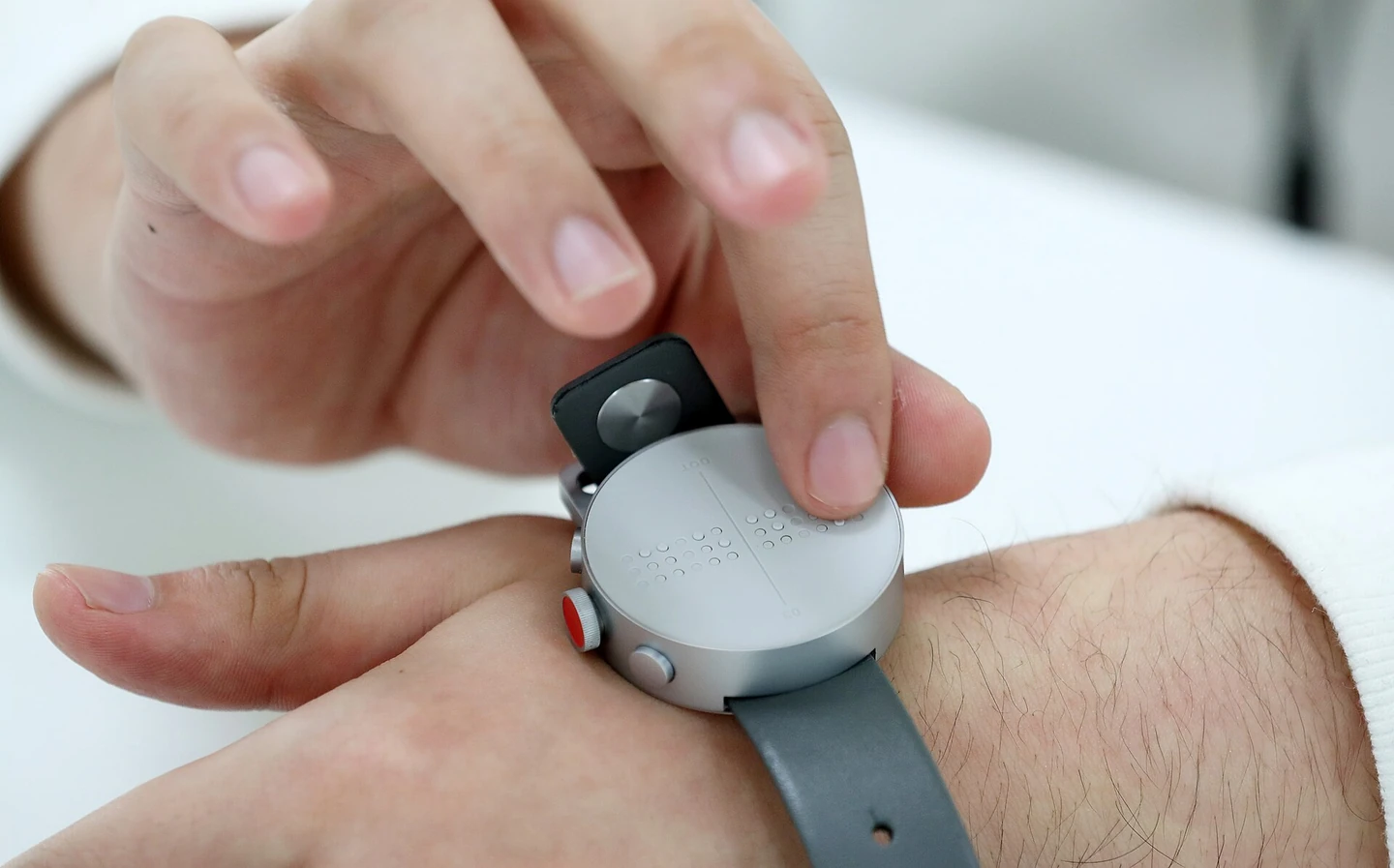
*Image: Korea.net / Korean Culture and Information Service, "Dot Smart Braille Watch" (2017), CC BY-SA 2.0, Wikimedia Commons.jpg)*
Braille, too, has gone digital: braille terminals where pins rise and fall to continually change the displayed characters. The Seoul-based startup Dot, after making a braille watch, spent about two years co-developing the Dot Pad with Apple — a device with 2,400 pins that renders not just text but images and graphs under the fingertips. Since December 2021, it has worked with the screen-reading features on iPhone and iPad (The Economist (Korea)).
The problems are cost and training. A braille display device easily costs more than 5 million won. When Gyeonggi Province opened applications for distribution in 2025, 3,600 people applied and only 761 received one (Gyeonggi Ilbo). On top of that, more than 90% of people with visual impairments reportedly cannot read braille — many lose their sight later in life, and there are few places that teach braille.
Something I built: a board that carries speech forward
After reading this far, I wanted to build something myself, however small. I asked an AI to put together three things. First, a screen that, when text comes in, converts it into Korean braille and displays it the way a braille terminal does, with pins rising and falling. Second, a speech board where pressing picture buttons builds a sentence and reads it aloud — this kind of board is called augmentative and alternative communication (AAC). Third, a screen that transcribes speech and streams it onto that braille display, while also recognizing hand gestures through a camera. The cat pain scale was added because of the section on animals discussed later.
For security reasons, the microphone and camera are disabled inside this inline frame. Click listen and watch in a new window to open it as its own separate screen. Speech is transcribed using the speech recognition built into the browser (Chrome, Edge, Safari); in that process, the audio is sent to the browser company's servers. Camera footage never leaves the device. Hand gestures are recognized with Google MediaPipe's gesture-recognition model, which covers only seven shapes: thumbs up, thumbs down, open palm, fist, pointing finger, a V sign, and an "I love you" hand shape. I mapped these to "Good," "No," "Wait," "It hurts," "Excuse me," "Thank you," and "I love you," so that holding one for a second makes it speak the phrase aloud.
This is not sign-language translation. As noted earlier, sign language is a language that uses the face and space, and these seven gestures don't come anywhere close. It's really more of a signal board for someone whose hands make typing difficult, to use in a pinch.
The braille converter took the most time. Korean braille has more rules than you'd expect. The initial consonant ㅇ isn't written; a final consonant and an initial consonant use different dot patterns even for the same letter. For "ga, na, da, ma" (가·나·다·마) only the consonant is written, dropping the vowel ㅏ. Syllables like "eok, eon, eol, yeon, yeol, yeong, ok, on, ong, un, ul, eun, eul, in" each have their own single-cell contraction, and so does "geot" (것). Connectives like "geuraeseo" (so) and "geureonde" (but) are shortened into two-cell contractions.
To check whether the AI's first draft was correct, I compared it against the Korean table (ko-g2) from the open-source braille translation engine liblouis — setting a reference answer and checking against it.
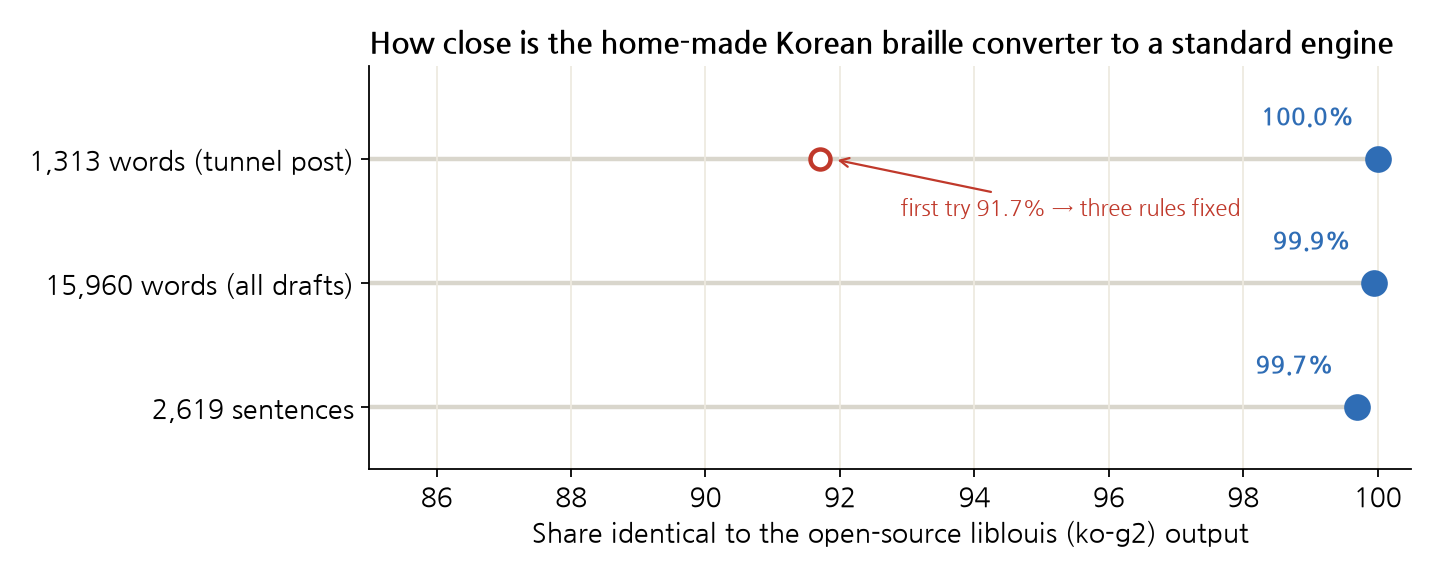
Where it went wrong
- The first draft scored 91.7%. Looking at the 109 words that came out wrong, I found I had three rules mistaken. First, words like "nam," "dat," "mal" use the "na, da, ma" contractions even when they have a final consonant — I had set it to spell these out in full whenever there was a final consonant. Second, "seong," "jeong," "cheong" are written with the "consonant + yeong" contraction, but I had mistakenly set the vowel as "yeo" instead of "eo." Third, characters with a compound final consonant, like "kkeunh" or "neolp," still attach the remaining final consonant to the "eun/eol" contraction.
- I didn't know about the spacing rule after numbers. As in "100 meters," when a character starting with ㄴ, ㄷ, ㅁ, ㅋ, ㅌ, ㅍ, or ㅎ follows a number, a space is inserted. That's because the dot pattern for numbers overlaps with the initial-consonant dot pattern for these seven consonants; without the space, it would read as though the number continued. I also fixed a case where the comma in "1,210" had been entered as an English braille comma.
- The remaining 0.3% I left undetermined. Of 2,619 sentences, 8 still differ. These involve things like whether a hyphen goes before "ye" following a vowel in "ilgi-yebo" (weather forecast), or how to write the ㅆ final consonant in "kkeotda." Based on the rules I read, my version looks correct, and in "robot-cheongsogi" (robot vacuum cleaner) liblouis seems to have dropped the ㅊ — but I wasn't able to check this line by line against the original text of the National Institute of Korean Language's "Korean Braille Regulations." A professional braille transcriber might reach a different judgment.
- English is rendered only in uncontracted Grade 1 braille. The English-version screen transliterates letter by letter. Actual English braille books mostly use Grade 2, which relies heavily on contractions.
- The voice reading things aloud depends on the device. The speech board uses the speech synthesis built into the browser. On a computer without Korean voice packs installed, it will read awkwardly or not at all.
Other beings that cannot speak
Rereading the sentence from my notebook, it occurred to me that humans aren't the only beings who can't speak. Anyone with a companion animal at home has probably experienced this. You watch a cat that won't eat and sits curled up in a corner, with no way to ask what's wrong. In Korea, as of the end of 2024, 5.91 million households — 26.7% of all households — live with a companion animal (KB Financial Group Research Institute, via Daily Vet).
When I looked into it, the most trustworthy "animal translator" available today turned out, surprisingly, not to be AI but a checklist made by humans. Researchers at the University of Montreal in Canada published the Feline Grimace Scale in 2019, which reads pain from a cat's face (Scientific Reports). It scores five features from 0 to 2: whether the ears are rotated flat to the sides, whether the eyes are narrowed into a squint, whether the muzzle is rounded or tensed into an oval, whether the whiskers are pulled straight forward, and whether the head droops below the shoulder line. Agreement between different observers' scores (ICC) was 0.89, and the researchers even set a threshold — above 0.39 of the maximum score, pain relief is considered necessary. This is the scale included in the "board that carries speech forward" above.
AI is now trying to read this checklist automatically from photographs. A model trained on photos of 29 cats' faces correctly identified the presence of pain more than 72% of the time (Scientific Reports, 2022), and for video of 7 horses, accuracy was 88.3% (PLOS ONE, 2021). In Korea, AI for Pet's "Tteutie Care" was trained on more than 100,000 photos of dogs' eyes to flag eye disease, with the company claiming 90% accuracy (Daily Vet) — though exactly what photos and what method produced that 90% figure hasn't been disclosed. The accuracy claims made by apps that purport to translate cat meows are, likewise, mostly numbers the companies measured themselves.
There are also talking buttons. Recorded buttons for words like "outside," "play," and "food" are placed on the floor for a dog to press with a paw. Researchers at the University of California San Diego ran a blinded experiment — keeping the experimenter unaware of what was played — and played button sounds to 59 dogs. The dogs responded appropriately to "outside" and "play," but showed no clear response to "food" (PLOS ONE, 2024). The researchers themselves described the result as "only slightly above chance." They went to such lengths precisely to rule out the Clever Hans effect, where an animal picks up on an unconscious cue from its owner rather than actually understanding the signal.
In wildlife research, what AI has shown so far is not "meaning" but "structure." A study analyzing 8,719 sperm whale sounds reported more than 143 frequently used patterns formed by combinations of rhythm, tempo, and ornamental flourishes at the end of a call (Nature Communications, 2024). Even the authors wrote that the meaning remains an "open question." DolphinGemma, which Google released in April 2025, is likewise a model that predicts a dolphin's next sound, not a decoder of meaning (Google). The Coller Dolittle Prize, which has committed up to $10 million (as equity investment) to research on communicating with animals, gave its first annual award in 2025 to a team studying dolphin whistles. Their finding was that among whistles shared between dolphins, one type may function like an alarm and another like a question (Woods Hole Oceanographic Institution).
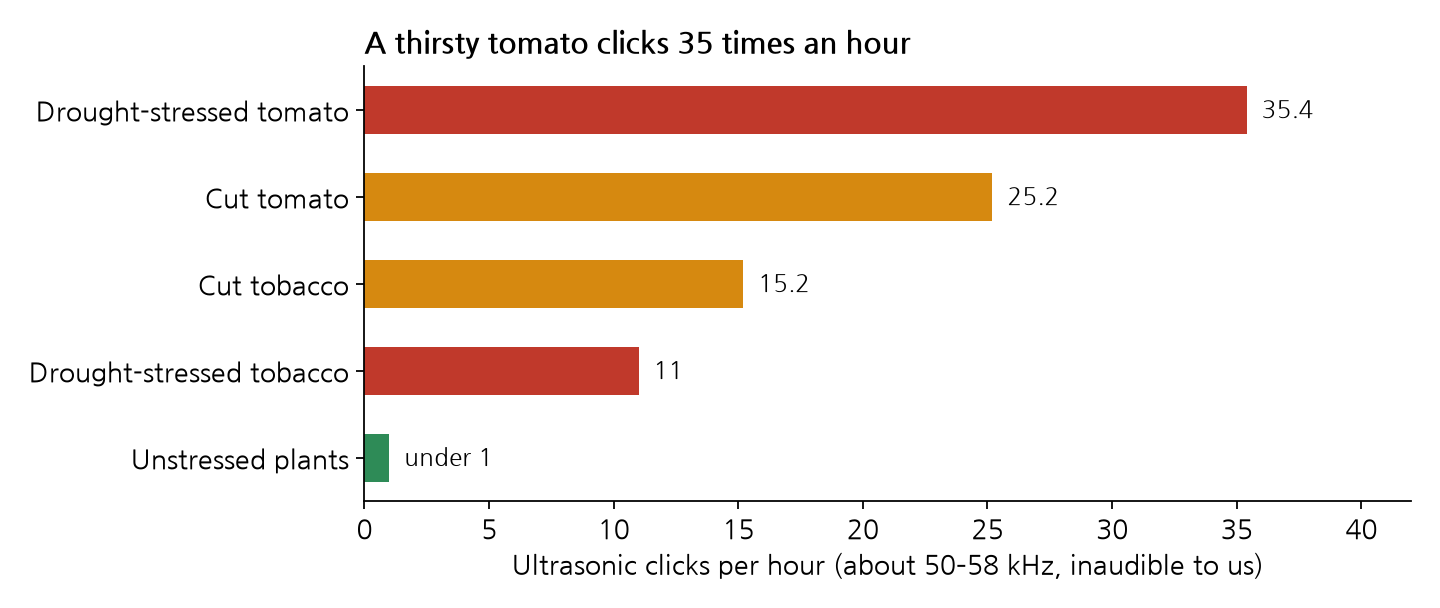
Plants are even more surprising. Researchers at Tel Aviv University in Israel reported in 2023 that water-deprived tomato plants emit ultrasonic sounds at 50–58 kHz, inaudible to the human ear, about thirty-five times an hour (Cell). Healthy plants made essentially no such sounds. Simply by counting these clicks in a greenhouse, researchers correctly identified thirsty tomato plants 84% of the time. However, this isn't the plant deliberately speaking — it appears to be a physical phenomenon, air bubbles bursting inside the water-conducting vessels of the stem. Even so, if we could only listen, it amounts to a tomato signaling "I'm thirsty." There are also claims that plants learn and remember, though reproducibility failures have kept that debate unresolved (eLife, 2020).
We should also weigh the cost of an animal translator being wrong. If an app mistranslates a pet's signal as "I'm fine" and that causes someone to miss a trip to the vet, it would be better not to have the app at all. Right now, technology that helps people not miss a signal of pain is more useful to animals than technology that tries to make them talk.
Think about their story
The technologies I looked into this time had something in common. The ones that worked well generally didn't try to fix the person who couldn't speak — they fixed the listener instead. They retrained machines to understand atypical speech; they reconstructed a person's own voice using a family member's. The ones that failed did the opposite: the sign-language glove told Deaf people to put on a glove.
That's why the second half of the notebook's sentence stays with me. "Think about their story" means: ask first what that person wants to say. If nine out of ten blind people can't read braille, then sound may need to come before a braille terminal. For someone whose native language is sign language, sign interpretation comes before subtitles. Technology comes after that.
"One Page Today" starts from a single line in a notebook and arrives, each time, at a page of today's thinking.
If you enjoyed reading this, please leave a comment.
Sources
- Number of registered people with disabilities: Ministry of Health and Welfare, as of end of 2025 (announced 2026-04-20) — news report. The 2023 figure for speech impairments is from the Korea Disabled People's Development Institute webzine
- Braille conversion comparison: liblouis 3.36, Korean table ko-g2.ctb (LGPL). The words and sentences used for comparison were drawn from Oosioo manuscripts
- Gesture recognition: Google MediaPipe Gesture Recognizer (seven default gestures)
- Feline Grimace Scale: Evangelista et al., Scientific Reports 9:19128 (2019)
- Plant ultrasound figures: Khait et al., Cell 186:1328 (2023), figures based on the bioRxiv preprint text
Image credits
- Cover: National Institute of Korean Language, "Korean Braille" (2013), CC BY-SA 2.0 KR, Wikimedia Commons
- Louis Braille: Henri Thiriat (1887), public domain
- Hawking's speech synthesizer: Science Museum London / Science and Society Picture Library, CC BY-SA 2.0
- Dot braille watch: Korea.net / Korean Culture and Information Service (2017), CC BY-SA 2.0
- 4 graphs: created by the author
