oosioo
Read in English
A vision engineer measures and simulates coffee, from the moment a bean breaks between the burrs to the moment it reaches the tongue. Read in order →
The Aroma That Escapes at Grinding
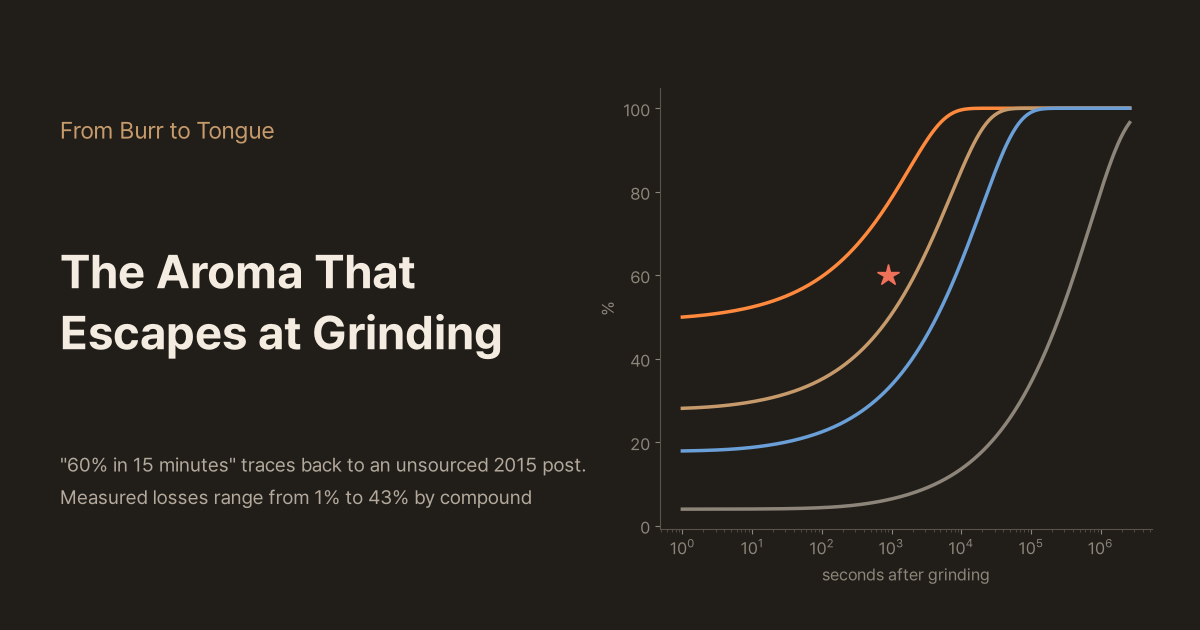
I traced "ground coffee loses 60% of its aroma in 15 minutes" back to its source. Most pages give none; the one that does leads to an unsourced 2015 LinkedIn post. The only primary 15-minute measurement, Grosch (1999), found 43% of methanethiol and 39% of acetaldehyde gone, but just 1% of furanones in 30 minutes. A model combining opened cells and diffusion gives release times by particle size, with a calculator to try it yourself.
Static and Clumping
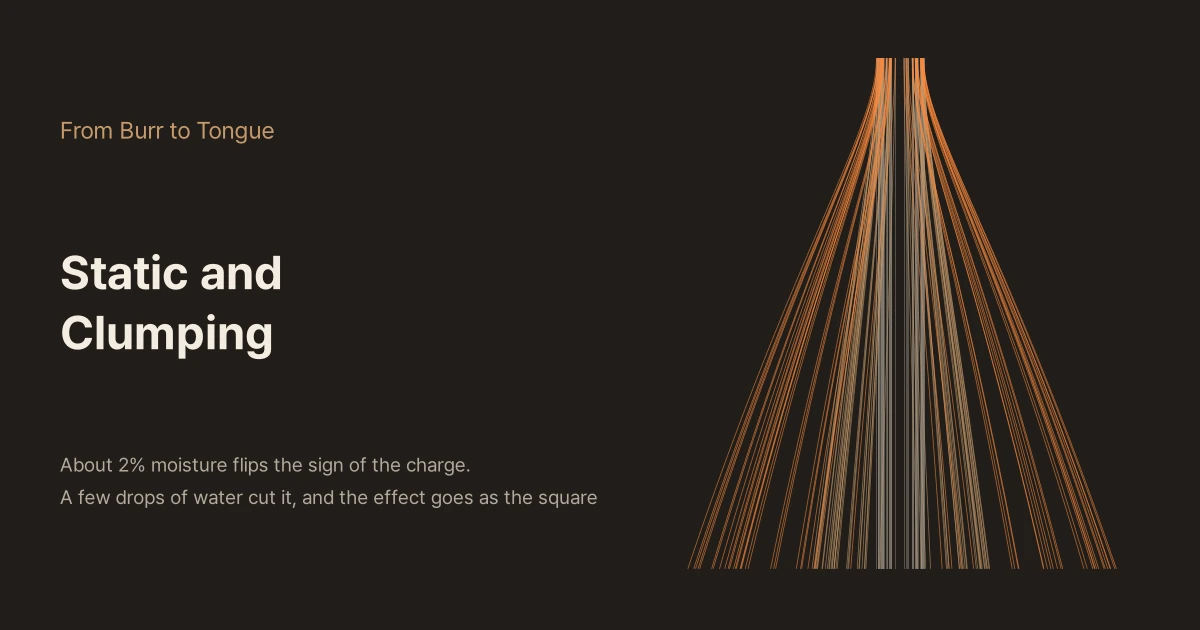
Is a drop of water on the beans (RDT) a myth? Measurements show ground coffee carries tens of nanocoulombs per gram, flips sign at about 2% bean moisture, and has large chunks and 100–300 µm particles of opposite sign. A few drops of water cut the charge from half to almost zero and grinder retention from 12% to 2.5%; effects on extraction and taste vary. Treated as a whole stream, same-sign charge pushes the grounds apart with a force that goes as the square of the charge. With a stream simulator.
Do Dark Roasts Grind More Evenly?
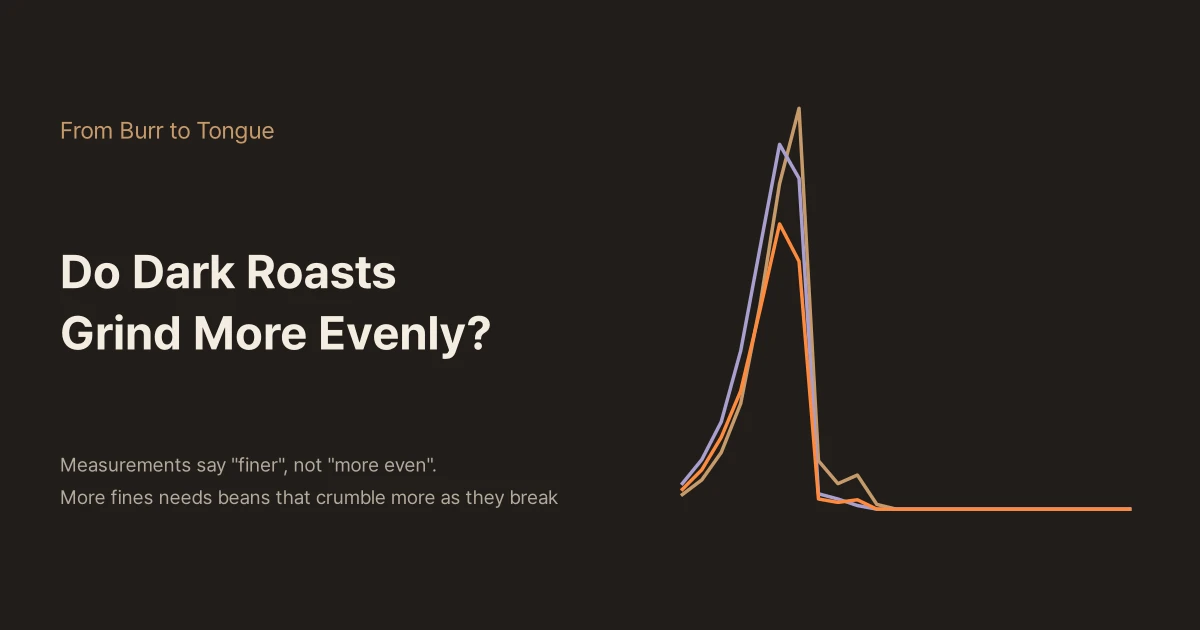
"Dark roasts grind evenly" or "dark roasts make more fines"? Measurements say that at the same setting dark roasts grind finer with more fines (over 10% more fines on sieves, a mean size about 100 µm smaller by laser); the case for "more even" is weak. In the virtual grinder, more fines required beans that crumble more as they break, and depending on how clumps are handled, different methods can read the difference differently. With a comparison tool.
Blade vs Burr
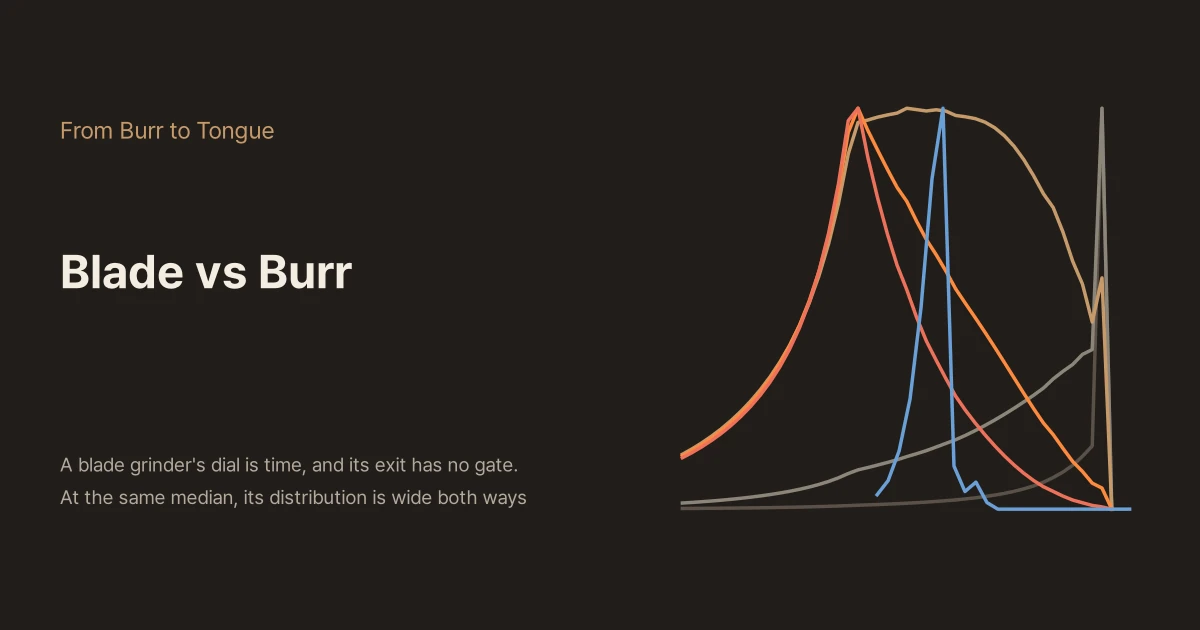
No peer-reviewed study backs up "buy a burr grinder, not a blade". What exists is one blade grinder tested at different grind times and sieve-based product tests (27–44% in the target band versus over 60% for burrs). A population balance model shows a blade grinder's dial is time, and with no gate at the exit its distribution is wide both ways even at the same median (D10 138, D90 2,941 µm). Shaking trims the coarse tail. With a calculator.
Grind Simulator v1
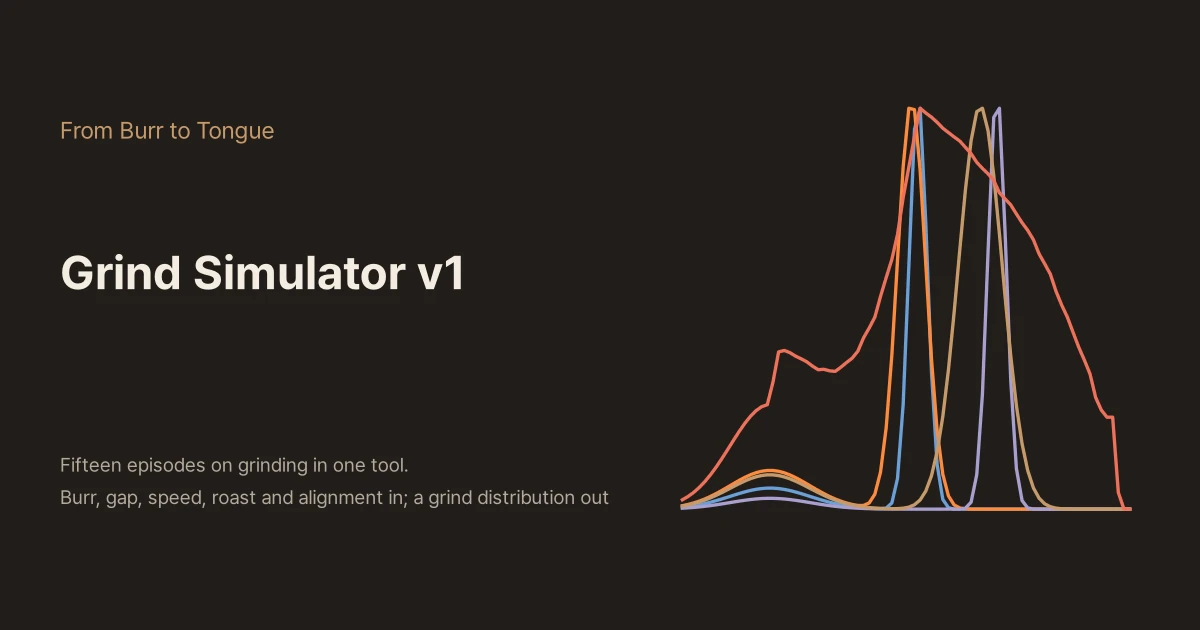
I gathered the results of fifteen episodes on how beans break inside a grinder into one tool. Put in burr type, gap, speed, alignment and roast, and it returns a mass distribution combining a fines peak (cell size, 38 µm) and a gap-set coarse peak; blades run the population balance model as is. I note what is measured and what is a model trend, and the distribution can be downloaded as a CSV.
Porous Media 101
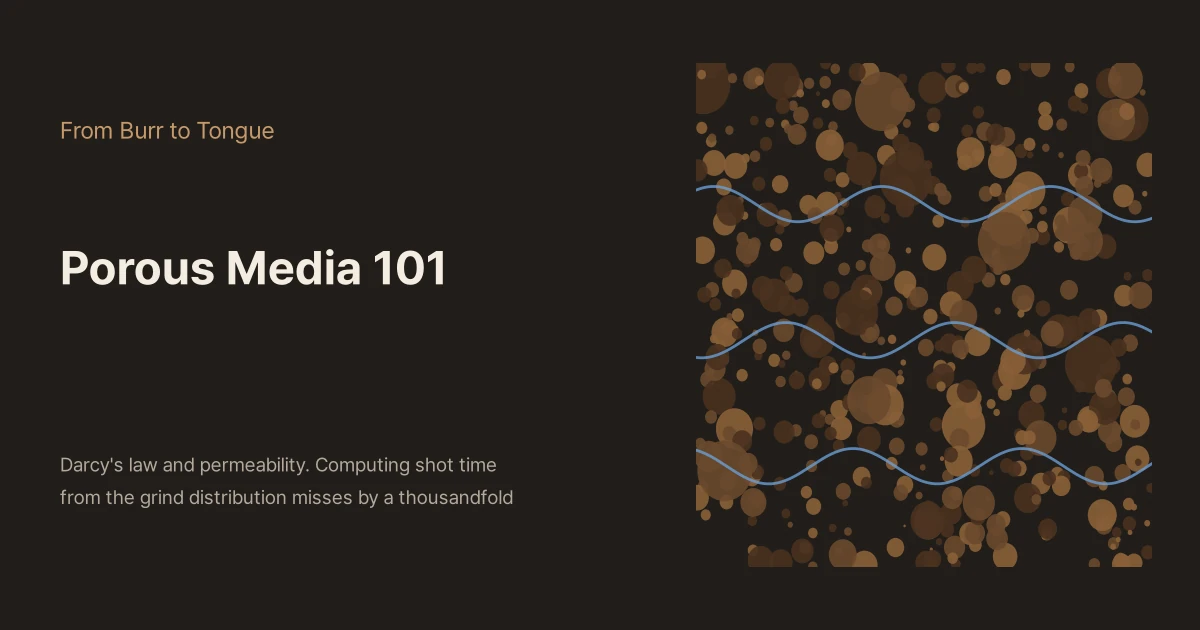
Looking at the espresso puck through Darcy's law and permeability. Solving a typical shot backwards gives about 2.3×10⁻¹⁵ m², but running Kozeny–Carman on Grind Simulator v1's dry distributions gives one to two thousand times more, so 36 g would run through in under a second. Adding 10% fines cuts permeability to 28%, and 2.3 g more in the same cell cuts it three- to fourfold. I go through the candidates for the thousandfold gap (swelling, compression, fines migration) and include a calculator.
Looking Inside the Puck with CT
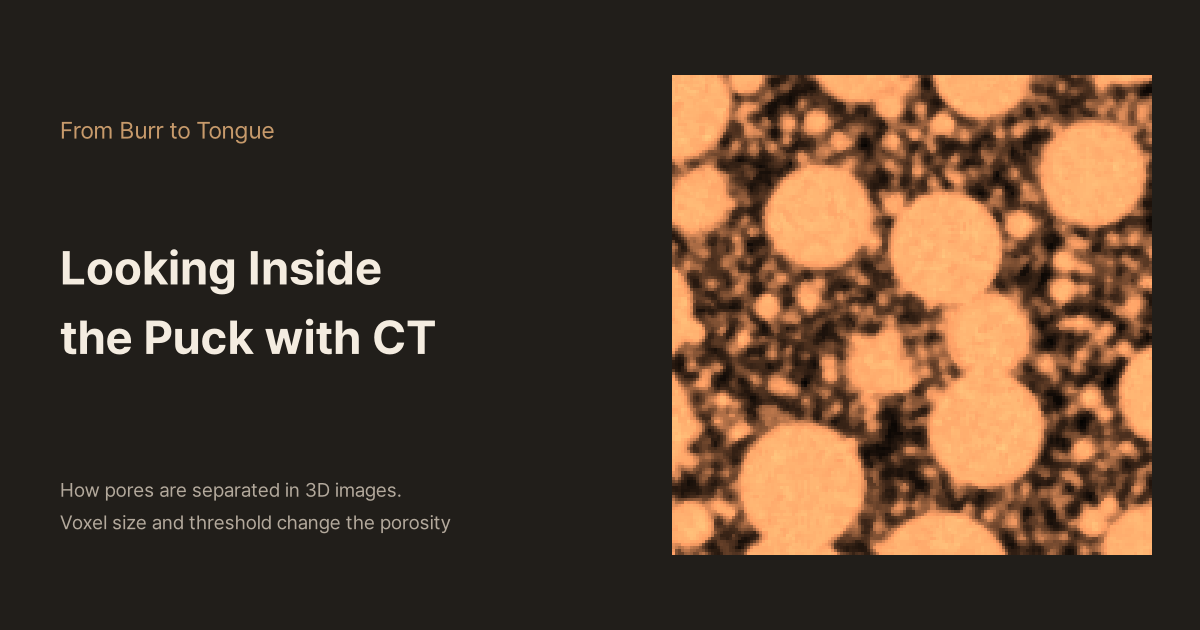
When CT images a puck, much of the conclusion is decided when each voxel is classified as coffee or space. Mo et al.'s (2023) 16.8 µm images had a single-peaked histogram, so porosity was set to the literature value of 0.17. Scanning a virtual puck of known porosity 0.31 at 16 µm and segmenting with Otsu's method gave 0.49, only 13% of the fines were detected, and the permeability from that image was 66 times the truth. Includes a virtual CT slice tool.