oosioo
Read in English
Things that started as a one-line request and ended as something usable — including where it went wrong. Read in order →
Is a Karaoke Backing Track Just the Original Song With the Voice Removed? — 50 Years of Source Separation, and One Song Split Seven Ways
Karaoke backing tracks are not made by erasing the singer from the original. Karaoke companies still transcribe every song by ear and rebuild it from scratch. For decades the common wisdom was that once sounds are mixed, they can't be pulled apart again — and that wisdom collapsed over the past ten years. This piece traces how the technology changed, from a 1970s patent that subtracted the right channel from the left, through matrix factorization and deep learning, to the Beatles' final song. I also split the same songs with seven methods from different eras and scored them.
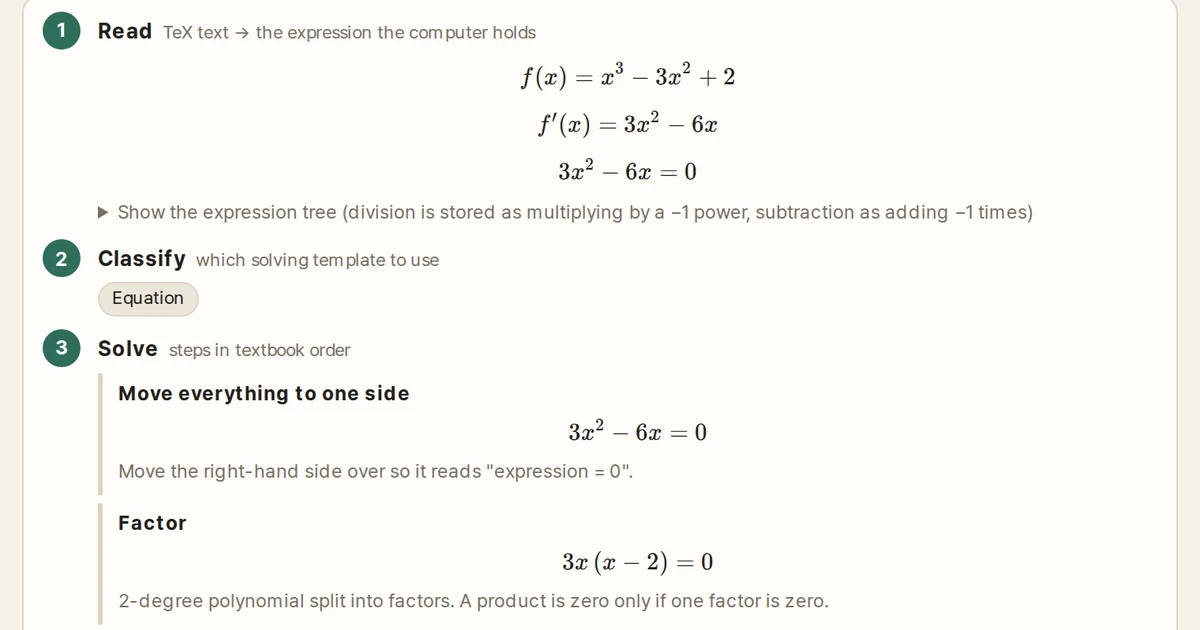
AI Solved a Hard Maths Problem? What Exactly Was Solved — Sorting the Headlines by Kind, and an Engine That Solves Your Equation and Checks the Answer
Headlines like "a 90-year-old problem cracked in 88 hours" or "Riemann hypothesis proof included" now appear several times a month. But the same word "solved" mixes exam problems with known answers, searches scored by a machine, finding papers that already existed, and genuinely open problems. I start with what solving a maths problem actually involves, then sort out what was really solved in 2026 and what was inflated. I also look at how AIs that solve CSAT and SAT problems work, and built a small engine that takes an expression in TeX and shows the solving steps and the check.
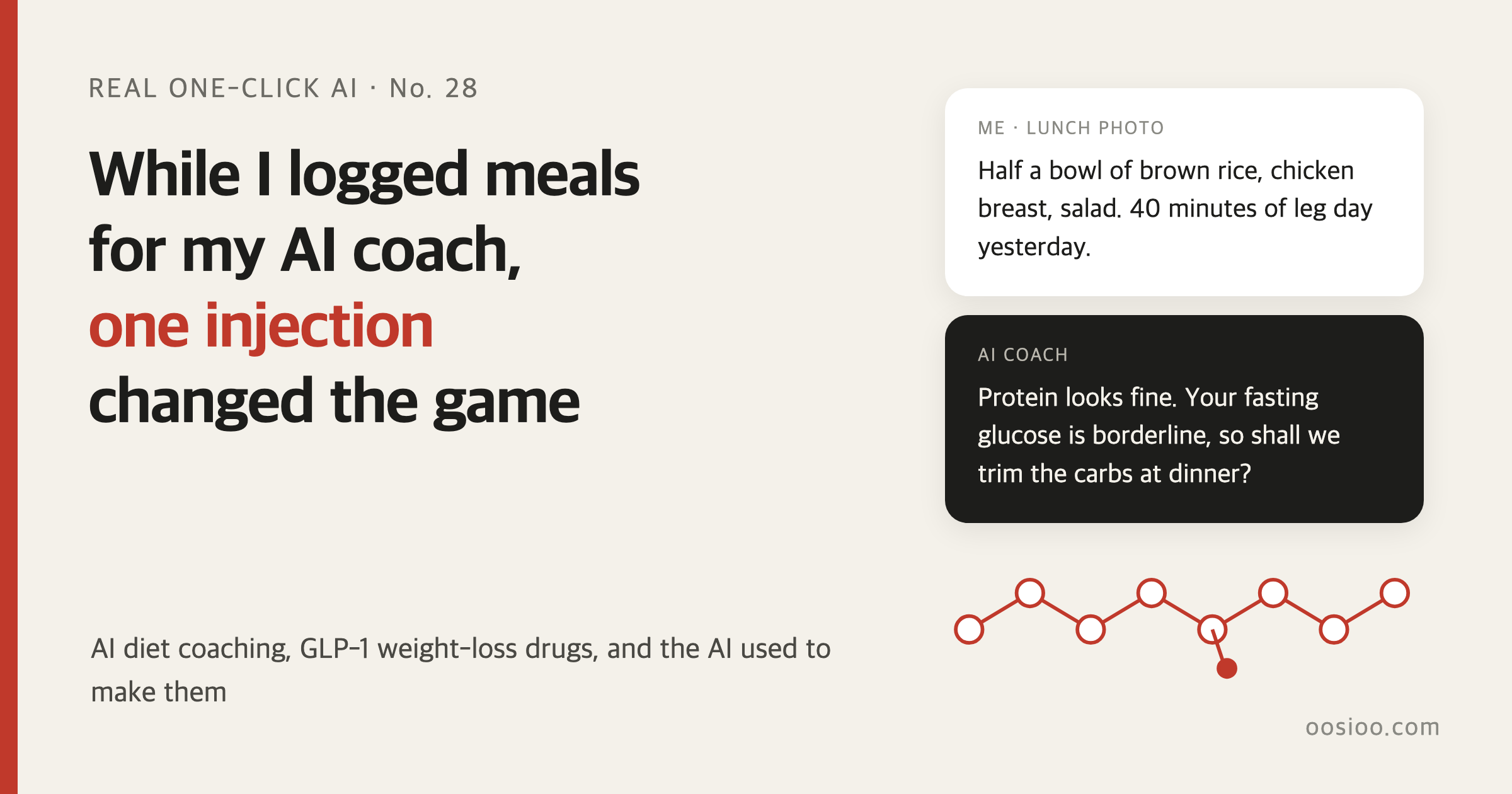
While I logged meals for my AI coach, one injection changed the game: AI diet coaching, GLP-1 weight-loss drugs, and the AI used to make them
Feeding an AI your check-up results and logging meals and workouts so it can advise you like a personal trainer is already a crowded market at home and abroad. I sorted out, from papers and company announcements, whether people actually lost weight and where the AI gets it wrong. Meanwhile Wegovy and Mounjaro have arrived, and word is that gyms and the diet industry are reeling. I separated what the numbers confirm from rumour, and rounded up where AI is really used in developing these drugs, with examples from Korea and abroad.
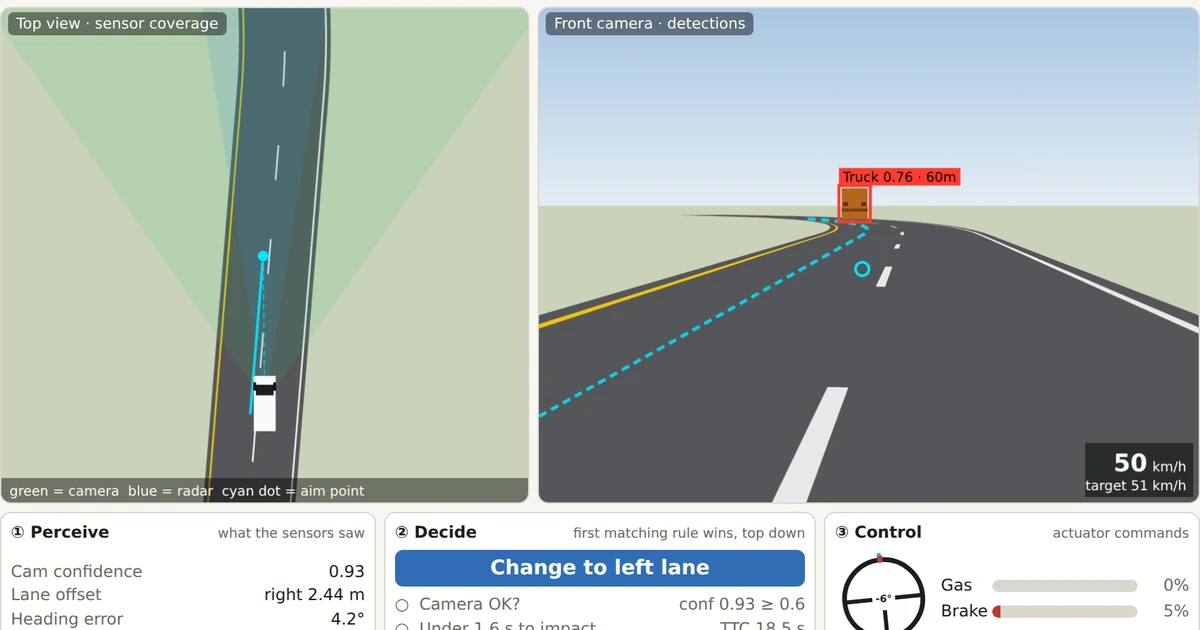
Forget the Flying Roadster: Tesla's Real Weapon — Taking Apart How a Self-Driving Car Sees and Decides, with a Simulator
Tesla's flying Roadster grabbed the headlines, but what made Tesla famous is physical AI such as FSD. Today, open data and open-source simulators let individuals experiment with self-driving too. I sorted what is out there by the hardware it needs, then built a very simple self-driving simulator that sees with a camera and radar, decides by rules and moves the steering wheel and pedals, so perception, decision and control all move together on one screen.
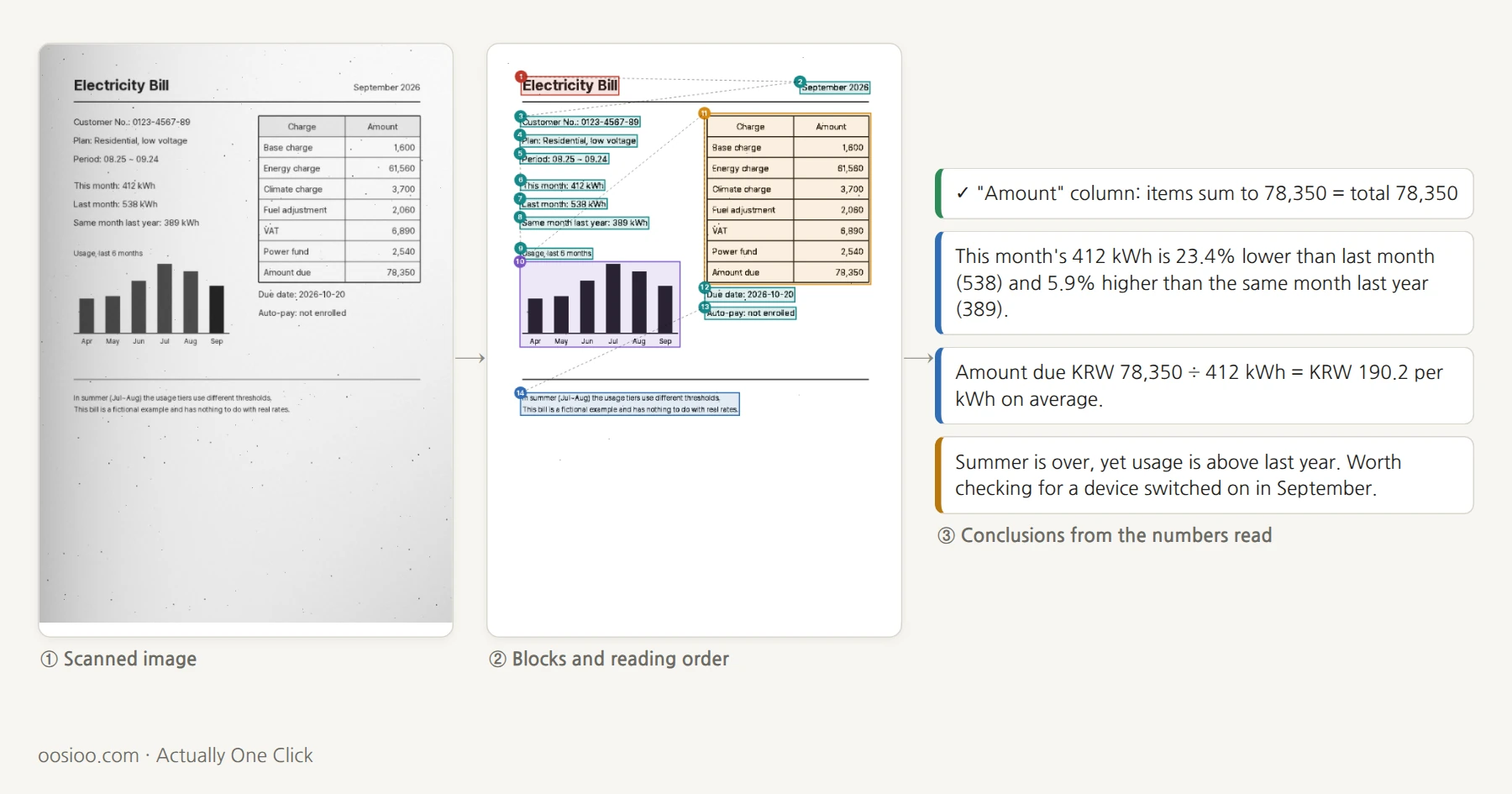
How Does AI Read a Sheet of Paper? 112 Years of OCR, and a Toy That Takes a Scanned Document All the Way to Conclusions
OCR, reading text from photographed or scanned documents, began in 1914 with a machine that turned letters into sound. Today models of about 1B parameters convert tables and formulas to Markdown and plug into tools like Claude Code through MCP. I traced those 112 years and built a single-file Document Reading Dissector that binarises scanned receipts, bills and statements, finds the text, decides the blocks and reading order, recognises the letters, turns tables and key-values into data, and checks the sums.
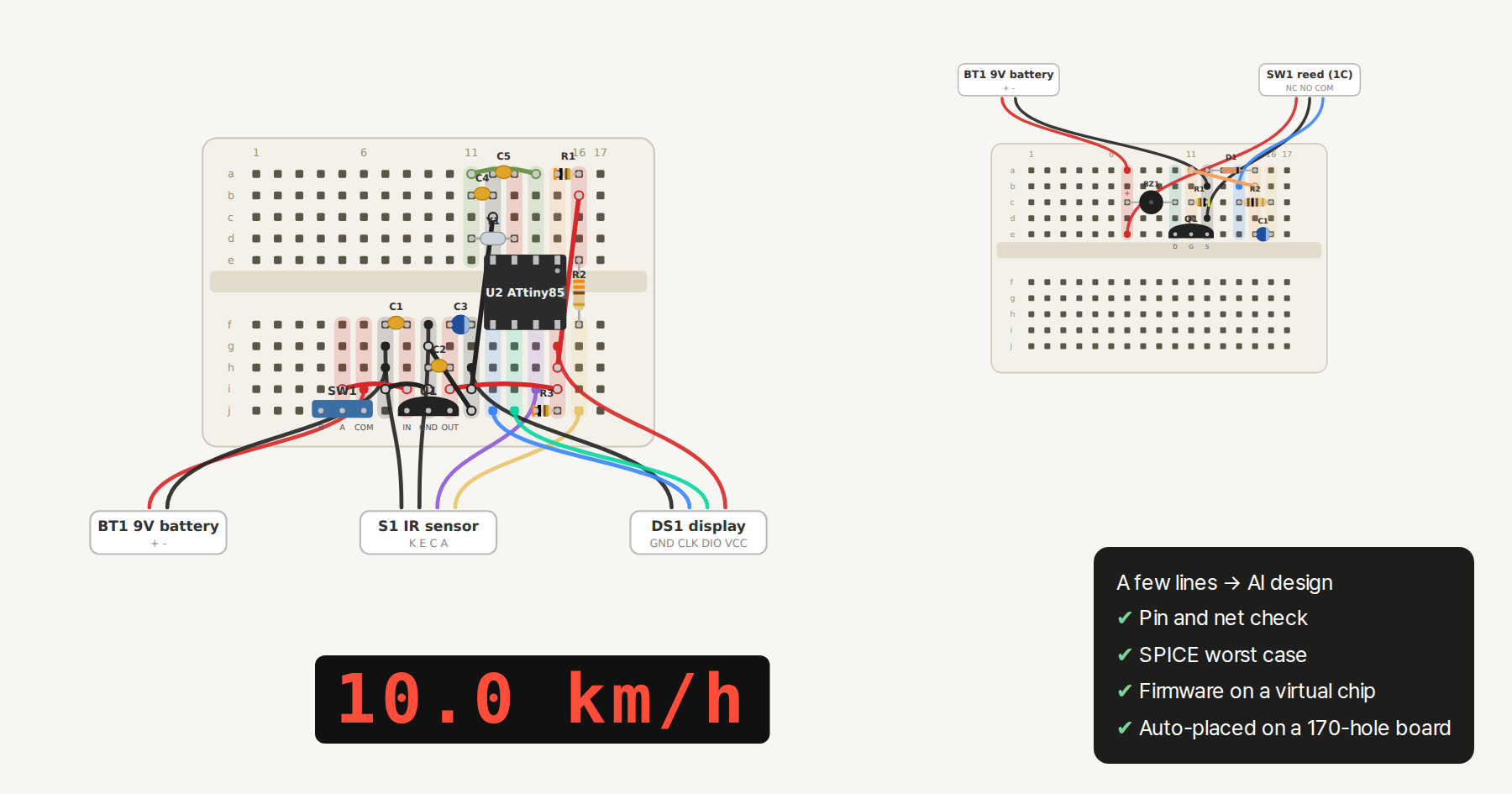
Can Circuit Design Be One Click? Giving an AI a Plain-Words Requirement, Verifying It in a Simulator, and Placing It on the Smallest Breadboard
Circuit tools like PSpice are powerful once you know them, but they ask for circuit knowledge and software skills first. Could circuits work like vibe coding, where you describe the feature and get a design? I traced 65 years from the 1961 maze algorithm and 1973 SPICE to 2026's AI design agents, then had an AI design a door chime and a treadmill belt speedometer that run on a 9V battery. An automatic verifier (pin checks, ngspice worst cases, a virtual microcontroller) judged each design, and the ones that passed were placed automatically on a 170-hole mini breadboard with a bill of materials and a quote.

Can Book Typesetting Be One Click? — Put in a manuscript and photos, press one button, and get an EPUB and a print PDF: a book bound from “A Lucky Day”
Writing with AI is now normal, but typesetting that writing into a book still means learning InDesign or LaTeX. I built “Bind a Book”, a typesetting tool that runs in the browser: put in a manuscript and photos, press one button, and it divides the pages, places the pictures, builds the contents and index, and exports an EPUB and a print PDF. I bound Hyun Jin-geon's “A Lucky Day” (1924) with six photos of 1910s–20s Seoul into a 26-page sinkukpan book, and the EPUB passed the official checker EPUBCheck with 0 errors. I also added a story bible to catch continuity breaks in characters and settings, and it found where two AI-written sequels departed from the original.
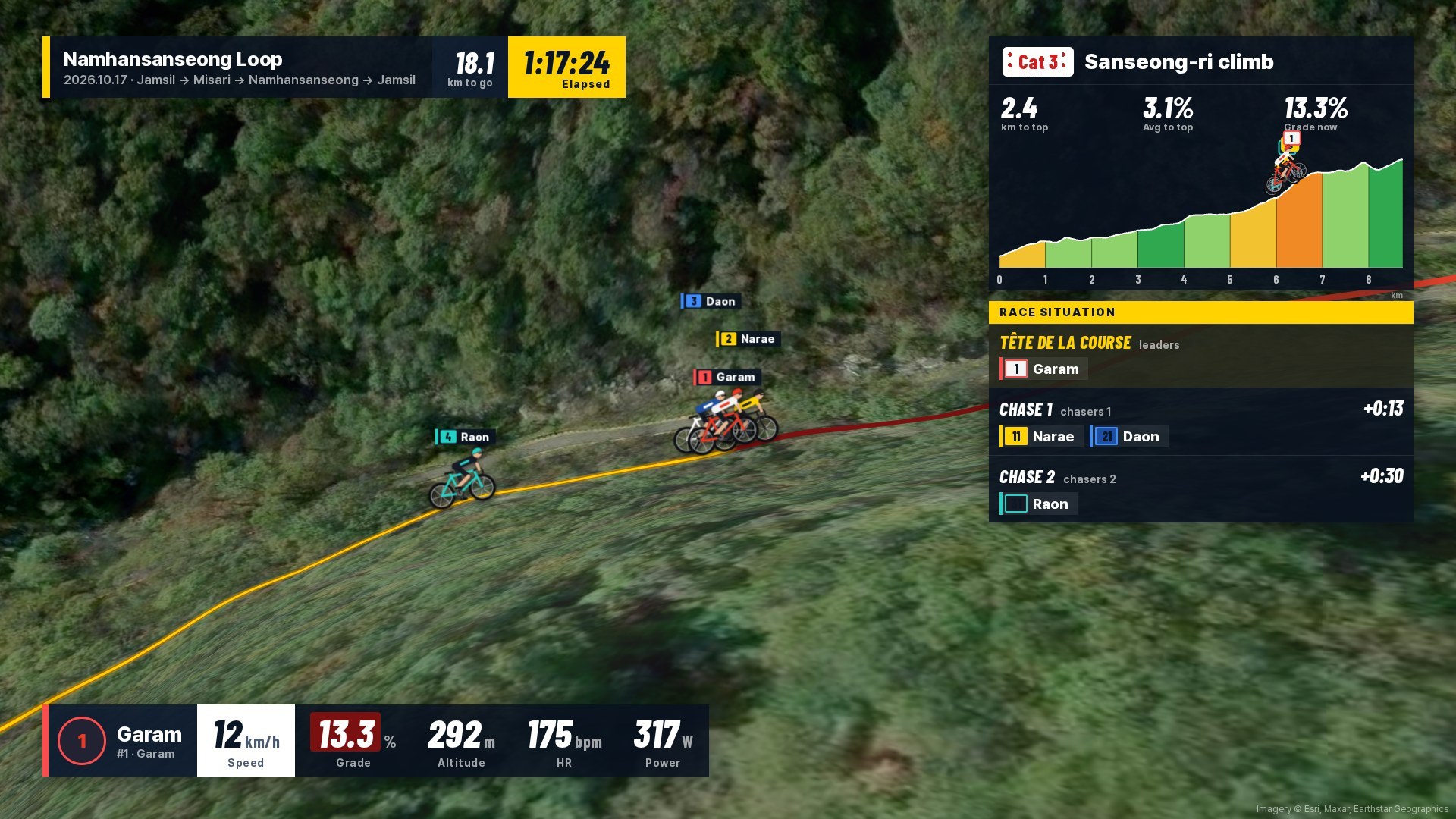
My Ride as a Tour de France Broadcast — a video maker where you drop in a GPX file and a director picks the shots
The 3D flyover videos that ride apps make are one camera following the course at the same angle, and they get boring fast. So I built ridecast, a “broadcast director” program: drop in GPX or FIT files and it picks helicopter, motorbike and side cameras for each stretch and cuts between them, stops time before a climb to show a gradient card, and ends with a photo finish and final standings. A four-rider, 2 h 19 min ride became a 197-second video. No AI is called at any point while the video is made. The first version was too fast, the camera got buried in the mountain, and the last rider never crossed the finish line. You can play it yourself inside the post.
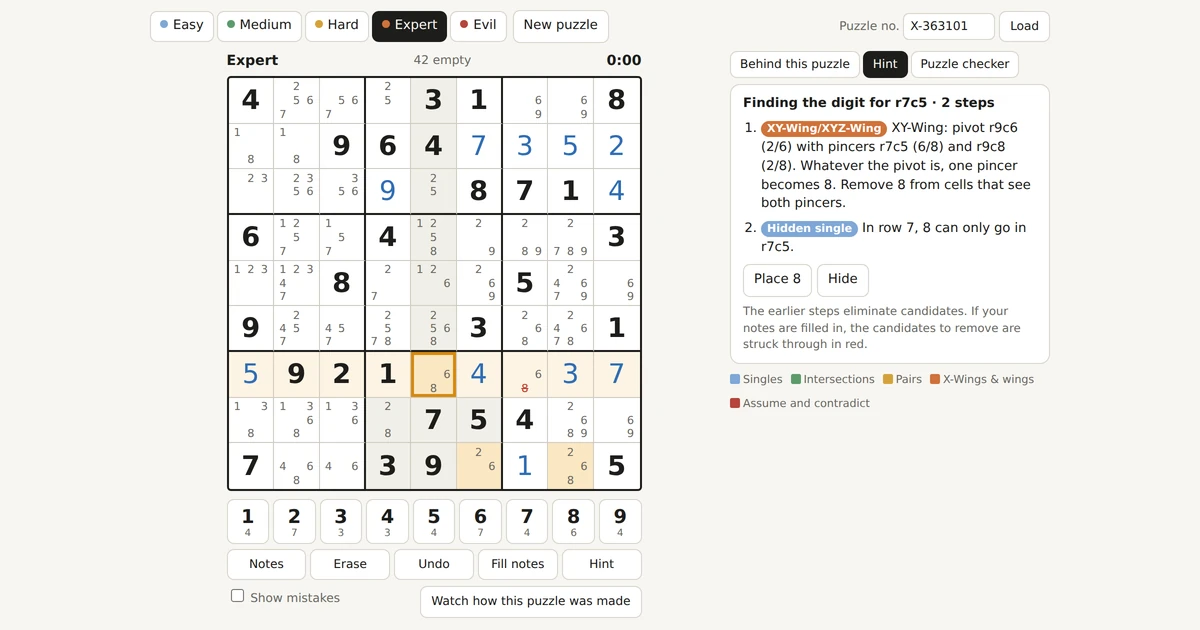
Why computers are good at making sudoku — a generator that proves the solution is unique and grades difficulty by the techniques people use, at five levels you can solve right here
Most game levels need a person to play them to know whether they can be beaten or are fun. Sudoku is different: checking an answer takes 27 looks, uniqueness can be proven by search, and difficulty can be measured by playing human solving techniques from easiest up. A machine can play both maker and sceptic. So I built a generator for five levels, Easy to Evil, with a solving screen on the same page. Across 3,000 random puzzles the clue count had almost nothing to do with difficulty, and Hard took 23 tries to get one. I also graded today’s three New York Times puzzles. An AI asked to make puzzles without tools handed in only the two easy ones and declined the rest as unprovable.
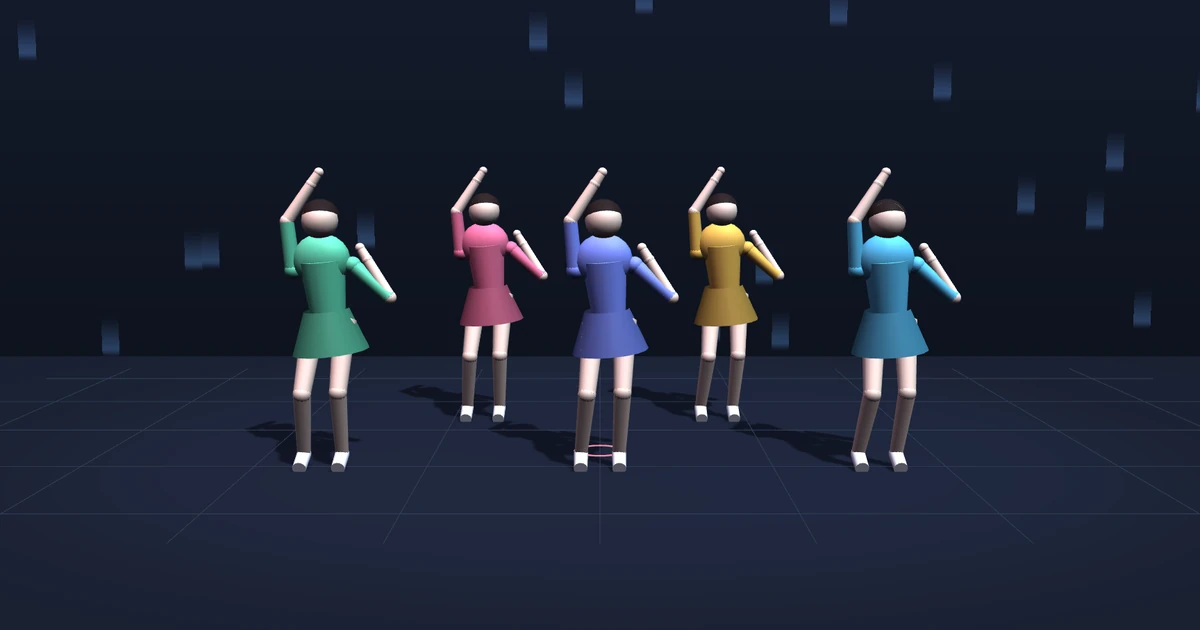
Can Five Dancers Move to a Song Just by Listening? — A Choreography Generator That Writes Point Moves, Formations and Paths for an Idol Track Made from Hwang Sun-won's "Sonagi"
An idol stage is not finished by the song alone. There is a point move repeated in every chorus, and there are the formations and paths five members use to trade places. Borrowing motifs from Hwang Sun-won's short story "Sonagi" (The Shower), I made a 2:30 girl-group track on a laptop GPU and built a generator that listens to it and choreographs for five. Five figures with 20 joints each dance on a 3D stage. Along the way I lay out how dance can be written as numbers: beat alignment, moving together, repetition structure, closest gap, Laban Effort. I made 300 candidates and picked one by those numbers. Removing repetition dropped the structure score from 0.147 to 0.019, and removing path detours made all 60 seeds collide. Given the same dictionary, an AI writing the plan itself produced one plan that ranked 2nd of 300 and another that ranked 164th.
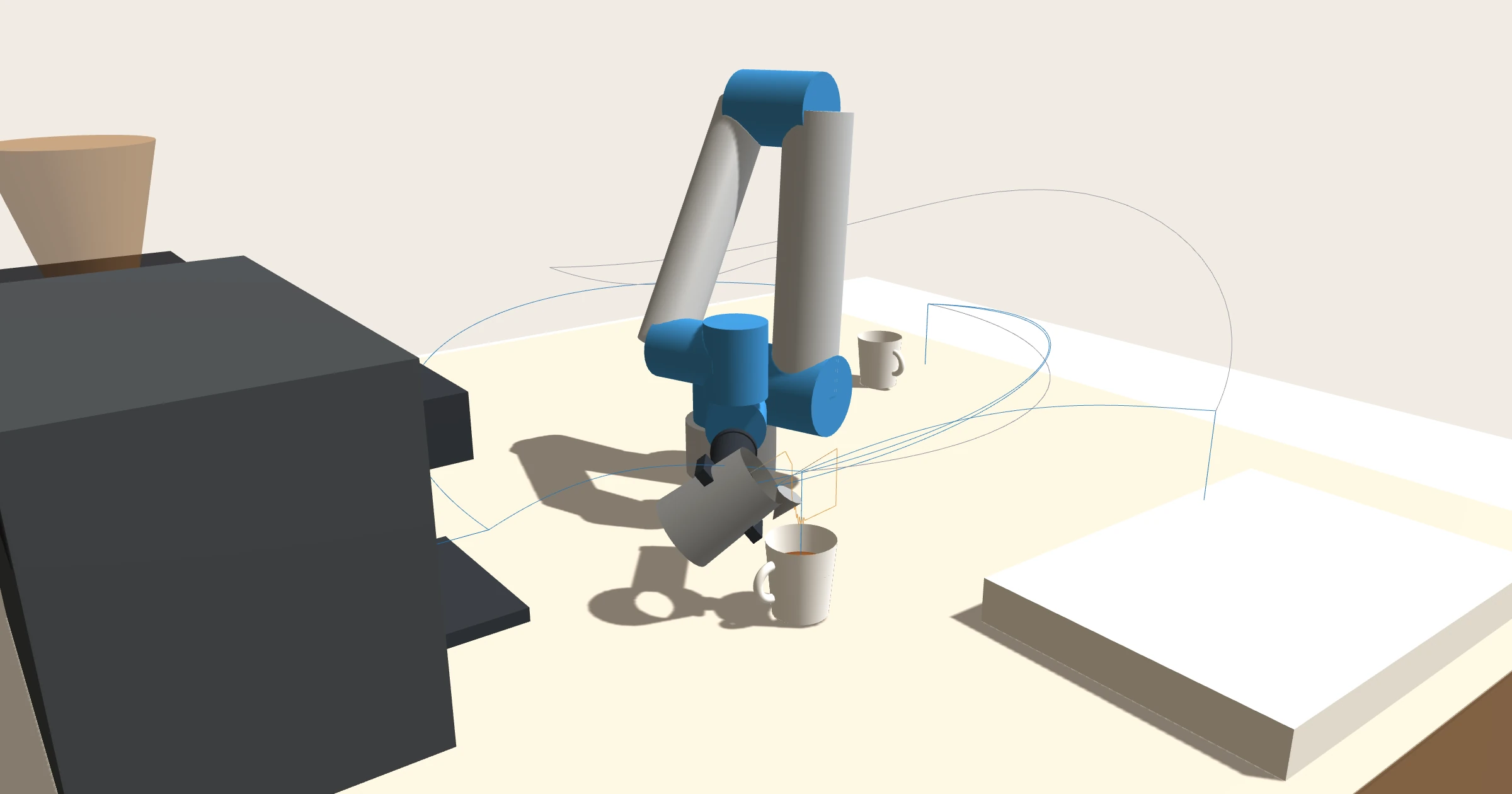
How Does a Robot Barista's Arm Decide Its Pose? — Solving the 56 Seconds a Collaborative Robot Takes to Make a Latte with a Pose Solver
Most robot arms making coffee in cafés are collaborative robots, industrial robots built to work beside people without a fence. I look at what cobots are and how they spread, and how far robot baristas have come in Korea and abroad. Then I built a pose solver that makes one latte with the most common form, a 6-axis arm (UR5e published dimensions). Give it a tool position and it computes eight candidate arm shapes, then picks one that hits nothing and gets there fast. It plans paths that keep the cup from spilling and slows down when a customer comes close. For the same tool point, choosing the wrong arm shape flipped the cup 180 degrees on the way. Solving 2,000 random poses numerically found answers for only 77%, and just 32% matched the chosen solution. Using the standard separation formula as is, the robot stopped as soon as a customer stood at the pickup shelf.
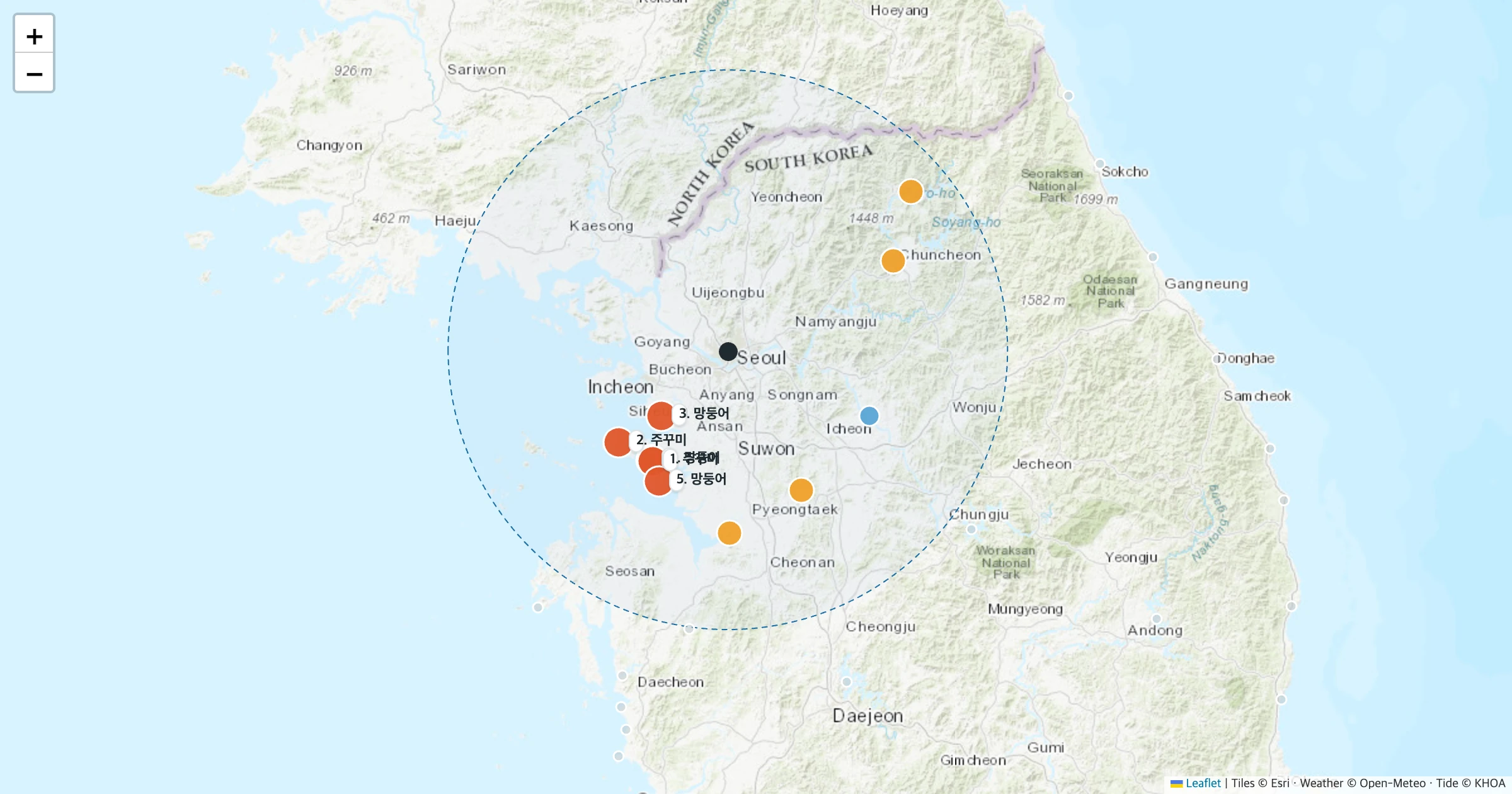
Where Should We Go Fishing Tomorrow? — A Web App That Uses Tides and a Map to Pick Where, When, What and How for Beginners Who Know Neither the Spot Nor the Species
There are plenty of tide apps, catch report apps and closed-season apps. But most of them only work once you pick a region, a target species or a fishing style. A total beginner who wants to try fishing tomorrow needs the opposite: enter where you start and the date, and get places, times, species and rigs. So I built a web app that shows exactly that on a map. It computes tides for 56 spots across Korea from KHOA harmonic constants, overlays wind and wave forecasts with each species' season and closed season, and gives a rough probability of catching at least one fish during your stay. The computed high and low water times were 14 minutes off KHOA predictions on average; a public sea level forecast (Open-Meteo) was 34 minutes off. Shaking each species' base assumption by 0.5 to 2 times left the top five picks from Seoul unchanged 69% of the time.
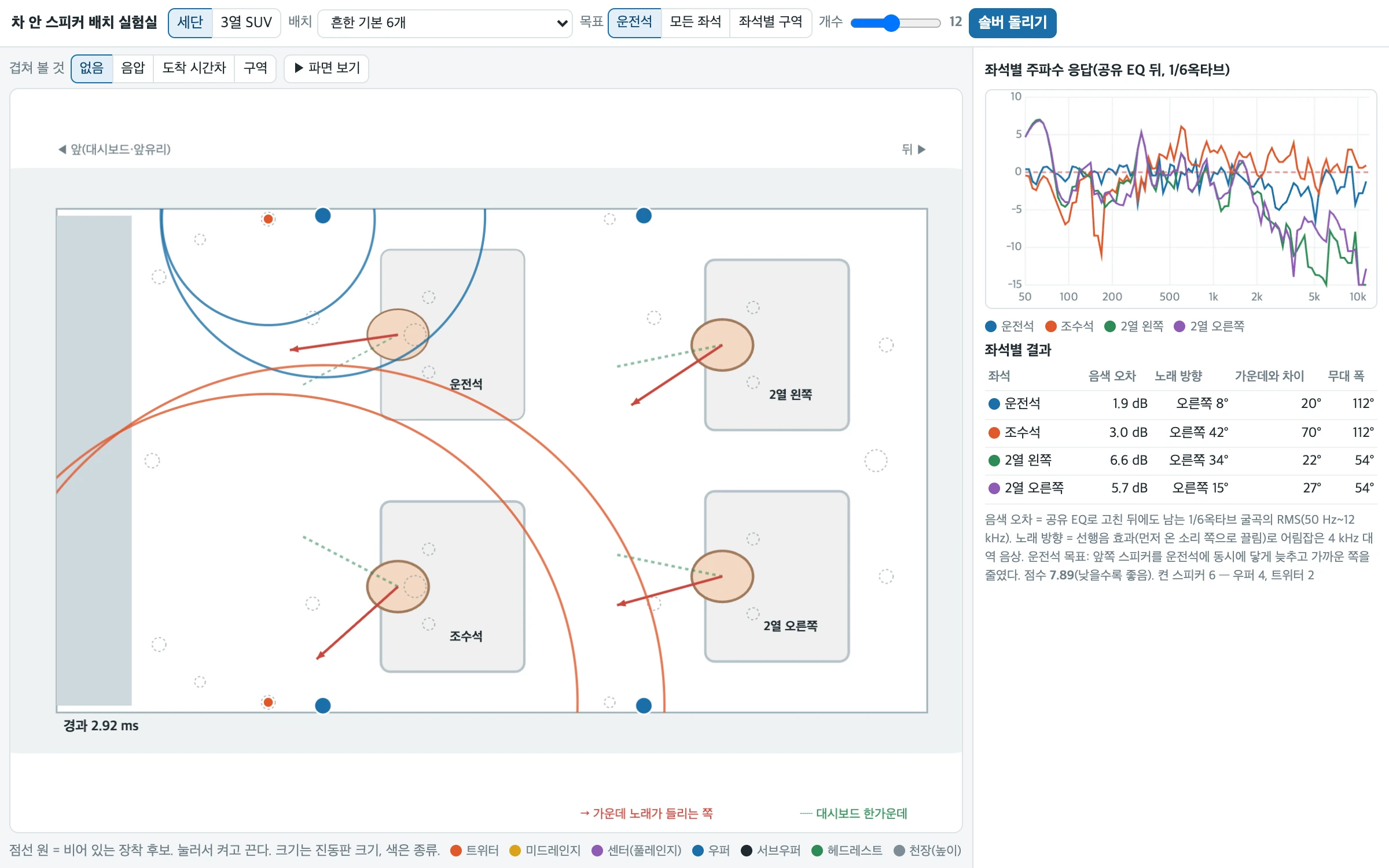
How Many Speakers Should a Car Have, and Where? — A Simulator That Follows Why Every Seat Hears Something Different
Cars now carry anywhere from 8 to 36 speakers. Yet the driver, the passenger and the back seats hear different things in the same car, because the cabin is small, wrapped in glass, and nobody sits in the middle. I built a simple acoustic model that stacks 5,832 reflection paths inside a box-shaped cabin, and a solver that picks positions from 32 candidate spots (sedan) or 38 (3-row SUV) for a goal. Limited to 4 speakers for the driver, it kept A-pillar tweeters, a center speaker and a subwoofer; for all seats, the center speaker came first. The score stopped improving at about 13 speakers. Per-seat sound zones kept about 20 dB of contrast with headrest speakers even with the head moved 3 cm, but only 10 dB with door speakers.
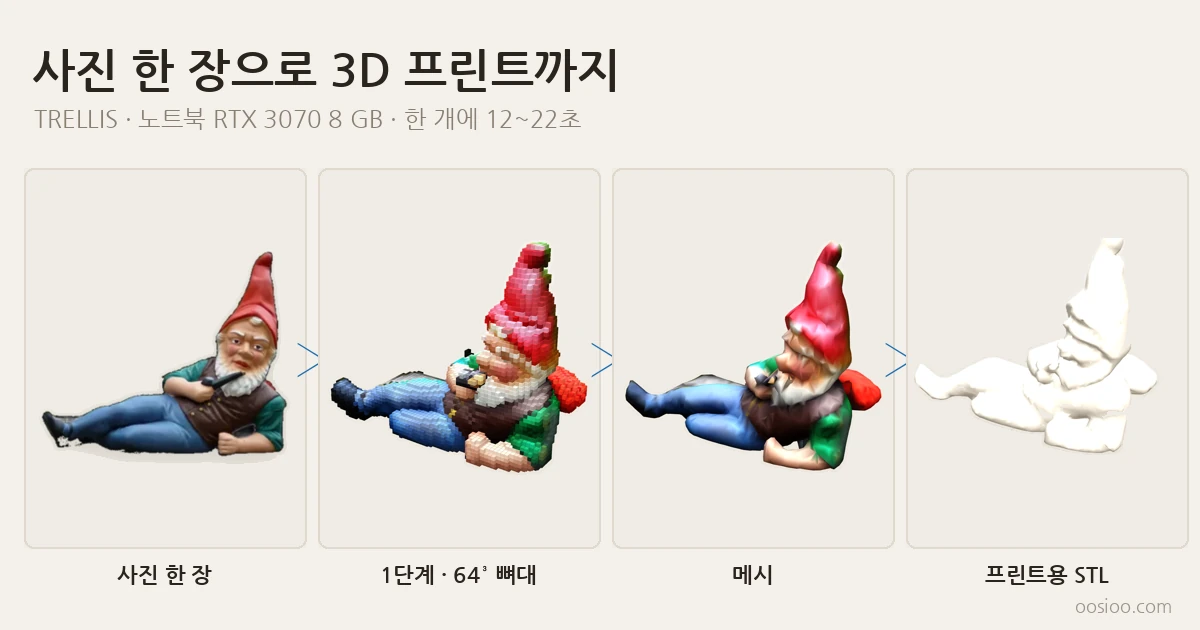
Can One Photo Get You to a 3D Print? — Running TRELLIS on a Laptop GPU
Upload a photo to services like Tripo or Meshy and a 3D model comes back in tens of seconds. I tried doing the same on a personal laptop with TRELLIS, released by Microsoft. The official requirement is 16 GB of GPU memory, but loading only the models each stage needs made it run on an 8 GB laptop (RTX 3070) in 12–22 s per object. Measured against ground truth, the public models landed within 1 mm on average when printed at 6 cm. Objects I built myself drifted to 1.5–3 mm, and a handle the photo did not show was never made. Getting to a 3D printer took more work: the generated meshes were hollow skins with only 4–56% of the volume they have once filled. I also compared it on the same laptop with TripoSR and TripoSG, released by Tripo: TripoSG matched or beat TRELLIS on shape and came out solid, but has no color and was more than three times slower. This post also lays out the lineage of 3D reconstruction methods and the principles behind Tripo and TRELLIS.
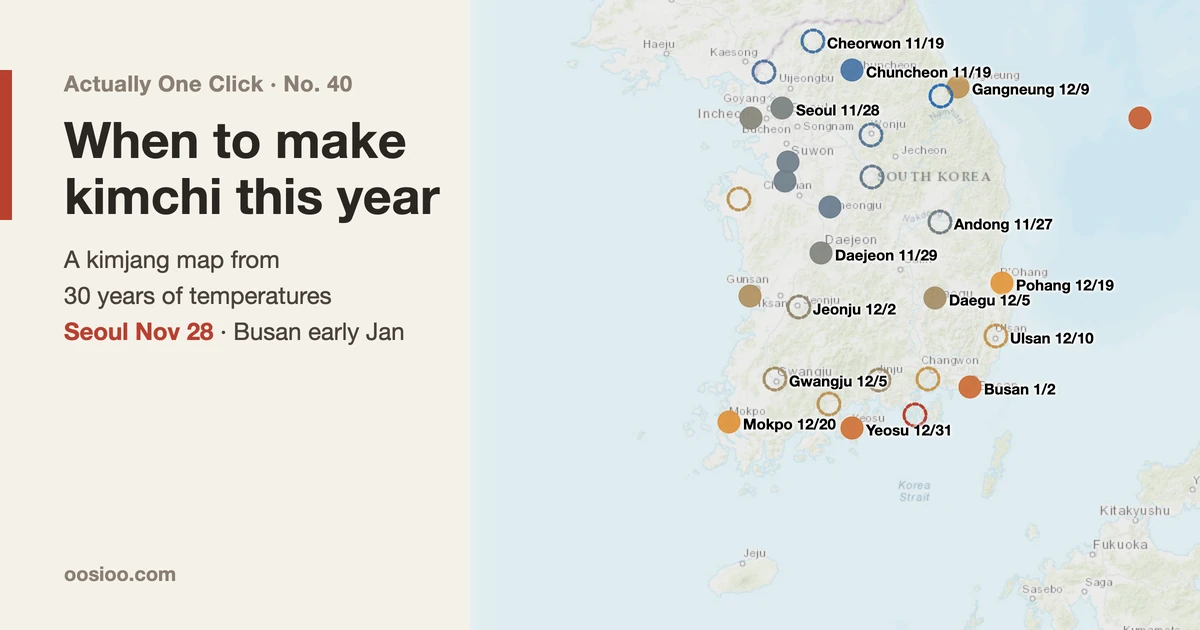
When Should You Make Kimchi This Year? — A Regional Kimjang Map from 30 Years of Temperatures, and Why the First Cold Snap Is a Trap
Kimjang, Korea's once-a-year making of winter kimchi, is traditionally timed for when the daily mean temperature stays at or below 4°C and the daily low at or below 0°C. The Korea Meteorological Administration used to publish this itself; since 2016 it has been left to private forecasters. I applied the same rule to 1991–2020 station temperatures to recalculate each region's normal date: Seoul 28 November, Daejeon 29 November, Chuncheon 19 November, Gangneung 9 December, Busan 2 January. The biggest error in the calculation came from one word, "stays". Taking the first day the temperature dipped below 4°C made Seoul's date 14 days early on average. Reanalysis temperatures, used to cover the whole country evenly, pulled Seoul's date 7 days earlier, because the grid washed out the city's heat. Seoul's normal date has moved 2–3 days later over 70 years, but the latest 30 years show no trend. This year the KMA one-month outlook says "above normal" from 9 November to 6 December, so around 1 December is likely for Seoul. The brief cold snap around 7 November is not the time.
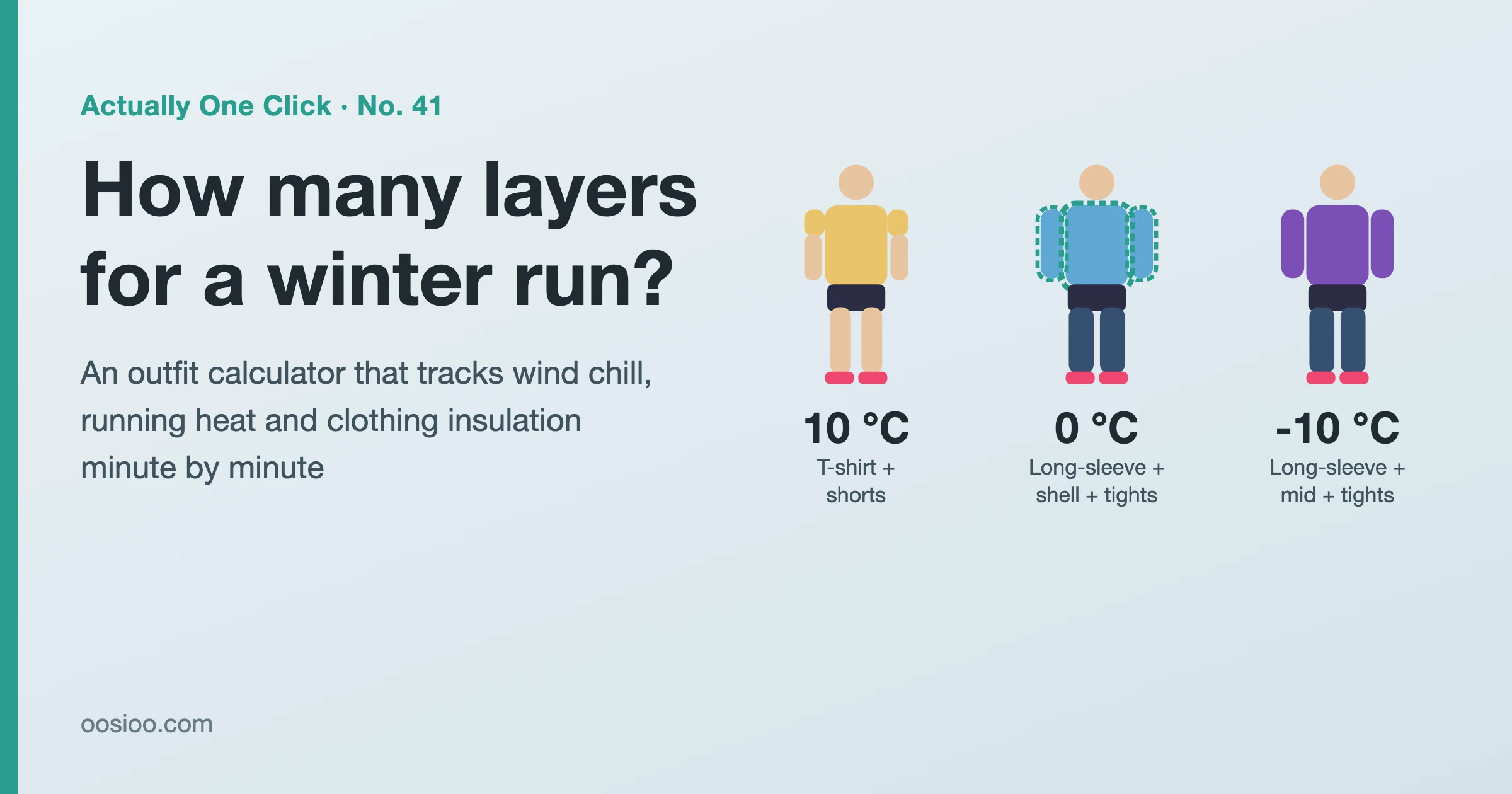
How Many Layers for a Winter Run? — An Outfit Calculator That Tracks Wind Chill, Running Heat and Clothing Insulation Minute by Minute
Every winter morning I face the same question at the front door: one more layer or not? Runners pass around two rules of thumb: "dress as if it were 10 ℃ warmer" and "start out cold". To check them with numbers, I built a body-temperature model. It links the heat running produces (the ACSM equation), the heat clothing holds in (the ASHRAE clothing table with the ISO 9920 correction) and how body temperature moves over time (the Gagge two-node model), then checks the result against an experiment of 40-minute runs at 5 ℃. With the model's defaults, skin temperature came out 6 ℃ warmer than the experiment. Changing one coefficient brought the skin within 1 ℃, but then core temperature came out 1.5 ℃ high. By this model, "start out cold" is right: one more layer raises skin temperature at the coldest moment by 1.3 ℃, but adds 11% more sweat and runs hot later on. "Add 10 ℃", on the other hand, turned out far too small: the outfit the model picked for 0 ℃ is what suits a 25 ℃ day when standing still.
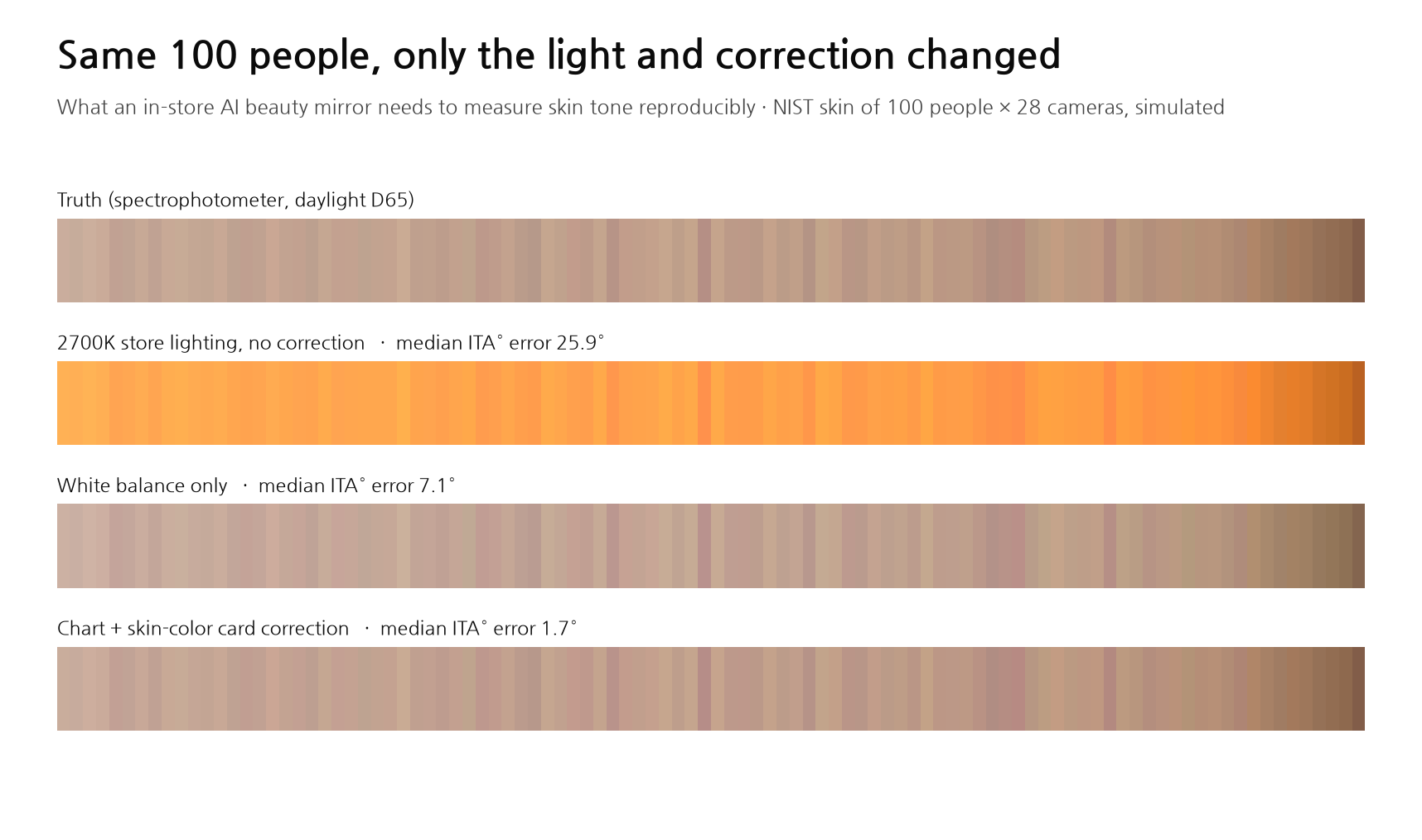
For a Store Mirror to Measure Skin Tone — The Code Takes a Day; Reproducibility Is Decided by Light, Distance and Shine
In-store devices that measure skin, like the Samsung AI Beauty Mirror shown at CES 2026, are spreading. The core calculations — skin-tone angle (ITA°), melanin/blood separation, shine removal — are 20- to 30-year-old methods you can code on a laptop in a day. But when I simulated capturing the measured skin reflectance of 100 people from the US National Institute of Standards and Technology (NIST) with 28 cameras, the results swung widely with the lighting. Measured without correction under 2700K store lighting, ITA° was off by 26° and 92 of 100 people changed category. White balance or a 24-patch color chart still left 6–8°. Adding six skin-color reference swatches brought it down to 1.6°. Leaning in just 5 cm put half of them in a different category, and shine made medium skin tones read up to 17° lighter. In dark skin, one RGB image could barely separate blood at all. A simulator you can run yourself is included.
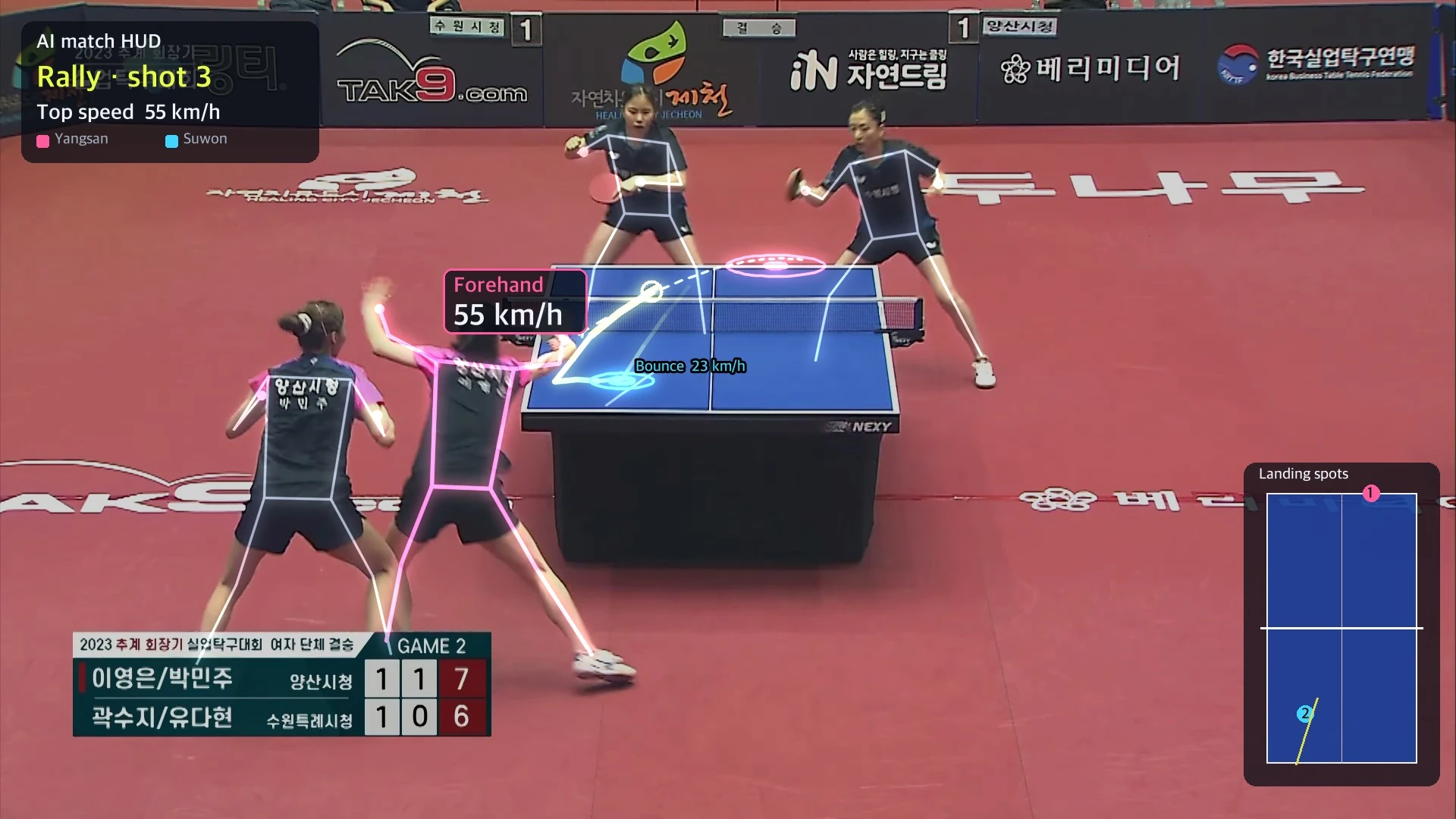
Putting an AR HUD on a Table Tennis Broadcast — Computing Speed, Landing Spots and Forehands from Public Match Footage
Table tennis and badminton clips on social media now carry a ball trail, speed, landing spot and stroke type drawn over the match. I built the same overlay on a freely licensed (CC BY) broadcast of a Korean corporate league women's team final, played in doubles. Six points, the table corners and the net-post tops, gave the camera position (17 m behind the end line, 4.4 m up). Ball candidates came from background difference, YOLO and a small neural network, and a ballistic model with air drag plus player pose gave 3D paths and speed. In the reviewed rally, the four shots left the racket at 33–55 km/h and bounced at 23–35 km/h. Without drag, the same ball came out inflated to 77 km/h. Fully automatic tracking, though, found the ball only 36% of the time, because the two near players cover the table in doubles and at 30 fps the ball smears into a streak.
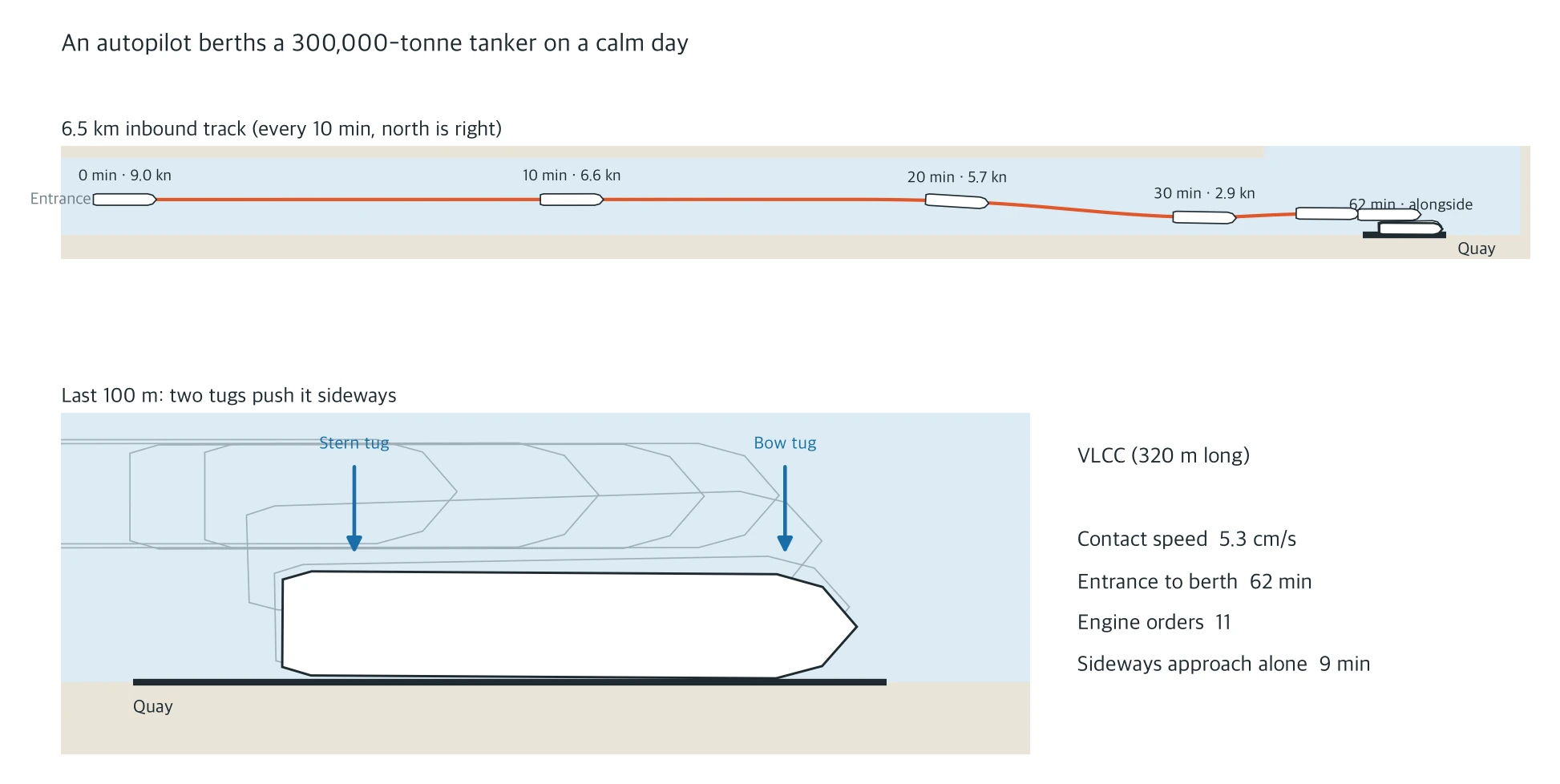
Can a Harbour Pilot Be Replaced by One Click? — Building an Autopilot That Berths a 300,000-Tonne Tanker in a Simulator
A harbour pilot boards a big ship and brings it from the port entrance to the berth, and the job is famously well paid. Can it be automated? I built a made-up port around the manoeuvring model of a 320 m, 300,000-tonne tanker (KVLCC2), wrote an autopilot that uses engine orders, rudder and three tugs, and ran more than 1,100 trials while changing wind, tug power, radio delay and position sensor. On a calm day it took 62 minutes and 11 engine orders to go from the entrance to the berth, touching the quay at 5.3 cm/s, close to a Singapore terminal's 0.1-knot (about 5.1 cm/s) guide. With box-ship windage, an 11 m/s beam wind pushed the contact speed to 12.8 cm/s. From 13 m/s the wind outpushed two 60-tonne tugs and half the runs hit something other than the berth first. It also broke when tug orders ran more than 45 seconds late or the wind force was not computed in advance. Much of the calculation that moves the ship can be automated. What remains is deciding whether to go in at all, the talk with tugs and traffic control, and responsibility.
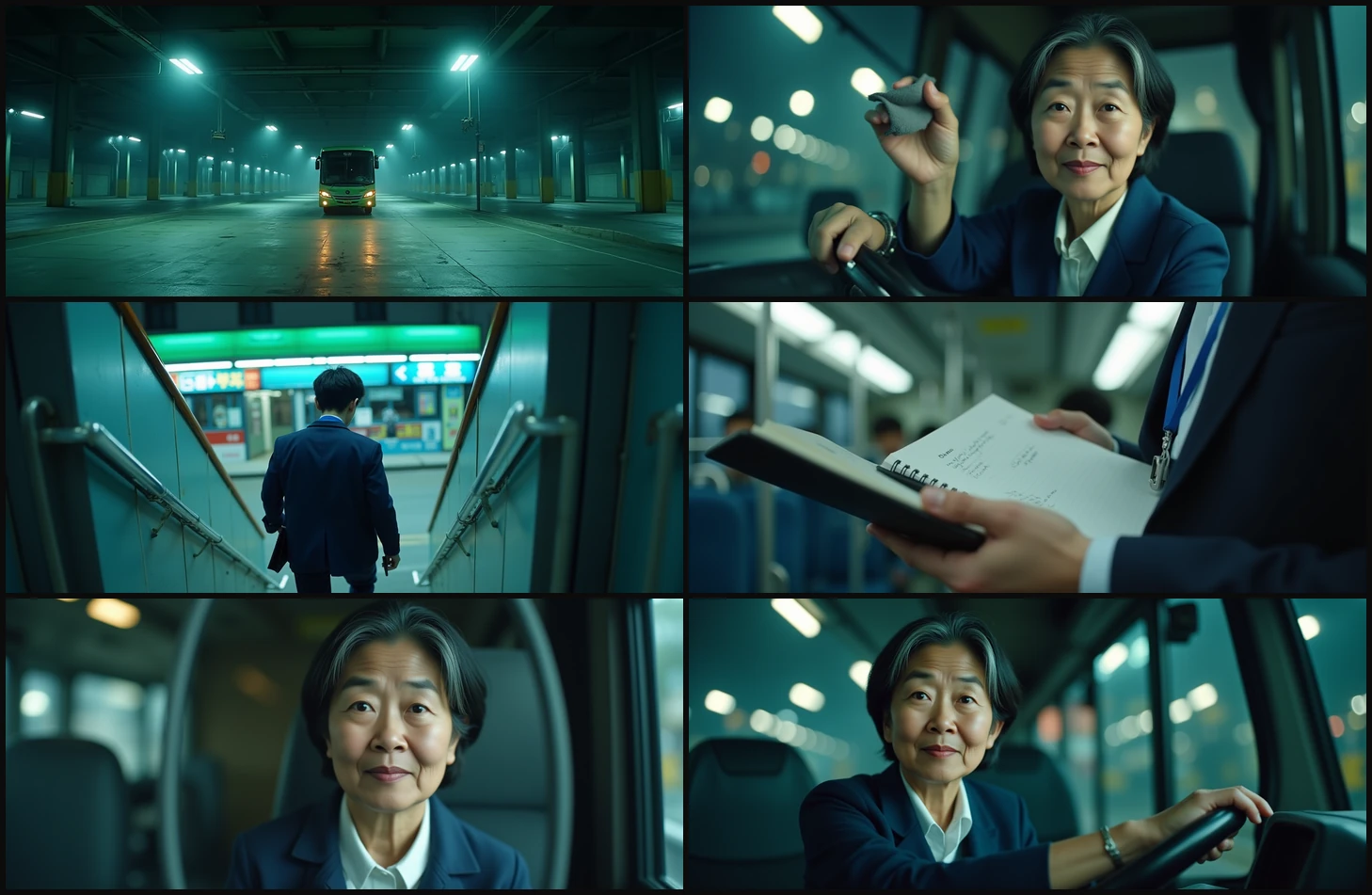
What Happens When AI Makes a Short Film Alone? — Shooting a 5-Minute Film on One MacBook, From Script to Edit
We gathered where AI has actually been used in film and fiction, then handed a 5-minute short over to AI entirely. Netflix said it used generative AI in about 300 titles this year, but most of that was post-production filling in crowd and background shots that were never in the budget. Two films billed as "Korea's first AI features" each drew audiences in the 600-700 range. In fiction, studies show AI catching up to humans on sentence quality, but readers still price in who wrote it. In our MacBook experiment, the script came out in 54 seconds. Once we told the AI director the equipment's limits, it rewrote all 26 lines of dialogue to play off-screen in a 59-shot shooting script. Faces were cast by rule, voices by description, and the three music tracks took 26 minutes. Instead of the full film, four scenes are shown as GIFs. The script works in one click — the screen doesn't, yet.
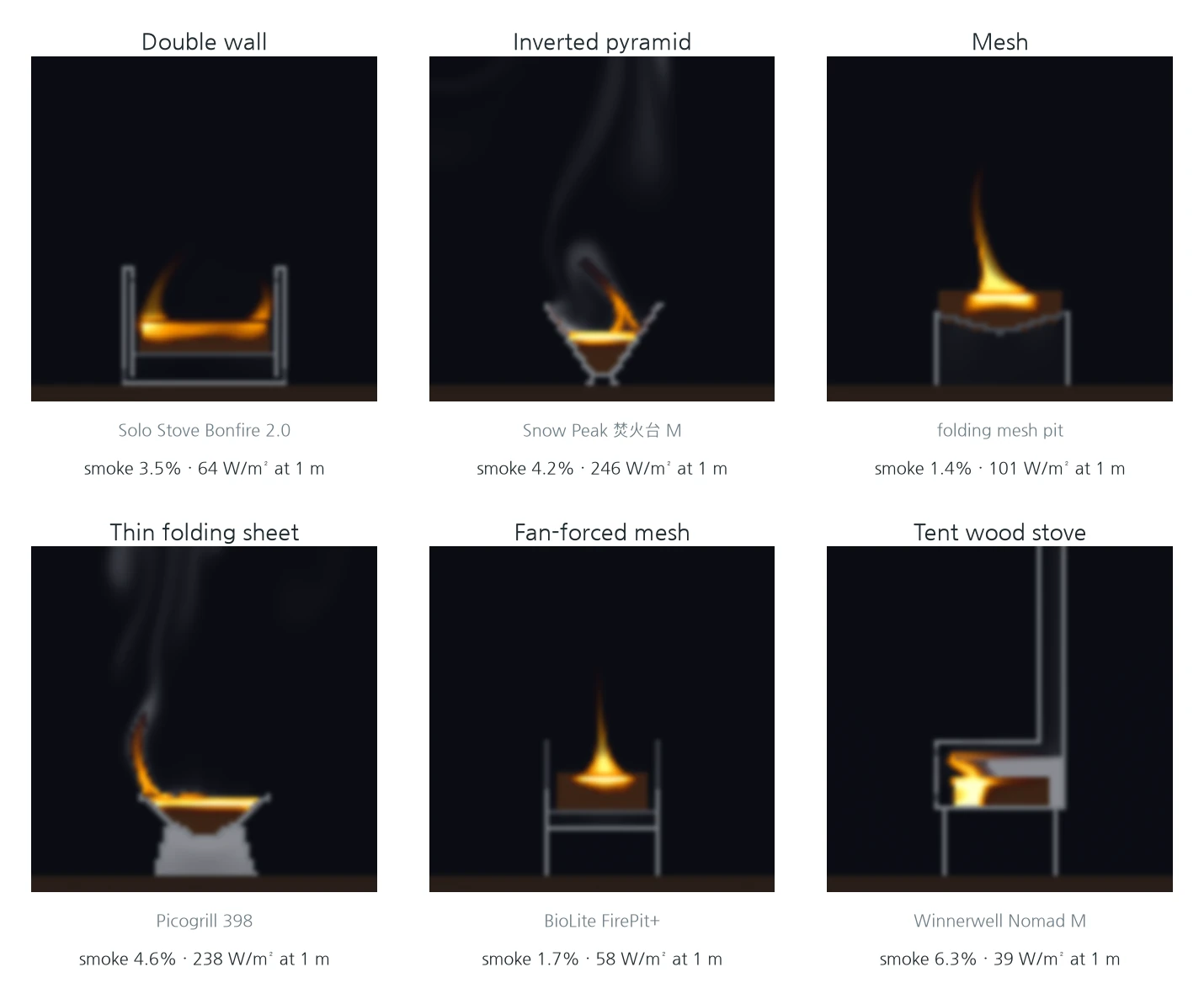
Light a Fire Before You Buy the Fire Pit — Running Six Popular Fire Pit Designs Through a Combustion Simulator
The best part of winter camping is staring into a wood fire. But fire pits differ in smoke, flames and where the heat goes. Can you see that in advance from shape and structure alone? I drew the published dimensions of a double-wall cylinder (Solo Stove Bonfire 2.0), an inverted pyramid of solid plates (Snow Peak Takibi M), a mesh pit, a thin folding sheet (Picogrill 398), a fan-forced pit (BioLite FirePit+) and a tent wood stove (Winnerwell Nomad M) into a cross-section grid, and ran 60-odd trials of a 2D simulator that computes airflow, the burning of wood gas and charcoal, and radiant heat rays together. With the same wood (3 kg per hour), radiant heat on a person 1 m away was 246 W/m² for the inverted pyramid and 64 W/m² for the double wall, a fourfold gap. Unburned smoke was 1.4% for mesh, 1.7% fan-forced, 3.5% double wall and 4.2% inverted pyramid. Widening the double wall's gap from 1.25 to 3.75 cm dropped its outer wall from 314°C to 79°C, while the top secondary-burn holes only cut smoke (3.6% to 2.6%) when the wood was tripled. I also summarize the history of calculating fire (Franklin stove, Rumford fireplace, rocket stoves, EPA rules) and how well-known simulators work (FDS, Rothermel, Stable Fluids, EmberGen).
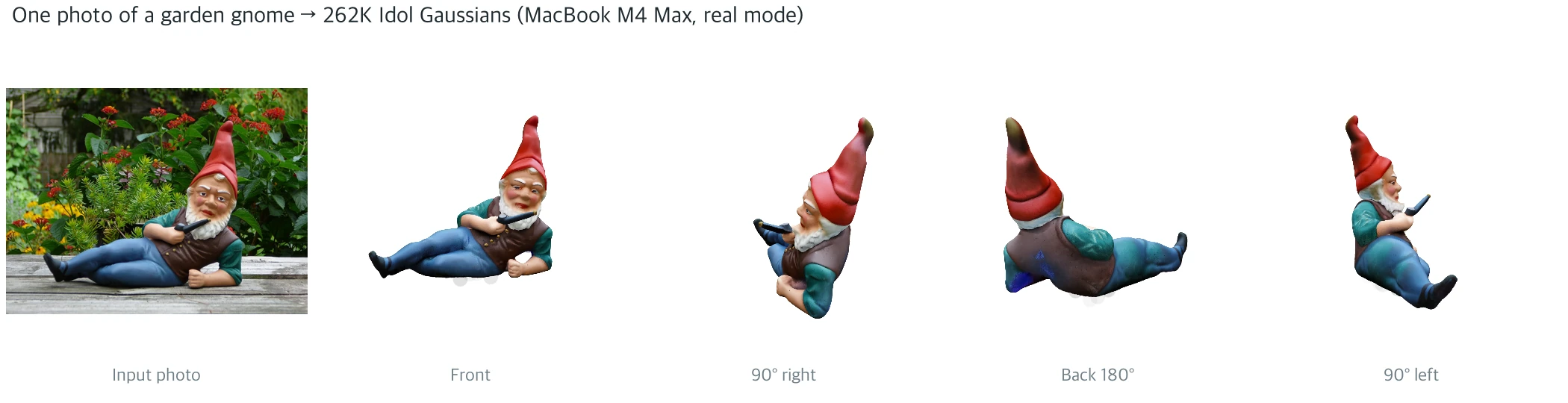
One Photo to 3D, Now on a MacBook — Scoring Idol on the Same Test as Episode 39's TRELLIS
I took the problem from episode 39, where TRELLIS ran on a laptop GPU, and solved it with Idol on a MacBook (M4 Max) with no NVIDIA GPU. Idol, released in April, is a 660-million-parameter model that turns one photo into a bundle of 3D Gaussians, and it has a port to Apple's MLX. I rendered episode 39's five ground-truth objects at the same angle and scored them with the same code. On the three public models it stayed within 1 mm like TRELLIS (0.77–0.95 mm). On my custom little house it was 1.79 mm, better than TRELLIS (2.98 mm): where TRELLIS copied the front door onto the back wall, Idol left the wall blank. It still did not invent the mug handle missing from the photo. Each object took 227–289 seconds, more than ten times slower than the episode 39 laptop, and MLX memory peaked around 8.6 GB. Increasing the Gaussian count 16-fold barely changed the time. The output is splats, so I extracted meshes with Poisson reconstruction and ran them through episode 39's print conversion; all seven became single watertight STL files. Re-scoring as meshes did not change the order.
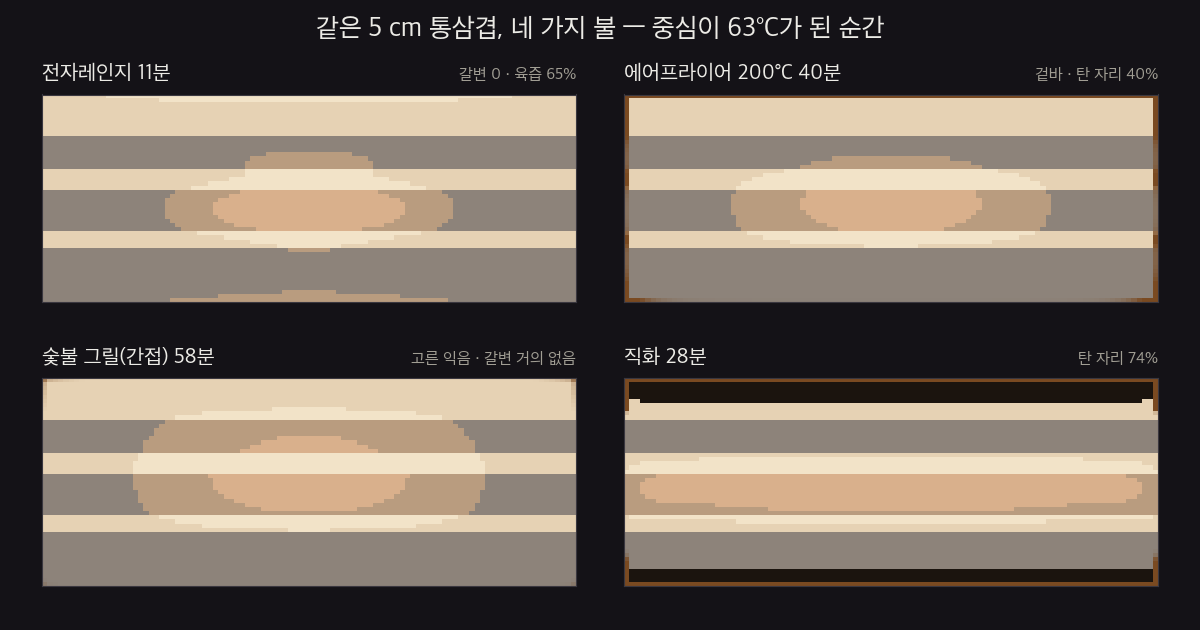
Does Barbecue Add Up? — I Ran a 5 cm Pork Belly Through a Microwave, Air Fryer, Charcoal Grill, and Open Flame in a Simulator
The same meat becomes a completely different food depending on where you cook it. I sliced the cross-section of a 5 cm pork belly roast into a 1 mm grid and built a simulator that jointly computes heat conduction, surface evaporation, juice loss, Maillard browning, and collagen softening. Cooking to a 63°C core took 11 minutes in the microwave, 28 over direct fire, 40 in the air fryer, and 58 in a lidded charcoal grill. The microwave kept 65% of the juice but produced zero browning; direct fire charred 74% of the surface — the calculation itself explains why Koreans slice pork belly thin for grilling. A search over 32 two-phase recipes that switch appliances mid-cook crowned 'microwave to 50°C, finish in a 200°C air fryer' (19.5 minutes), with the barbecue community's reverse sear re-emerging near the top. Also covered: the people who compute cooking for real — baking simulation in graphics (UCLA), meat-as-polymer food engineering (Wageningen), computational gastronomy (IIIT-Delhi), and AI recipe exploration at Sony AI, IBM, and NotCo.