oosioo
Read in English
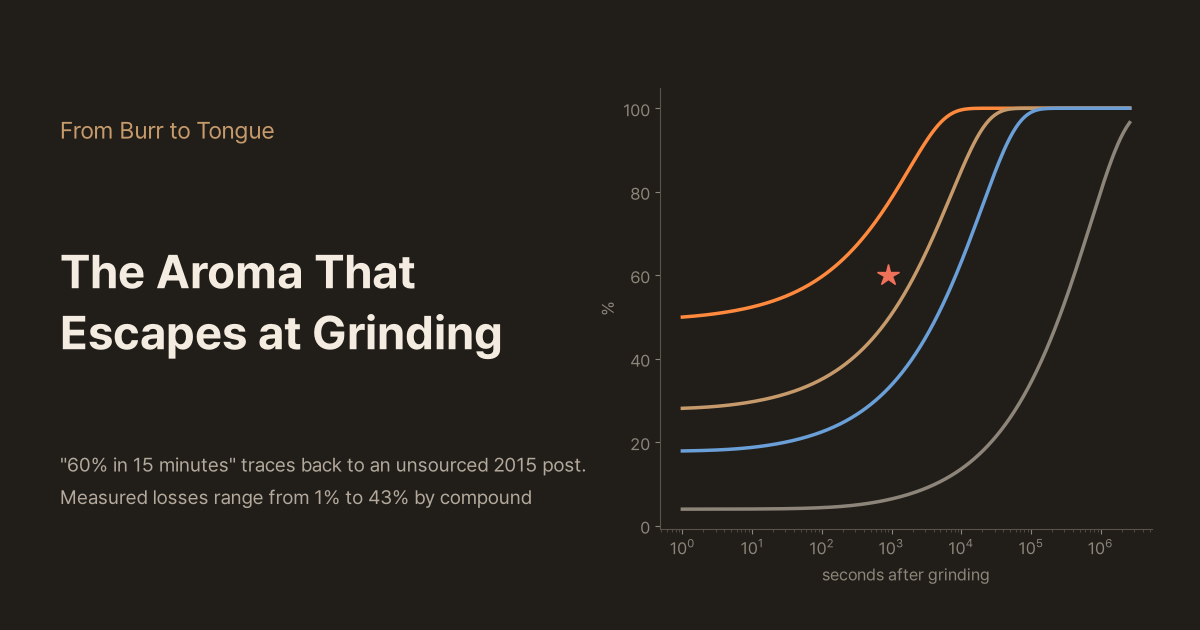
The Aroma That Escapes at Grinding
I traced "ground coffee loses 60% of its aroma in 15 minutes" back to its source. Most pages give none; the one that does leads to an unsourced 2015 LinkedIn post. The only primary 15-minute measurement, Grosch (1999), found 43% of methanethiol and 39% of acetaldehyde gone, but just 1% of furanones in 30 minutes. A model combining opened cells and diffusion gives release times by particle size, with a calculator to try it yourself.
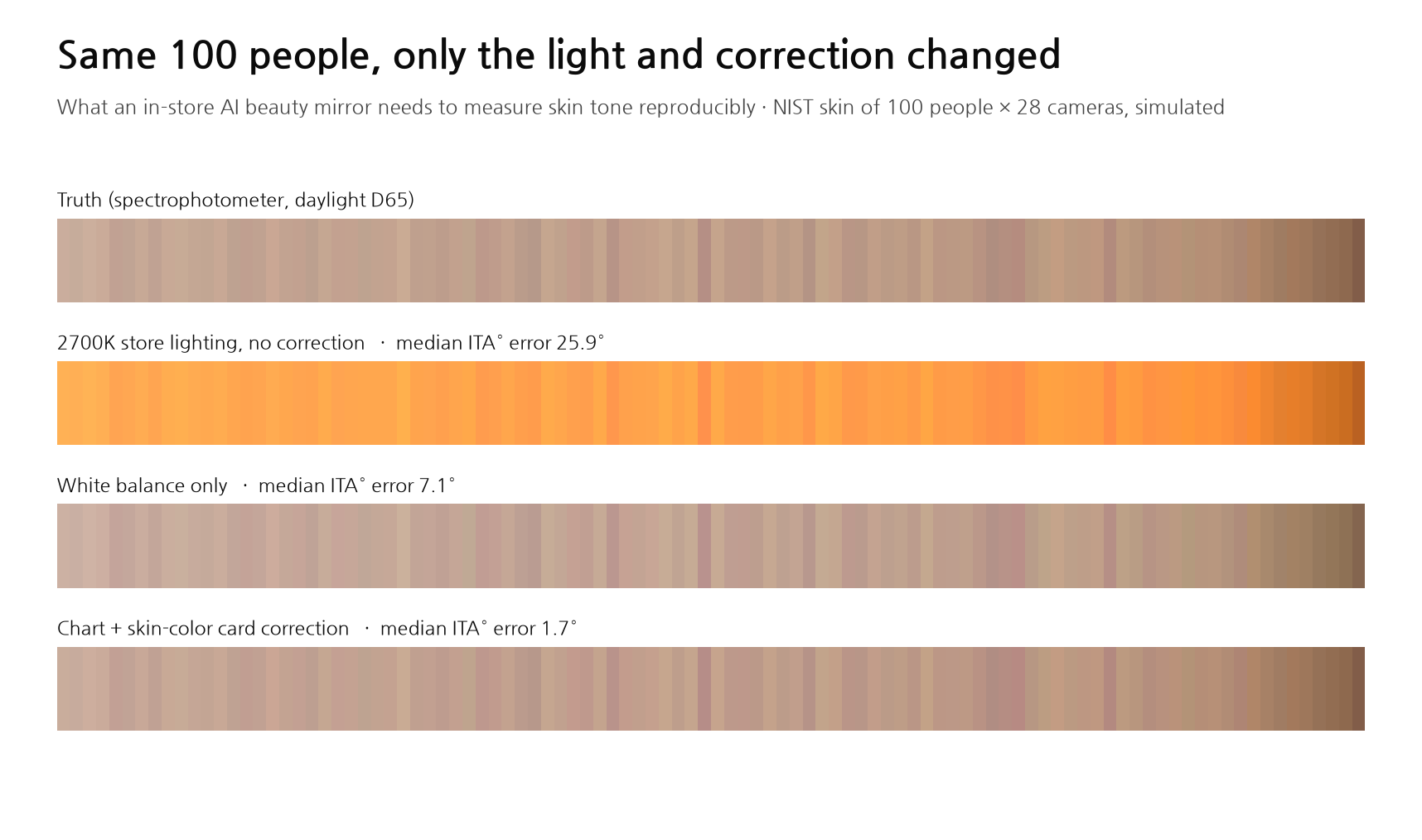
For a Store Mirror to Measure Skin Tone — The Code Takes a Day; Reproducibility Is Decided by Light, Distance and Shine
In-store devices that measure skin, like the Samsung AI Beauty Mirror shown at CES 2026, are spreading. The core calculations — skin-tone angle (ITA°), melanin/blood separation, shine removal — are 20- to 30-year-old methods you can code on a laptop in a day. But when I simulated capturing the measured skin reflectance of 100 people from the US National Institute of Standards and Technology (NIST) with 28 cameras, the results swung widely with the lighting. Measured without correction under 2700K store lighting, ITA° was off by 26° and 92 of 100 people changed category. White balance or a 24-patch color chart still left 6–8°. Adding six skin-color reference swatches brought it down to 1.6°. Leaning in just 5 cm put half of them in a different category, and shine made medium skin tones read up to 17° lighter. In dark skin, one RGB image could barely separate blood at all. A simulator you can run yourself is included.

How to Notice Happiness (2) — You Can't Catch It by Someone Else's Standard
I grew anxious over other people's success, and even as my salary rose, I kept seeing someone who earned more. Happiness defined by comparison never arrives. How far can money buy it?
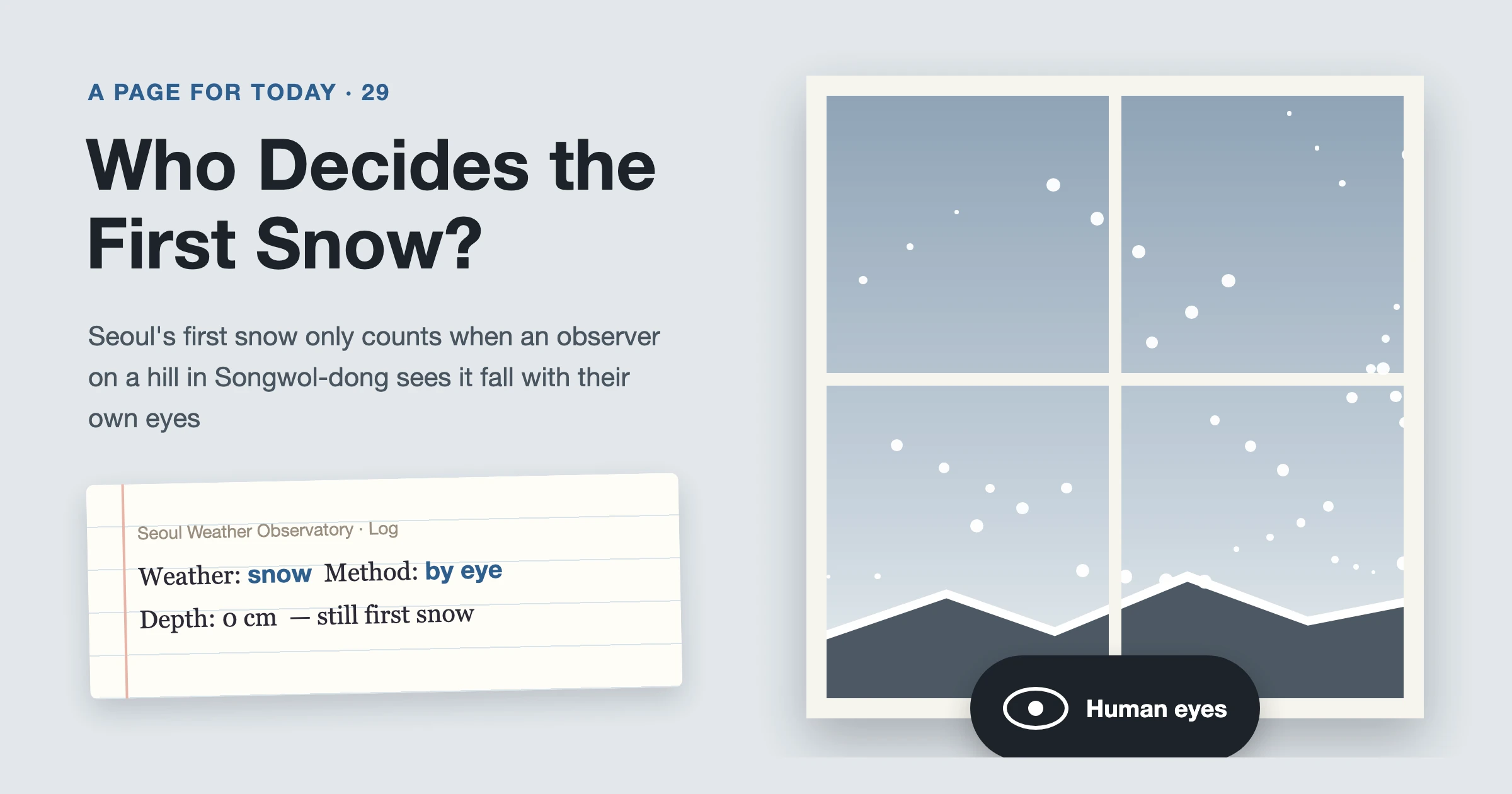
Who Decides the First Snow?
Seoul's first snow is not decided by whether it snows somewhere in Seoul. It is recorded only when an observer at the Seoul Weather Observatory in Songwol-dong, Jongno-gu, sees snow falling with their own eyes. Sleet on Bukhansan or snow pellets in Gangnam don't count unless they reach Songwol-dong. Matching press reports of KMA announcements for twelve winters, 2014 to 2025, the earliest and latest first snows were 30 days apart. After Kyoto switched to machine judging in 2020, its normal first snow moved six days earlier, and in the United States snow under 0.1 inch is only a "trace". Under the same sky, the first snow date depends on who measures it and with what. An interactive lets you judge "Is this first snow?" yourself. This year's first snow was seen on Seoraksan on 29 October, but as of 4 November Seoul's first snow has not come. The twenty-ninth piece in A Page for Today.
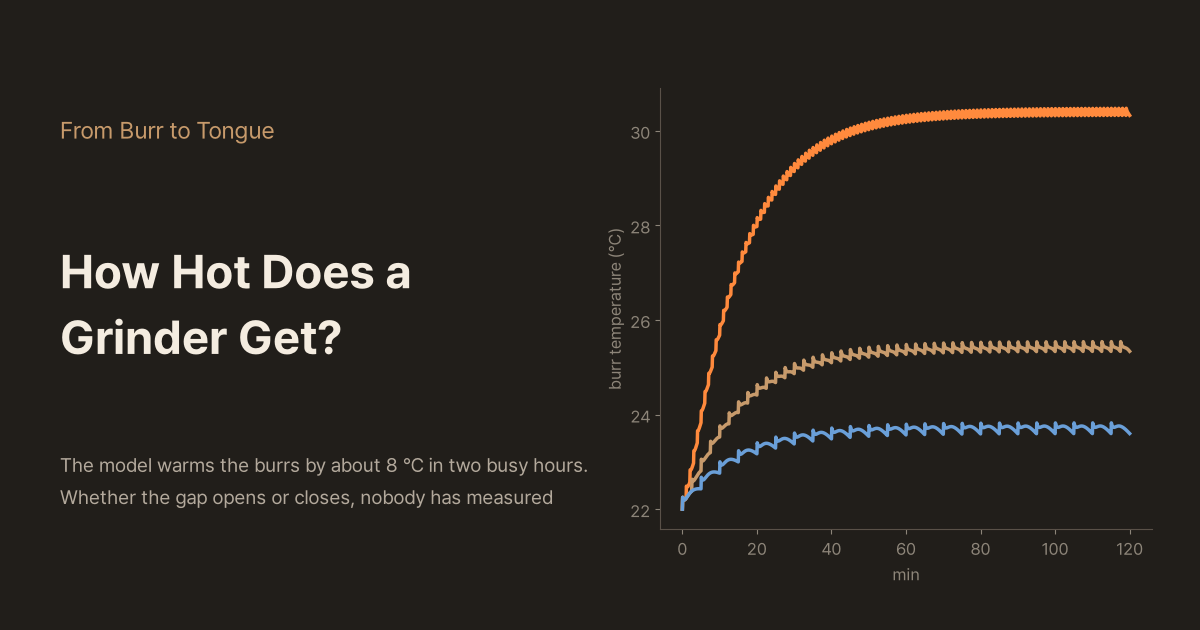
How Hot Does a Grinder Get?
Cafés tighten the grind as the afternoon goes on: is a warm grinder the reason? I found no public record of burr temperature during service, nor of the gap on warm burrs. Fitting a thermal network to the only two measured points (+12 °C in the grounds after ten minutes of continuous grinding), a shot a minute for two hours warmed the burrs by about 8 °C. A 3 µm gap shift changes espresso shot time by a little over 2%, but whether the gap opens or closes depends on the grinder's build. With a heat calculator.
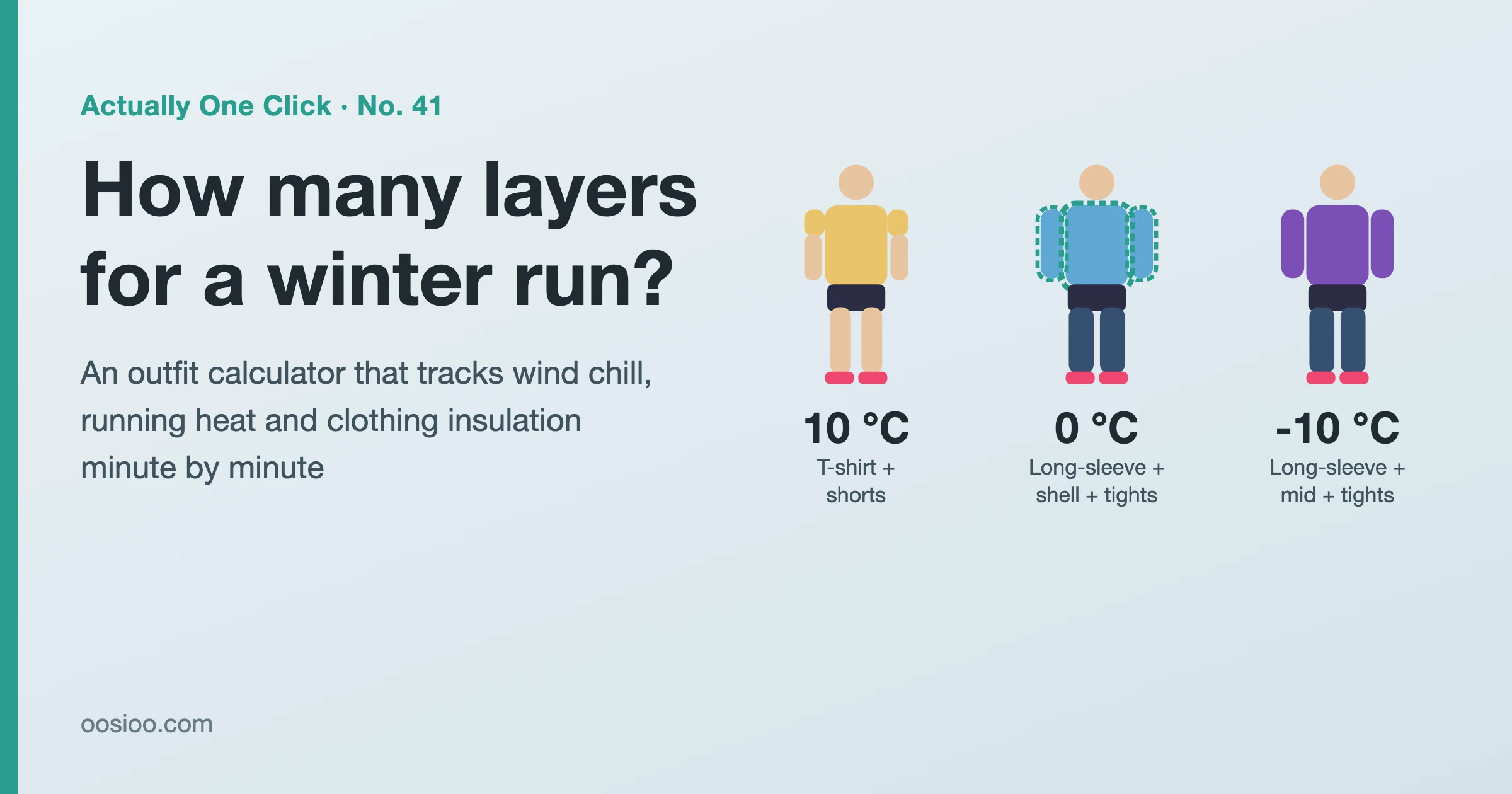
How Many Layers for a Winter Run? — An Outfit Calculator That Tracks Wind Chill, Running Heat and Clothing Insulation Minute by Minute
Every winter morning I face the same question at the front door: one more layer or not? Runners pass around two rules of thumb: "dress as if it were 10 ℃ warmer" and "start out cold". To check them with numbers, I built a body-temperature model. It links the heat running produces (the ACSM equation), the heat clothing holds in (the ASHRAE clothing table with the ISO 9920 correction) and how body temperature moves over time (the Gagge two-node model), then checks the result against an experiment of 40-minute runs at 5 ℃. With the model's defaults, skin temperature came out 6 ℃ warmer than the experiment. Changing one coefficient brought the skin within 1 ℃, but then core temperature came out 1.5 ℃ high. By this model, "start out cold" is right: one more layer raises skin temperature at the coldest moment by 1.3 ℃, but adds 11% more sweat and runs hot later on. "Add 10 ℃", on the other hand, turned out far too small: the outfit the model picked for 0 ℃ is what suits a 25 ℃ day when standing still.

How to Notice Happiness (1) — So, Are You Happy?
Small wins, value added, good leadership — none of it means much if you're not actually happy. Why is the belief that happiness arrives once conditions are met a mirage?
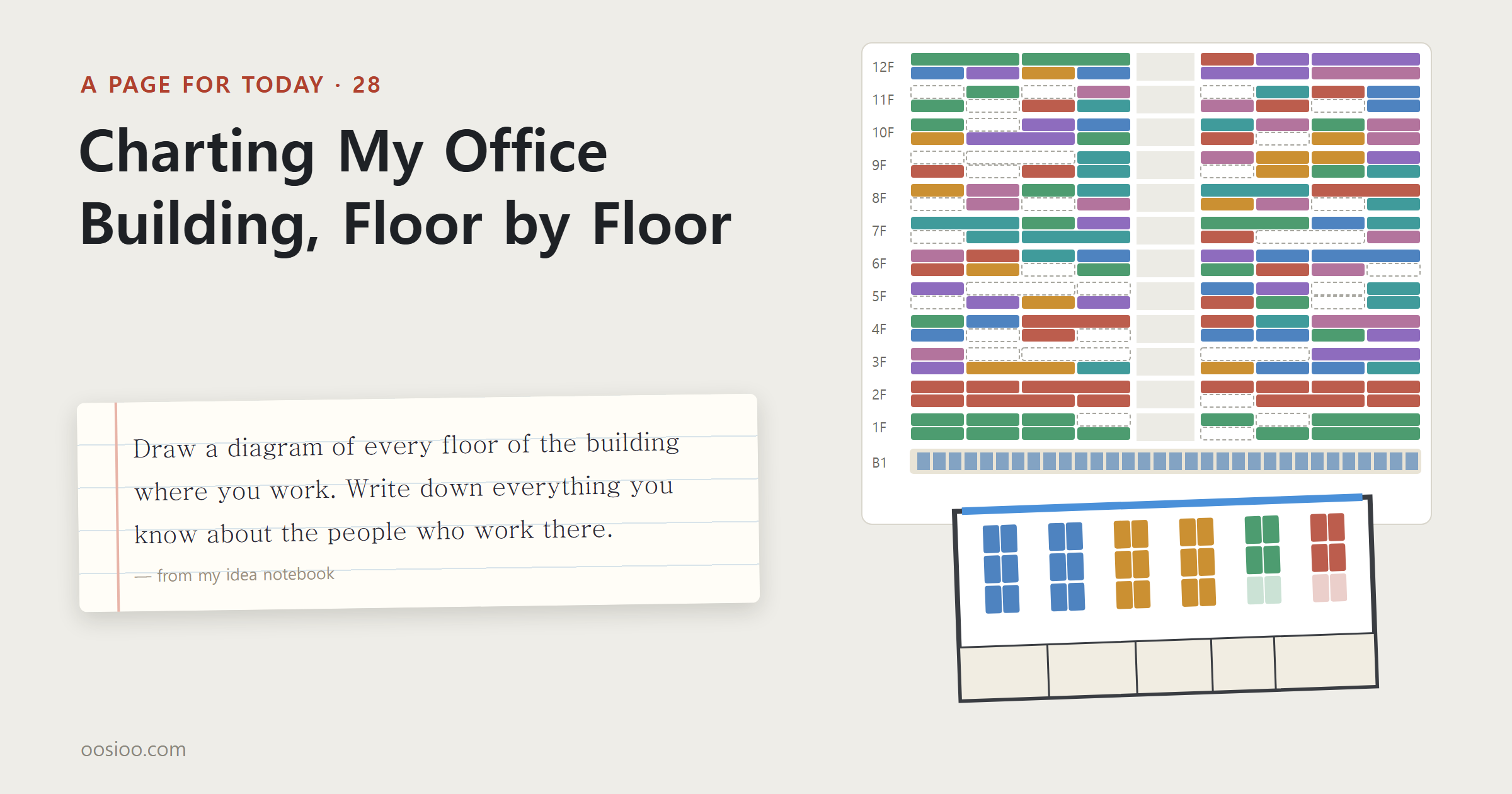
Charting My Office Building, Floor by Floor
My notebook said: draw a diagram of every floor of the building where you work, and write down everything you know about the people who work there. Thinking of the Korean office-factory block I work in, I start with what these 'knowledge industry centres' are and why so many now stand partly empty. I compare how much floor one person needs under fire codes, housing standards and office benchmarks, then follow the technology that solves space by calculation: the 1957 plant-layout problem, CRAFT and the Allen curve, parking solvers, generative office design, floor-plan datasets and furniture-layout research. An interactive stacks an imaginary building floor by floor, seats teams in an office you choose, furnishes flats and packs car parks. The twenty-eighth piece in A Page for Today.
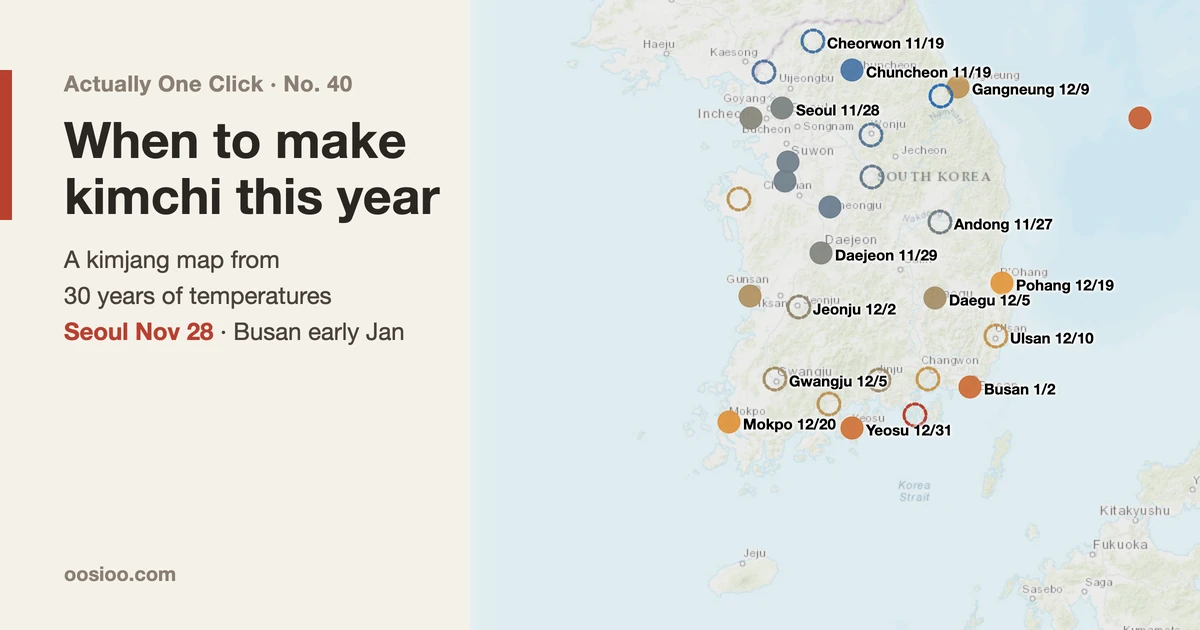
When Should You Make Kimchi This Year? — A Regional Kimjang Map from 30 Years of Temperatures, and Why the First Cold Snap Is a Trap
Kimjang, Korea's once-a-year making of winter kimchi, is traditionally timed for when the daily mean temperature stays at or below 4°C and the daily low at or below 0°C. The Korea Meteorological Administration used to publish this itself; since 2016 it has been left to private forecasters. I applied the same rule to 1991–2020 station temperatures to recalculate each region's normal date: Seoul 28 November, Daejeon 29 November, Chuncheon 19 November, Gangneung 9 December, Busan 2 January. The biggest error in the calculation came from one word, "stays". Taking the first day the temperature dipped below 4°C made Seoul's date 14 days early on average. Reanalysis temperatures, used to cover the whole country evenly, pulled Seoul's date 7 days earlier, because the grid washed out the city's heat. Seoul's normal date has moved 2–3 days later over 70 years, but the latest 30 years show no trend. This year the KMA one-month outlook says "above normal" from 9 November to 6 December, so around 1 December is likely for Seoul. The brief cold snap around 7 November is not the time.
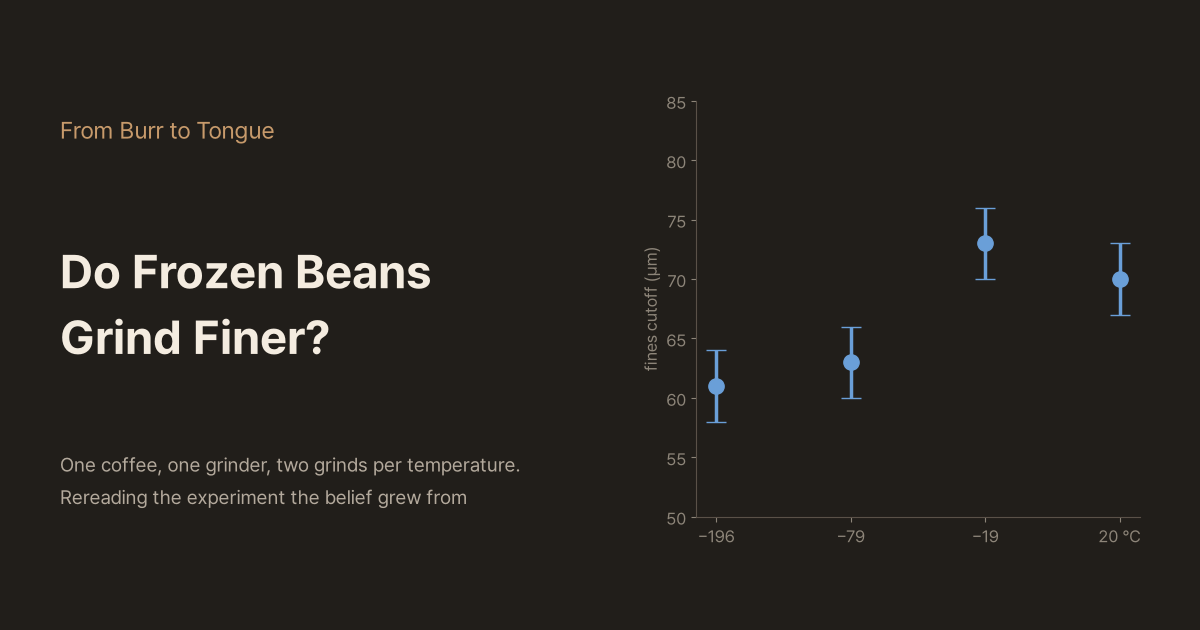
Do Frozen Beans Grind Finer?
I reread Uman et al. (2016), the starting point of the idea that frozen beans grind finer and more evenly. It used one coffee, one grinder, one day and two grinds per temperature, with no statistical test of the temperature effect; on one metric, freezer beans (−19 °C) came out larger than room-temperature beans. The co-authors included people from the grinder maker, the instrument company and the café. Giving a virtual grinder candidate "cold bean" properties, none produced a finer and narrower distribution at once. With a tool for working out how many grinds you need.

We Are All the Same (5) — The One Who Connects
No matter how different our backgrounds, people turn out to be the same in wanting to be recognized, understood, and to do meaningful work. Becoming someone who bridges others — enough attempts at that, and it adds up to trust.
Can One Photo Get You to a 3D Print? — Running TRELLIS on a Laptop GPU
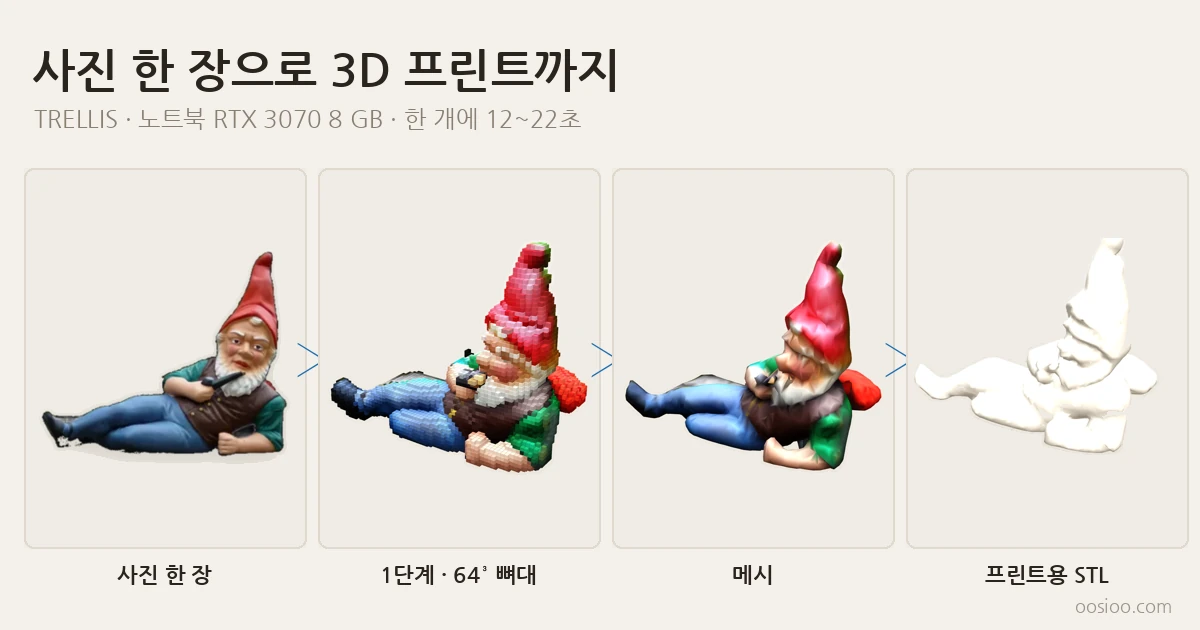
Upload a photo to services like Tripo or Meshy and a 3D model comes back in tens of seconds. I tried doing the same on a personal laptop with TRELLIS, released by Microsoft. The official requirement is 16 GB of GPU memory, but loading only the models each stage needs made it run on an 8 GB laptop (RTX 3070) in 12–22 s per object. Measured against ground truth, the public models landed within 1 mm on average when printed at 6 cm. Objects I built myself drifted to 1.5–3 mm, and a handle the photo did not show was never made. Getting to a 3D printer took more work: the generated meshes were hollow skins with only 4–56% of the volume they have once filled. I also compared it on the same laptop with TripoSR and TripoSG, released by Tripo: TripoSG matched or beat TRELLIS on shape and came out solid, but has no color and was more than three times slower. This post also lays out the lineage of 3D reconstruction methods and the principles behind Tripo and TRELLIS.
Can You Read the Reader from a Magazine of Nothing but Ads?
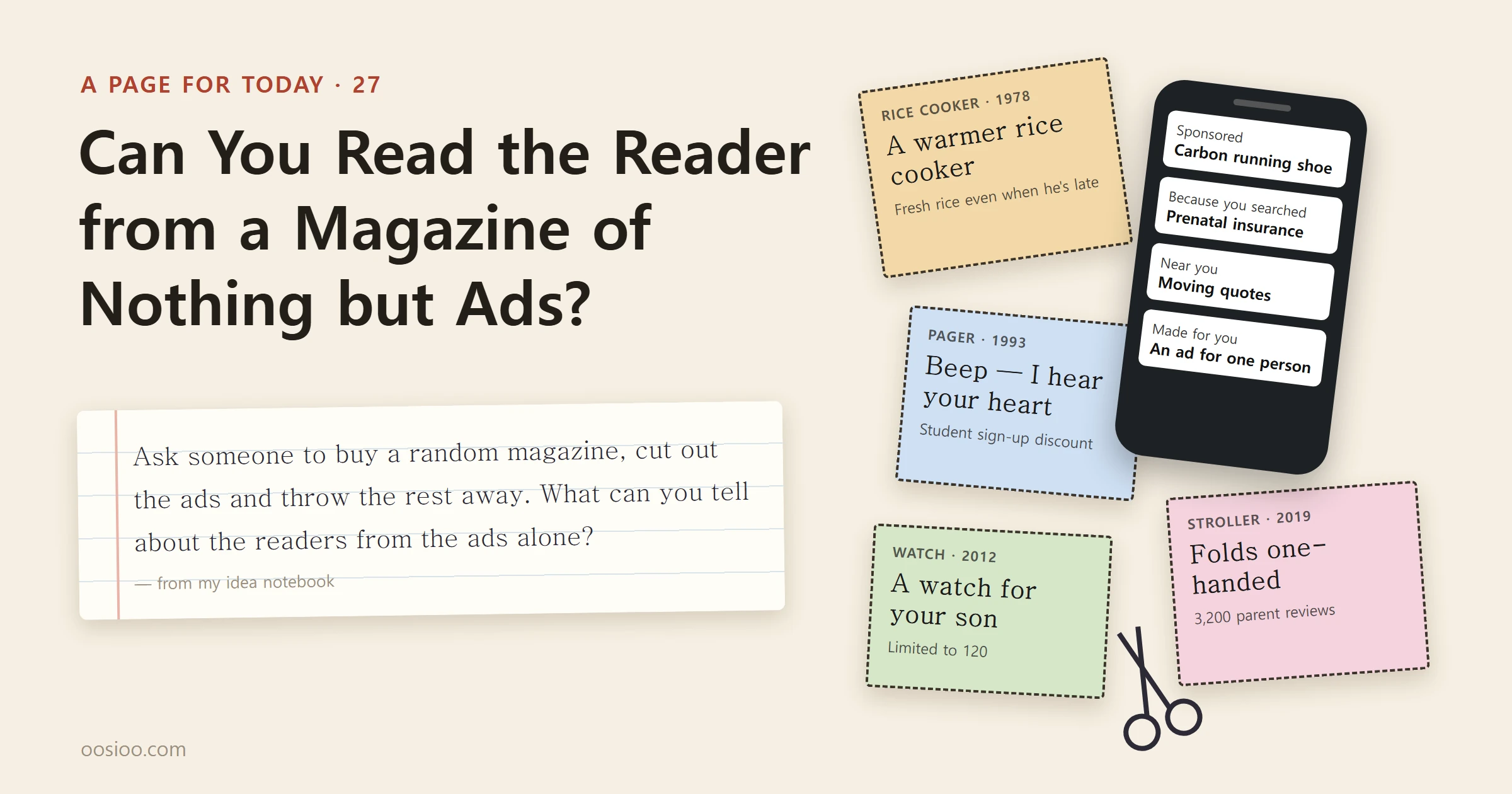
My notebook said: ask someone to buy a random magazine, cut out the ads and throw the rest away — what can you tell about the readers from the ads alone? Starting from Pompeii's election notices and a Song-dynasty needle-shop printing plate, I follow how advertising came to know its audience: the 1893 ten-cent magazine that began selling readers to advertisers, Listerine inventing an anxiety, Goffman reading a society's gender script from ad photos, banner ads that started counting clicks, and a 2012 study that reconstructed users from the ads on their screens. Then I look at how AI is changing how ads are made (the $2,000 commercial, Coca-Cola, full automation), the ad market (agency consolidation, algorithmic buying) and the people who see ads (AI summaries eating clicks, ads inside chatbots, distaste for AI ads, deepfake scams). An interactive lets you clip ads from imaginary magazines to guess the reader, and build a magazine for one from your own behaviour. The twenty-seventh piece in A Page for Today.
The RPM Mystery
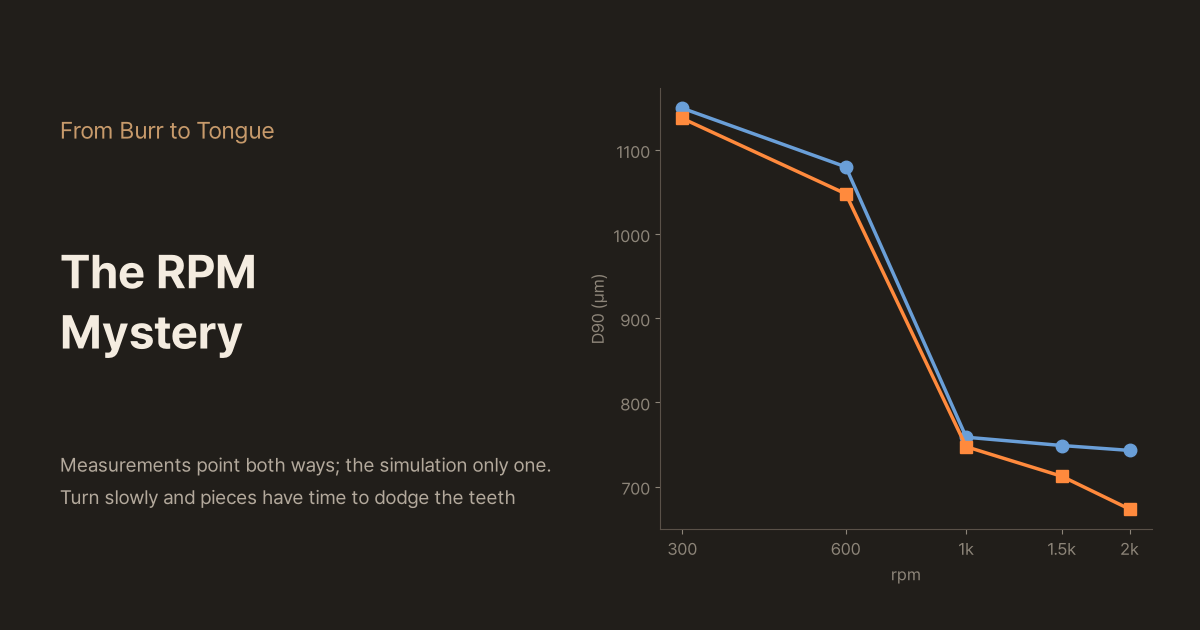
Raise the speed at the same setting: do the grounds get finer or coarser? Measurements and patents split into "faster is finer", "faster is coarser" and "no difference". Changing only the speed of a 3D virtual flat burr, faster always meant finer (D50 697 µm at 300 rpm, 430 µm at 1,000 rpm): at low speed, gap-sized pieces dodged the teeth and slipped out. "Faster is coarser" never appeared in the model; I list candidate reasons. With a comparison tool.

We Are All the Same (4) — Walking in the Other Person's Shoes
Perfect understanding is impossible. But just the attitude of trying to understand changes a lot. This is a story about ten minutes from the other person's point of view, and a shared goal worth wrestling with together.
How Many Speakers Should a Car Have, and Where? — A Simulator That Follows Why Every Seat Hears Something Different
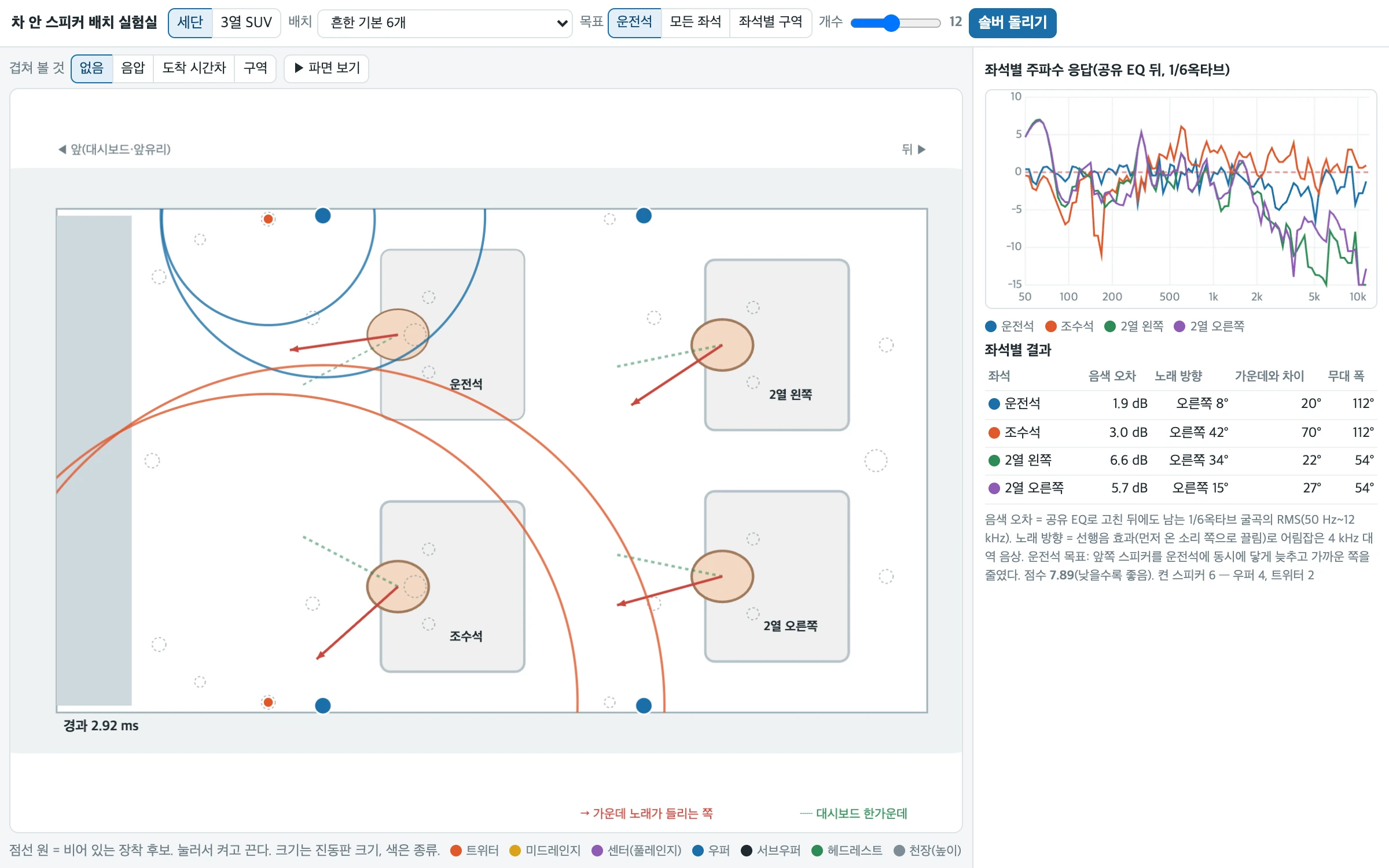
Cars now carry anywhere from 8 to 36 speakers. Yet the driver, the passenger and the back seats hear different things in the same car, because the cabin is small, wrapped in glass, and nobody sits in the middle. I built a simple acoustic model that stacks 5,832 reflection paths inside a box-shaped cabin, and a solver that picks positions from 32 candidate spots (sedan) or 38 (3-row SUV) for a goal. Limited to 4 speakers for the driver, it kept A-pillar tweeters, a center speaker and a subwoofer; for all seats, the center speaker came first. The score stopped improving at about 13 speakers. Per-seat sound zones kept about 20 dB of contrast with headrest speakers even with the head moved 3 cm, but only 10 dB with door speakers.
Before Guessing at an Unsolved Murder
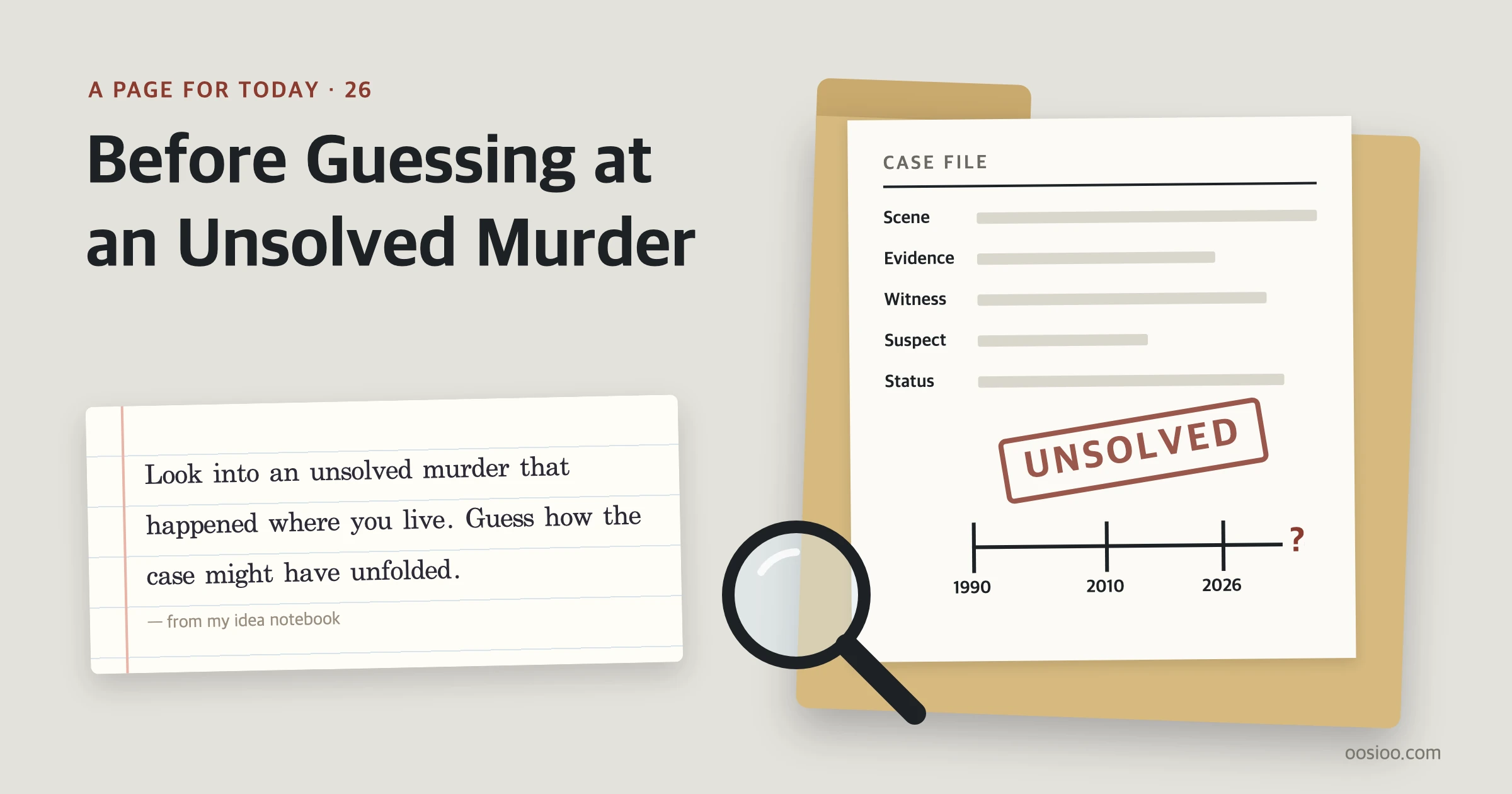
My notebook said: look into an unsolved murder where you live and guess how it unfolded. Speculating about a real case can wound victims' families all over again, so instead of guessing I followed the numbers, the timelines and the technology. Why 86% of Korea's 274 unsolved murders since 1998 date from 2000–2008, a study showing half of solved cases are solved within a week, cases cracked twenty years on by DNA and fingerprints, and a falsified forensic report that sent an innocent man to prison for nearly twenty years. I also weigh what digital forensics, CCTV and AI monitoring, genetic genealogy and face recognition add and what they cost, with an interactive fictional case that shows which evidence time erases and technology revives. The twenty-sixth piece in A Page for Today.
Burr Size, Alignment and Seasoning
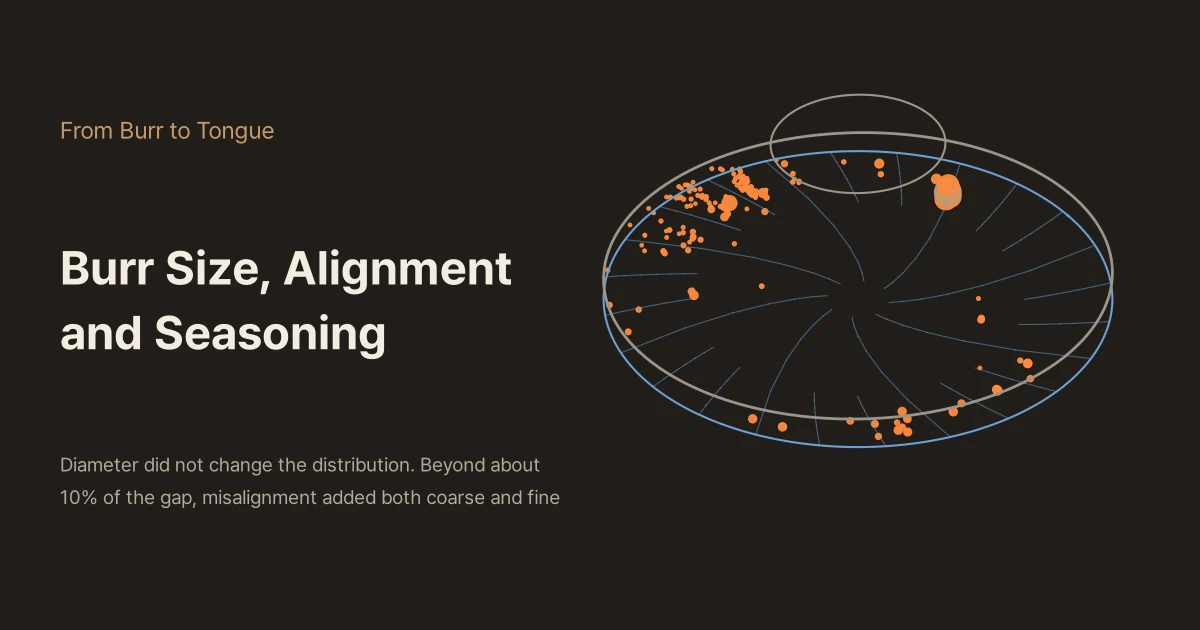
Are bigger burrs better, how much does a slight misalignment matter, and how long should new burrs be broken in? I moved the simulation to 3D to find out. Making the burr 1.5 times wider left the distribution unchanged. Edge errors within 8% of the gap made no difference; beyond 17%, a tilted burr sent coarse pieces out of its wide side and fine ones out of its narrow side, spreading the distribution both ways. The same 30 µm is 12% of an espresso gap. With a 3D replay and a gap map.

We Are All the Same (3) — When Translation Is Needed
Each floor speaks a different language. Simply rendering that language into words the other side can understand, adding a single line of context, turned complaint into comprehension.
Do Conical Burrs Really Make More Fines?
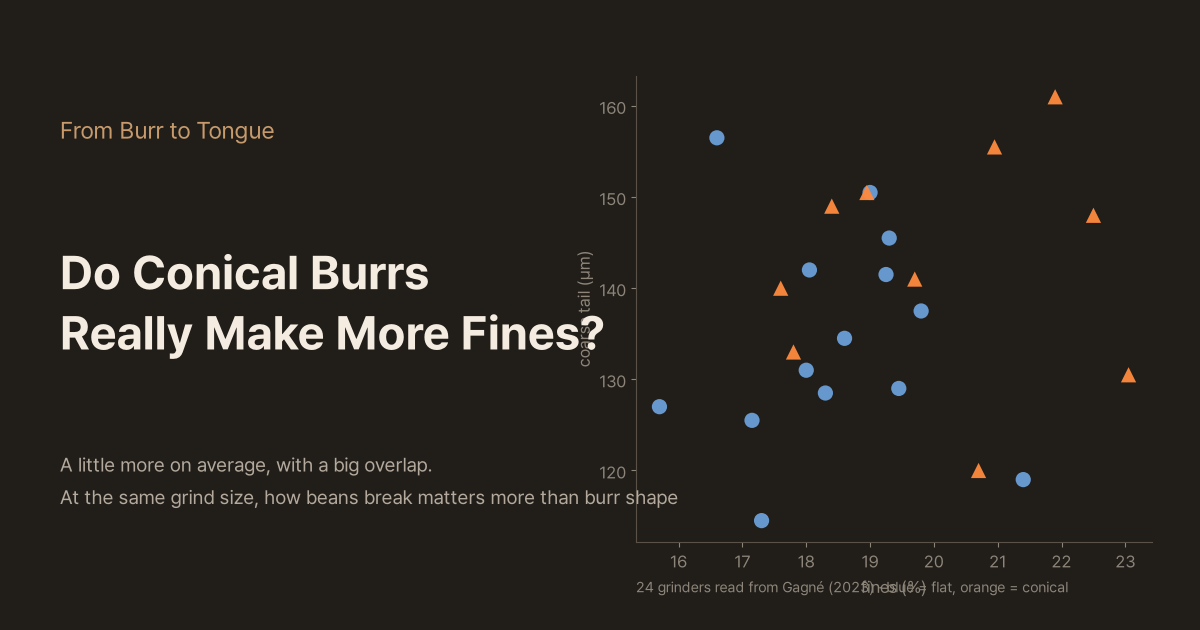
How true is it that conical burrs make more fines and two peaks while flat burrs grind evenly? In data from 24 espresso grinders (Gagné 2023), conicals averaged 1.8 points more fines, but the grinders overlapped heavily and all 24 had two peaks. Matching twelve virtual flat and conical burrs to the same grind size, the difference in fines was only about 0.4 points; the real difference was a long coarse tail in slowly turning conicals. With a tool for comparing them yourself.
Where Should We Go Fishing Tomorrow? — A Web App That Uses Tides and a Map to Pick Where, When, What and How for Beginners Who Know Neither the Spot Nor the Species
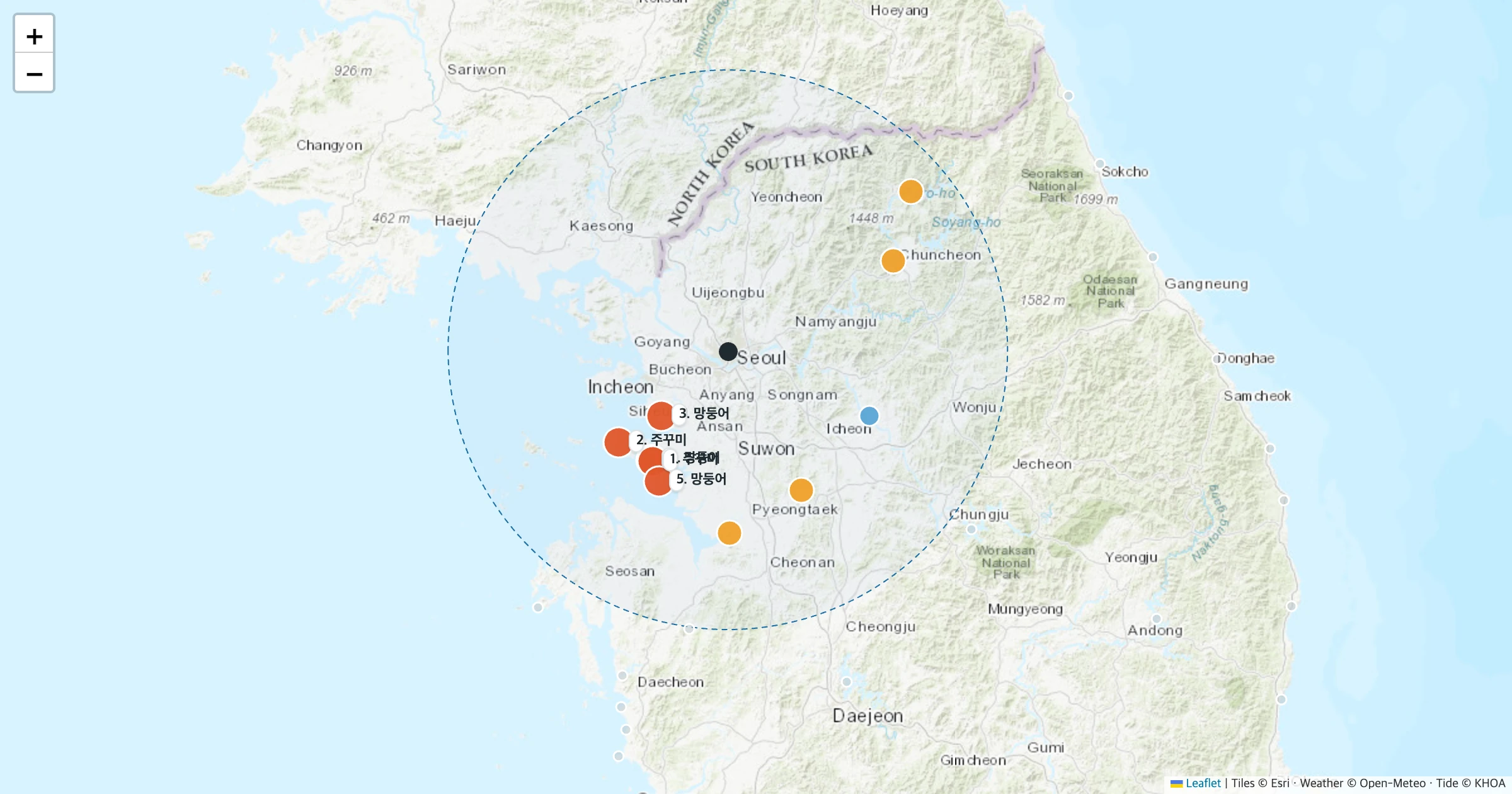
There are plenty of tide apps, catch report apps and closed-season apps. But most of them only work once you pick a region, a target species or a fishing style. A total beginner who wants to try fishing tomorrow needs the opposite: enter where you start and the date, and get places, times, species and rigs. So I built a web app that shows exactly that on a map. It computes tides for 56 spots across Korea from KHOA harmonic constants, overlays wind and wave forecasts with each species' season and closed season, and gives a rough probability of catching at least one fish during your stay. The computed high and low water times were 14 minutes off KHOA predictions on average; a public sea level forecast (Open-Meteo) was 34 minutes off. Shaking each species' base assumption by 0.5 to 2 times left the top five picks from Seoul unchanged 69% of the time.
Read the Front Page Aloud in Two Minutes
My notebook said: buy a newspaper and spend two minutes reading every article on the front page out loud. The last time I opened a newspaper was in the waiting room of a vehicle inspection center. In Korea the share who read a print paper fell from 85% in 1996 to 8.4% in 2025, and news moved to portals and then to YouTube. I look case by case at how the press changed, from a circulation-inflation scandal and shrinking newsrooms to machine-written articles, follow how newspaper-based teaching and essay-exam prep gave way to media literacy education, and explain why reading aloud sticks in memory. A playground lets you read a fictional front page aloud for two minutes. The twenty-fifth piece in A Page for Today.

We Are All the Same (2) — The Illusion of Generations
Gen Z, the old guard: we often blame conflict on generations. But the data says generational differences are far smaller than we think. The real problem seems to have been communication, not generations.
The Path of a Bean Through a Conical Burr
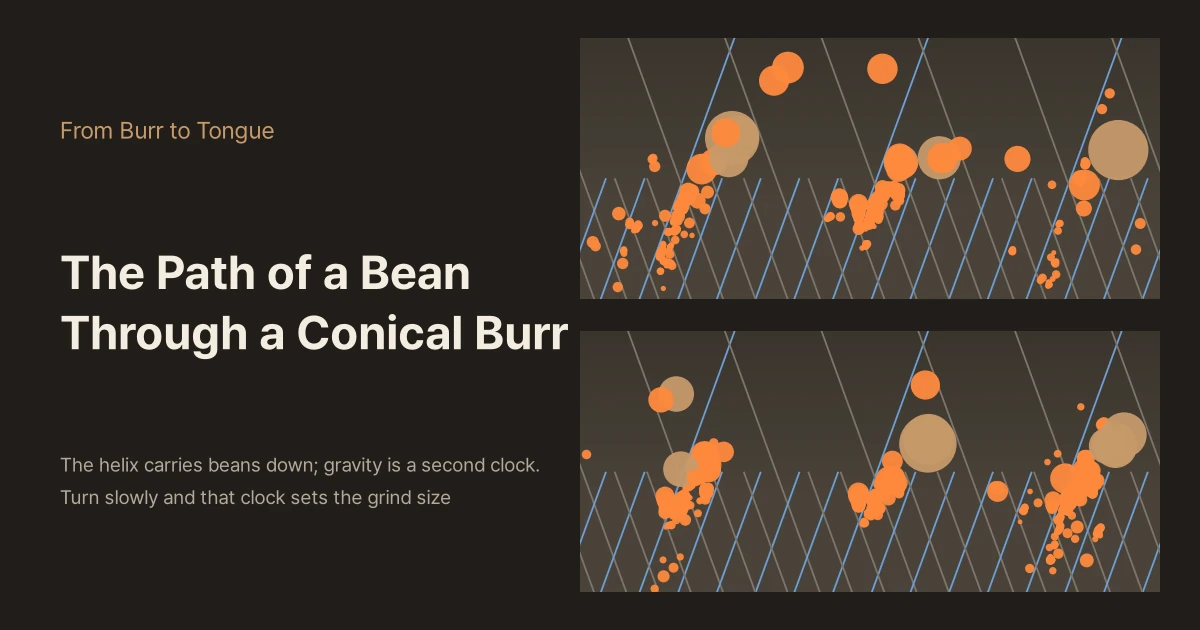
A hand grinder turns a little more than once a second, and electric conical grinders run at only 330–500 rpm. What sends the beans down: gravity or the helix? I built a virtual conical burr in a 2D DEM on the unrolled gap between cone and ring and ground beans in it. With gravity off, pieces passed in 0.7 turns at any speed, just as the screw-conveyor formula says. Gravity is a second, independent clock, so below 200 rpm the grounds came out coarser at the same gap (D50 450 → 820 µm). With a simulation you can run yourself.